


How to grow Chrysanthemum
Now here’s a plant we think is due a comeback. With a range of flower forms and colours to rival the dahlia, chrysanthemums belong to that indispensable gang of late season Asteraceae (or daisy family) plants, which add vibrancy to the garden as summer displays begin to fade.
Depending on the variety, chrysanthemums can be hardy enough to leave in the ground without protection, or, more commonly, half-hardy and therefore in need of help to get through winter (see ‘Cold Protection’ for more information). Finally, there is the kind you find sold on a large scale in garden centres. These have typically been treated with dwarfing hormone and temperature manipulation, and are usually sold in flower as conservatory or houseplants. These are best treated as annuals, i.e., discarded after one growing season.
A word on the naming, which can be confusing even to professionals. You may come across terms such as ‘garden chrysanthemums’ or ‘florist’s chrysanthemums’, which generally refer to the widely available half-hardy perennial types. Some sellers also call these (somewhat misleadingly) ‘hardy chrysanthemums’. The genuinely hardy species and varieties are known as ‘Korean’ or ‘Rubellum’ chrysanthemums. However, it’s best not to rely on the common name alone, and instead always research each individual variety to be certain of its hardiness and care requirements.
Just to add to the confusion, some species of chrysanthemum have been reclassified as Dendranthema though growers and sellers continue to use the two names interchangeably. A popular example is the Indian chrysanthemum (formerly Chrysanthemum indicum, now Dendranthema indicum), an aromatic species used in Asian cuisine.
You may also hear people shorten the word chrysanthemum – in the US they tend to use ‘mums’, and in the UK you’ll hear ‘chrysanths’.
Got all that?! Let’s find out how to grow this plant of many names…

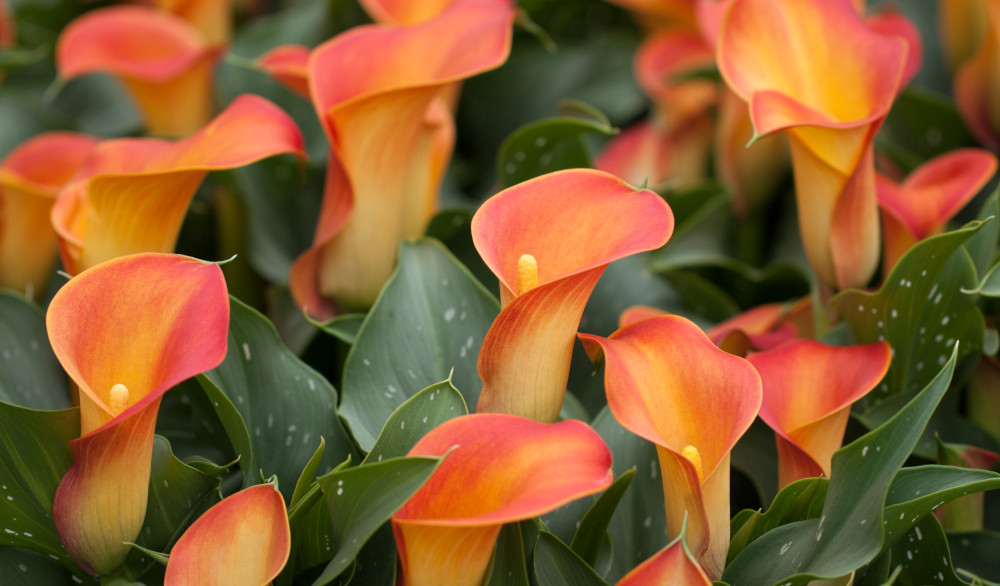
Zantedeschia is a genus of flowering plants from the family Araceae and is native to southern Africa. With a rich history dating back to the Ancient Romans, these deciduous or semi-evergreen perennials have been used as a symbol of celebration. Zantedeschia was Named after Professor Giovanni Zantedeschia, an Italian botanist.
There are two main forms of Zantedeschia: hardy and tender. Hardy forms of the plant can be grown outdoors, enjoy moist soil and full sun or partially shaded conditions - these are known as Arum lilies. Tender forms of Zantedeschia prefer being grown in containers or pots and should be brought inside over the winter - these are known as Calla lilies.
With tuberous flora in all colours from whites, yellows and oranges to deep reds and purples, Zantedeschias are not to be overlooked in any garden, as long as they have sufficient sunlight to grow in.
Ready to learn more about growing Zantedeschia? Read on for all there is to know...
Key Information
Soil pH

Position

Hardiness


Where & when to plant Chrysanthemum
Position - Outdoors: a sunny, sheltered spot.
Indoors: bright, filtered light and good ventilation.
Soil - Open ground: moist yet well-drained, neutral to slightly acidic soil enriched with well-rotted manure.
In a container: a good quality, loam-based potting compost such as John Innes No. 2.
Flowering Period - Most commonly autumn, though earlier and later flowering varieties are available.
Hardiness - Varies according to variety, ranging from tender to fully hardy. Always check individual description for details.
Note that small plug plants are best potted up into 9 centimetre pots on arrival and grown on for a few weeks before being planted or potted. A greenhouse, conservatory, or sunny windowsill are ideal growing on spots.
Varieties with a hardiness rating of H4, H5, H6, or H7 may be planted in autumn or spring. An autumn planting can be done by those gardening in mild conditions (and broadly speaking, this is the southern half of the UK). For those liable to very cold winters, it is best to wait until spring (generally the northern half of the UK).
Those rated H3 and below will struggle to survive a UK winter and are best planted out in spring once risk of frost has passed. This varies from region to region, though tends to be somewhere around late May. If your plants arrive before it is safe to go outdoors, keep them in a bright, frost-free environment until the time is right. A greenhouse, conservatory, coldframe, or sunny porch or windowsill are all ideal. Just make sure you don’t let them dry out! When the time comes to plant out, it’s a good idea to harden them off for a few days first. This means leaving them outside during the day and returning to the indoor environment at night, then for the last couple of days, leaving them outside full time.
Finding out the hardiness and flowering period of your variety will help determine where you choose to plant it. Tender species (H1 or H2) are best grown indoors, as greenhouse, conservatory, or houseplants. Put them somewhere as bright as possible while not being exposed to direct sunlight during the hottest part of the day (light is amplified when it travels through glass and can scorch the leaves). Go for either an east or south facing aspect, somewhere with light shade netting, or set back from a south-facing window by a metre or so.
Half-hardy types (H3), and these are the most widely available chrysanthemums, can be grown in the open ground with an insulating layer of dry winter mulch if your frosts tend to be mild, or lifted and stored (much like dahlia tubers) if you experience hard frosts. If you have a late-flowering variety it is a good idea to grow these in a container, to allow you to bring them indoors where they can continue to bloom well into winter.
Genuinely hardy varieties (H4, H5, H6, and H7) can be grown in a sunny bed or border, or a permanent, outdoor container display.
All types of chrysanthemum (apart from the dwarf, houseplant types) will require staking. We find individual canes to be the most effective method.
How to plant Chrysanthemum
· For planting in the garden, dig the soil area removing any large stones and weeds and breaking up any lumps. Mix in a generous amount of well-rotted manure. Rake level and firm with your heels. Rake level again.
· Water plants well and allow to drain before planting.
· Dig a hole twice the width of the root-ball.
· Place the plant in the hole, ensuring the top of the root ball sits level with the surface of the soil. Too low and the plant may rot, too high and the roots can dry out.
· Backfill with soil and firm in gently.
· Soak well with water.
· Mulch around the base with well-rotted manure.
· Chrysanthemums are at their most impressive when grown in multiples (perhaps as a drift, or woven through other plants). Space 30-45 centimetres apart.
- For planting in a container, first choose an appropriately sized pot – you may wish to grow your chrysanthemum on its own, in which case go for one about 35-50 centimetres in diameter, or as part of a larger, mixed container. Either way, ensure there are plenty of drainage holes in the bottom.
- If you are using a large or heavy pot, it can be a good idea to fill and plant it in situ to save yourself the trouble of moving once full.
- Use a good quality loam-based compost with some slow-release fertiliser granules mixed in – these may already be present in the compost, or you may have to add them yourself.
- Start by partially filling the pot with compost; enough so that when placed on it the upper surface of the root ball is about 3 centimetres lower than the top of the pot.
- Fill around the plant with compost, firming down with your fingers then adding a little more so it is held tight.
- Pick up the container and lightly tap on the potting bench or ground a few times to help further settle the compost around the plant.
- Soak well with water.
- A mulch with horticultural grit will look attractive and help to prevent a ‘cap’ or crust forming on the top of the compost (something container plants can suffer due to the artificial nature of their watering).

What to plant with Chrysanthemum
In the garden, chrysanthemums mix well with other autumn-interest flowering plants, such as asters, Japanese anemones, rudbeckia, and aconitum. Ornamental grasses are also at their peak during this time as their seedheads catch the soft, low light. Panicum, stipa, and miscanthus are just a few to get you going.
Chrysanthemums grown in conservatories and greenhouses can be combined with other cheerful, brightly coloured companions such as streptosolen, brugmansia, plumbago, dipladenia, jacobinia, abutilon and cestrum.


How to care for Chrysanthemum
Pruning and Deadheading
For a bushy, floriferous plant, pinch back the growing tip once the young plant reaches 15-20 centimetres, taking it down to three or four leaves above the base. You can use the removed section as a cutting if you like (see ‘How to Propagate Chrysanthemum’).
Alternatively, you may wish to take the opposite approach with a process known as ‘disbudding’. This involves removing all the flowerbuds apart from the main, terminal one, in order to achieve one single, extra-large flower on a long, tall stem. This technique is often used for show exhibiting. Allow ten days between planting or potting and disbudding.
Deadheading your chrysanthemum is a good way to keep the plant looking neat and prolong the flowering period. Nip spent flowers down to the next healthy leaf node below.
Chrysanthemums grown permanently in the ground are best cut back in early spring before growth commences (leaving spent stems intact over winter insulates the crown against the elements). Leave stubs of around 20 centimetres.
If you are lifting and storing your chrysanthemum, cut the stems back as you do so. See ‘Cold Protection’ for more advice on this process.
Chrysanthemum grown indoors can be cut back once flowering is finished.
Watering
Chrysanthemum enjoys reliably moist conditions and resents drying out. When grown in the ground, it benefits from a good watering in on planting and then a handful more soakings in the following few weeks. Providing it has been given a generous mulch (more on this next), once established it should need watering only in prolonged periods of hot, dry weather.
Grown in a container, chrysanthemum will need to be watered regularly throughout the growing season, aiming for consistently moist but not soggy compost (allowing the top few centimetres of compost to dry out each time is a good way to avoid overdoing it). Be aware that in hot weather, containers may need watering more often than you might think; particularly smaller or very full containers which can need it as often as once a day.
Feeding
It’s a good idea to get into the habit of feeding your chrysanthemums for increased vigour and flowering.
Apply a general fertiliser such as blood, fish and bone in early spring (either to the soil, if permanently in the open ground, or to the top of the compost if in a container). From midsummer until the buds begin to show colour, a weekly dose of balanced liquid feed such as seaweed fertiliser is recommended.
Chrysanthemum grown in the ground will also thank you for a thick mulch of well-rotted manure, applied when planting and again each spring if left permanently in the ground. Not only does this gradually release extra nutrients into the soil, but it also supresses weeds and locks in moisture.
Cold Protection
Unless you have free-draining soil and mild-ish winters, it’s a good idea to move half-hardy chrysanthemums into a dry, frost-free environment during the colder months. Those in a container can simply be moved indoors in early autumn, before the first frosts strike and put a premature end to flowering. Those grown in the open ground will need to be lifted once the first frost has blackened the foliage:
- Cut the whole lot back to stubs of just a few centimetres.
- Gently dig out of the ground using a garden fork.
- Shake and then rinse off as much soil as possible.
- Pot up into a dry, loamless potting compost.
- Store somewhere dry and cool yet frost-free, such as a shed, or garage.
- In early spring, move somewhere light though still frost-free (a greenhouse or coldframe are ideal) and trigger a return to growth by soaking the compost with water. Grow on here until risk of frost has passed, and plant out as above.
Pests and Diseases
Chrysanthemums can be vulnerable to aphids, earwigs, eelworms, capsid buds, leaf miners, red spider mites, and whiteflies. They are also prone to fungal rot, grey mould, powdery mildew, white rust, and a number of viruses which can cause stunting, yellowing, and puckering of leaves.
As ever, our advice is to grow healthy, thriving plants which means giving them the right conditions, adequate water and nutrients, and creating a balanced garden ecosystem to grow in. You can do this by taking measures such as eliminating use of chemicals, providing food and habitat for wildlife, and growing a wide range of plants. Plants kept indoors benefit from a spell outside when the temperatures are warm enough. Here, the increased airflow can help ward off fungal diseases and viruses, and natural predators such as birds and larger insects can keep pests at bay.
How to propagate Chrysanthemum
Chrysanthemum can be propagated easily from basal cuttings taken in spring:
1. Water the parent plant well the day before.
2. Find several strong, basal shoots (originating from the crown) which are 5-7 centimetres long.
3. With sharp secateurs or a knife, sever cleanly from as close to the base as possible.
4. Put the cuttings in a plastic bag straight away to prevent drying out.
5. Fill a container with a free-draining compost mix.
6. If there are leaves, remove the lowest third. If the remaining leaves are large, cut in half with a sharp knife to reduce water lost through transpiration.
7. Insert the cuttings into the compost and water lightly. Several cuttings can be put in the same container if there is enough space to do this without them touching.
8. Place in a greenhouse or propagating unit if you have one, or covered with a plastic bag on a windowsill if not (out of direct sunlight).
9. Keep the cuttings misted and occasionally watered until they root. You will know this has happened when roots emerge out of the bottom of the container – expect it to take three to four weeks with bottom heat, longer without.
10. Once rooted, take the cuttings out of their pot and gently tease apart. Pot into individual 9 centimetre pots using a well-draining compost mix.
11. Grow on in a sheltered environment, keeping well-watered but never soggy. Plant out as above.
Alternatively, you can use the results of pinching back a few weeks later (see ‘Pruning and Deadheading’).
* Many plants carry Plant Breeders Rights and cannot be propagated for commercial purposes.
Common Chrysanthemum Questions
Do chrysanthemums make good cut flowers?
With a vase life of three to four weeks, chrysanthemums are the longest lasting cut flowers we know of.
Are chrysanthemums poisonous to cats?
Yes, this plant can be toxic to cats, though we have found most are usually wise enough to avoid them.
