


How to grow Liriodendron
Also known as the tulip tree (a nod to the tulip-like flowers seen on mature plants), liriodendron is a popular deciduous tree grown for its curiously shaped leaves, vibrant yellow autumn colour, and fast-growing nature. Unlike many trees with a rapid growth rate the wood of its trunk is relatively strong (in fact, it was traditionally used by Native Americans to make canoes), though it must be said that the adjoining limbs are weaker and can be prone to breaking off in strong winds. This is made more likely in late autumn/ early winter by the leaves remaining on the branches long after many other deciduous trees have shed theirs. Although a desirable quality in terms of a long-lasting autumn display, this does mean the tree is more vulnerable during early storms (its coverage of large leaves acting like a sail in the wind).
There are just two species of liriodendron. The North American Liriodendron tulipifera is the most widely grown, though its Chinese/ Vietnamese equivalent L. chinense is also seen occasionally. To the casual eye the two look relatively similar, though they may be distinguished by their flower colour: those of L. tulipifera are green with orange banding at the base, while on L. chinense they are green with yellow veining.
It is worth noting here that liriodendron has the potential to grow up to 30 metres in height and 15 metres across (though it usually only reaches one of these maximums, rather than both – see ‘Position’ below) and is therefore best grown where this won’t pose a problem. For smaller spaces there are many more suitable alternatives, such as snowy mespilus, Japanese maple, or lilac.

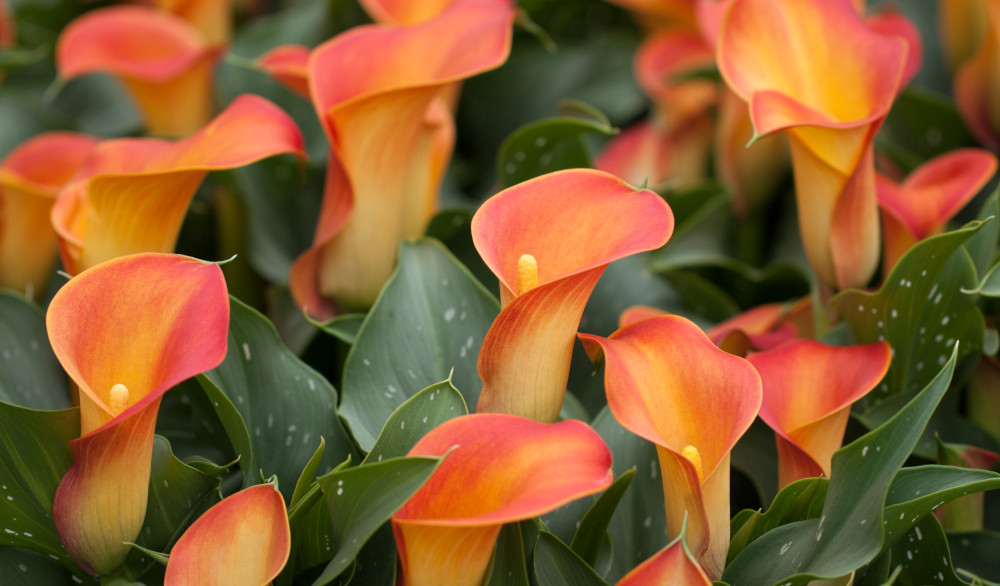
Zantedeschia is a genus of flowering plants from the family Araceae and is native to southern Africa. With a rich history dating back to the Ancient Romans, these deciduous or semi-evergreen perennials have been used as a symbol of celebration. Zantedeschia was Named after Professor Giovanni Zantedeschia, an Italian botanist.
There are two main forms of Zantedeschia: hardy and tender. Hardy forms of the plant can be grown outdoors, enjoy moist soil and full sun or partially shaded conditions - these are known as Arum lilies. Tender forms of Zantedeschia prefer being grown in containers or pots and should be brought inside over the winter - these are known as Calla lilies.
With tuberous flora in all colours from whites, yellows and oranges to deep reds and purples, Zantedeschias are not to be overlooked in any garden, as long as they have sufficient sunlight to grow in.
Ready to learn more about growing Zantedeschia? Read on for all there is to know...
Key Information
Soil pH

Position

Hardiness


Where & when to plant Liriodendron
Position - Full sun or partial shade. In full sun, expect a short, wide habit, while in partial shade, a taller and more slender specimen is likely.
Soil - Moderately fertile, moist yet well-draining soil, preferably with a slightly acidic pH. Avoid areas prone to waterlogging or drought.
Flowering Period - Early to midsummer
Hardiness - Hardy, with a rating of H6 (-15 to -20°C)
Liriodendron can be planted anytime from autumn to early spring, avoiding days when the ground is very wet or frozen. Like all woody plants it will struggle to establish well from a summer planting, so any plants bought or acquired during the warmer months are best kept in the nursery pot (with regular watering and feeding!) until the time is right.
In terms of choosing a spot, liriodendron makes a wonderful specimen tree, perhaps in a large lawn or area of parkland where it will have enough room to grow freely. Note that it produces a fair amount of litter (first the flower petals, and then the leaves), so try to plant it where this won’t pose a problem. It is also notorious for dropping sticky sap, so is one to avoid where there will be cars or paving beneath. Liriodendron is a good choice if you’re looking to plant a tree for shade due to the combination of a fast growth-rate with large, light-blocking leaves.
With a speedy rate of growth (expect 60 centimetres per year at first, less as it gets older), liriodendron is not well-suited to life in a container and is far happier in the open ground. Having said that, very young specimens (e.g., those in a 9 centimetre pot) will thank you for being grown on in pot for two or three years. Start by potting it up into, say, a 2 litre pot, and repot into a slightly larger one each spring. This will give you a larger, more robust plant with a greater chance of successful establishment in the ground.
How to plant Liriodendron
· For planting in the garden, first dig the soil area, removing any large stones and weeds and breaking up any lumps. Now is your chance to improve the soil by mixing in a generous amount of organic matter, such as well-rotted manure, garden compost, or leaf mould. Rake level and firm with your heels. Rake level again.
· Water your tree well and allow to drain before planting.
· Dig a hole twice the width of the root-ball (this will encourage the roots to spread out and establish quickly).
· Place the plant in the hole, ensuring the top of the root ball sits level with the surface of the soil. Too low and the plant may rot, too high and the roots can dry out.
· Backfill with soil and firm in gently with your foot.
· Soak well with water.
· Mulch around the base with organic matter.
· Larger specimens benefit from staking to help protect from wind damage (this is less important for those still in their small, sapling phase). Taking care to avoid the roots, knock a stake into the ground, angled into the prevailing wind. Attach to the main trunk with a rubber stake tie. Remember to check and loosen this as the tree grows.
· It is also worth protecting newly planted trees with spiral tree guards, to prevent browsing deer and other wildlife stripping the bark.
· For planting in a container (recommended for growing on young specimens only), use a good quality loam-based compost (such as John Innes No. 3) with a little horticultural grit mixed in and, if not already present (check the labelling on the bag) some slow-release fertiliser granules.
· Use a pot with plenty of drainage holes in the bottom and start by partially filling it with compost; enough so that when placed on it the upper surface of the root ball is about 3 centimetres lower than the top of the pot.
· Fill around the plant with compost, firming down with your fingers then adding a little more so it is held tight.
· Pick up the container and lightly tap on the potting bench or ground a few times to help further settle the compost around the plant.
· Soak well with water.

What to plant with Liriodendron
Liriodendron can play a starring role in the great annual flush of autumn colour, which may include similarly intense and vibrant companions such as liquidambar, Euonymus alatus, parthenocissus, and acer.


How to care for Liriodendron
Pruning and Deadheading
Liriodendron is classed as RHS Pruning Group 1, which means shape-altering pruning is not only unnecessary but actively discouraged as it is likely to spoil the natural appearance. The only intervention needed is the removal of any dead, diseased, damaged, or badly placed growth, best done in late winter or very early spring. This is quite important for liriodendron, as its brittle branches have the potential to cause injury or harm in strong winds.
Where deadwood can be seen on larger specimens, it is advisable to have this removed by a tree surgeon.
Watering
Like all woody plants, liriodendron does best with regular watering for its first couple of growing seasons in the ground to encourage root establishment. After this it should be largely self-sufficient, particularly with an annual mulch to lock in moisture – more on this in our ‘Feeding’ section below. Having said this, in our changing climate it can still pay to soak trees and shrubs during prolonged periods of hot, dry weather, particularly younger specimens.
Young plants being grown on in a container have less access to moisture and will need to be watered regularly throughout every growing season. Aim for infrequent big soakings, rather than little and often, allowing the top few centimetres of compost to dry out each time. Try to avoid the compost drying out completely, being aware that this can happen in as little as 24 hours during the height of summer, and sometimes even less for very full containers. From mid-autumn, the British climate tends to take over watering needs, though do remember to step in in the event of an unseasonably dry spell.
Feeding
On healthy, fertile soil, an annual mulch of well-rotted organic matter should provide sufficient nutrients for your liriodendron. This has the added benefit of suppressing weeds and locking in moisture. Autumn and spring are the best times to carry out mulching.
For an extra boost (most needed in the first few years of the plant being in the ground, or annually if growing in poorer soil), apply a general-purpose granular feed such as blood, fish, and bone to the surface of the soil and lightly work it in. This is known as a ‘top dress’ and is best done in late winter or early spring.
Young plants being grown on in a container rely more on the gardener for nutrition. Get off to a flying start by making sure you use a good quality compost, then throughout the growing season (March to September) apply a liquid feed every three to four weeks.
Cold Protection
Although liriodendron is fully hardy, like many trees it may be damaged by a very hard frost when young. We recommend protecting smaller specimens with one of these handy fleece jackets.
Pests and Diseases
Liriodendron can be susceptible to verticillium wilt and leaf spot.
Verticillium wilt is a soil borne fungal disease which can cause branch dieback, sudden wilting, yellowing of the leaves, and is confirmed by black streaking in the wood. As far as prevention goes, it is important to keep the surrounding area free of weeds, as these can act as hosts. Sadly, once infected, the only thing is to remove and dispose of the whole plant, including as much of the root system as possible. Take care not to spread infected soil around the garden on muddy tools and boots.
Leaf spot can be caused by a range of different fungal diseases, and tends to appear as brown patches with yellow halos, often with premature leaf drop. The problem can be exacerbated by poor airflow, making it important to ensure your tree has sufficient room to grow freely. A healthy, thriving specimen is less likely to succumb than one under stress, so do try to follow our advice re. feeding, watering, and sunlight levels to help minimise the risk of problems.
How to propagate Liriodendron
Straight species of liriodendron can be propagated by seed (though be aware it will be many years before you are enjoying a mature, flowering tree). Named cultivars may not come true from seed and instead require the tricker method of grafting. It is usually best to buy the latter as young plants.
· Collect seeds in late autumn from the distinctive, cone-like fruits. Note that trees will not produce flowers or fruits until they are 15-20 years old (sometimes older), and at first these may be limited to the upper parts of the tree.
· Soak the seeds in water for 24 hours, then place in a polythene bag with damp sand. Refrigerate until early spring. This mimics the natural conditions needed to break the dormancy of the seeds.
· In March, fill a pot or module tray with a well-draining compost mix and compress the surface lightly with a wooden tamp or base of another pot.
· Sow the seeds onto the surface, and use a garden sieve to cover with a thin layer of compost. Alternatively, cover with a layer of vermiculite.
· Water gently with a fine spray until the compost is evenly moist but not waterlogged.
· Place the module tray somewhere warm and bright, such as in a greenhouse or on a sunny windowsill. If you have a heated propagator, all the better.
· Germination can be erratic and may take anything from a couple of weeks to several months.
· Once the seedlings have developed several sets of true leaves, they can be potted on into individual 9 centimetre pots. Grow on in a sheltered spot outdoors, repotting into a slightly larger pot each spring until large enough to plant out.
* Many plants carry Plant Breeders Rights and cannot be propagated for commercial purposes.
Common Liriodendron Questions
Is liriodendron poisonous?
This tree has no toxic effects reported to people or animals.
What plant family is liriodendron in?
Liriodendron belongs to the magnolia family. It is not related to tulips in any way!
Is liriodendron valuable for wildlife in the UK?
Yes, its flowers are visited by many species of pollinator, including bees and butterflies.
