


How to grow Olearia
Also known as the daisy bush, olearia is a genus of flowering shrubs and small trees from New Zealand and Australia, of which there are several species just about hardy enough to be grown in the UK. In milder spots these can be grown without concern (olearia is a popular hedging and windbreak plant along the South West coast), while in colder areas they need a more sheltered spot. Tender species may be grown as conservatory or greenhouse plants.
Olearia is a handsome, impressive plant with foliage which can be aromatic and grey-green, or green with a white, felted underside, ranging from oval to sharply-toothed. Most species have a highly floriferous nature and are often smothered in daisy-like blooms during the flowering period.

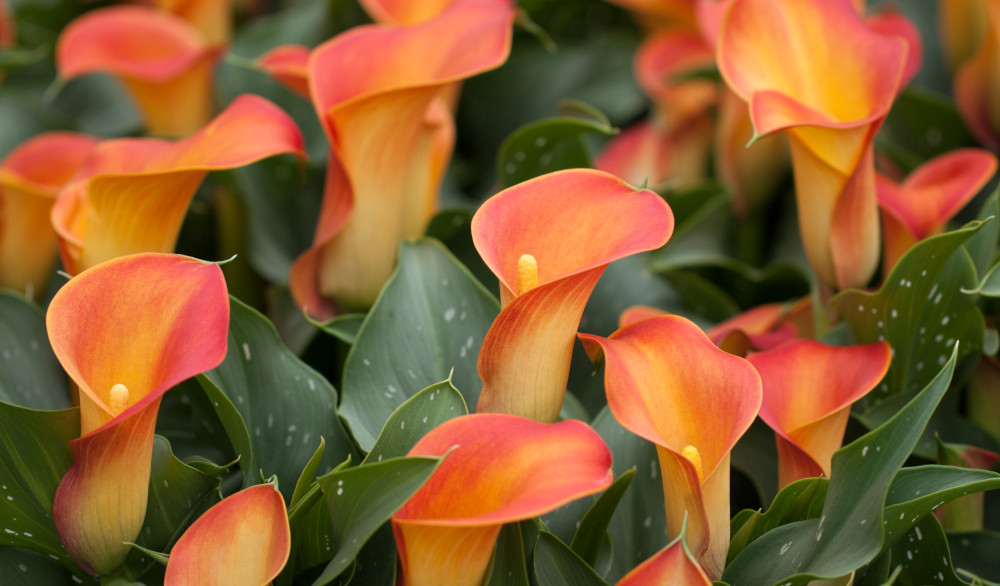
Zantedeschia is a genus of flowering plants from the family Araceae and is native to southern Africa. With a rich history dating back to the Ancient Romans, these deciduous or semi-evergreen perennials have been used as a symbol of celebration. Zantedeschia was Named after Professor Giovanni Zantedeschia, an Italian botanist.
There are two main forms of Zantedeschia: hardy and tender. Hardy forms of the plant can be grown outdoors, enjoy moist soil and full sun or partially shaded conditions - these are known as Arum lilies. Tender forms of Zantedeschia prefer being grown in containers or pots and should be brought inside over the winter - these are known as Calla lilies.
With tuberous flora in all colours from whites, yellows and oranges to deep reds and purples, Zantedeschias are not to be overlooked in any garden, as long as they have sufficient sunlight to grow in.
Ready to learn more about growing Zantedeschia? Read on for all there is to know...
Key Information
Soil pH

Position

Hardiness


Where & when to plant Olearia
Position - Full sun is best, though some light shade may be tolerated. Resistant to sea winds, though requires shelter inland.
Soil - Fertile and well-draining. Dry soil tolerated once established.
Flowering Period - Spring or summer, depending on the species.
Hardiness - Varies according to species. Most of those found in UK cultivation are hardy, rated H4 (-5 to -10°C). A few are half-hardy, rated H3 (1 to -5°C).
Olearia is best planted in late spring to give it a full growing season to establish before being faced with a UK winter. Where winters are very mild, you may also get away with an autumn planting.
In warm, coastal areas, olearia can be grown as a hedge, windbreak, or specimen plant, and it can also make a lovely focal point in a mild, urban courtyard. Where winds and winters are cold, it is best grown against a sunny wall where it might provide interest at the back of a border. Olearia can also be grown in a container, which can be a good idea if you experience harsh winters in that it allows you to temporarily move the plant into a protected, indoor environment. Smaller forms are best for containers, such as Olearia phlogopappa ‘Spring Bling’.
How to plant Olearia
· For planting in the garden, dig the soil area removing any large stones and weeds and breaking up any lumps. Now is your chance to improve the soil by digging in some well-rotted organic matter such as manure or garden compost.
· Rake level and firm with your heels. Rake level again.
· Water the plant well and allow to drain before planting.
· Dig a hole twice the width of the root-ball.
· Place the plant in the hole, ensuring the top of the root ball sits level with the surface of the soil. Too low and the plant may rot, too high and the roots can dry out.
· Backfill with soil and firm in gently.
· Soak well with water.
· Mulch around the base with well-rotted organic matter.
- For planting in a container, first choose an appropriately sized pot. The best practice is to go for a pot just a few centimetres larger than the current root ball and increasing by a few centimetres every year or two. Always ensure the pot is deep enough to provide sufficient anchorage, and that there are plenty of drainage holes in the bottom.
- If you are using a large or heavy pot, it can be a good idea to fill and plant it in situ to save yourself the trouble of moving once full.
- Use a good quality, loam-based compost (such as John Innes no. 3) with some horticultural grit mixed in for drainage and, if not already present (check the labelling on the bag) slow-release fertiliser granules.
- Start by partially filling the pot with compost; enough so that when placed on it the upper surface of the root ball is about 3 centimetres lower than the top of the pot.
- Fill around the plant with compost, firming down with your fingers then adding a little more so it is held tight.
- Pick up the container (if you can!) and lightly tap on the potting bench or ground a few times to help further settle the compost around the plant.
- Soak well with water.
- A mulch with horticultural grit will look attractive and help to prevent a ‘cap’ or crust forming on the top of the compost (something container plants can suffer due to the artificial nature of their watering).

What to plant with Olearia
If you’re planting a seaside garden, other shrubs similarly unbothered by coastal winds include escallonia and eleagnus. In terms of perennials, armeria, eryngium, libertia, erigeron, agapanthus, and limonium are a few coastal favourites.


How to care for Olearia
Pruning and Deadheading
Using secateurs, trim flowered stems back by around a quarter every year to maintain a neat, compact form (left untouched, olearia can become somewhat scrappy with bare, leggy patches at the base). Remove any dead, diseased, damaged, or badly placed growth whilst you’re at it.
For early-flowering species (such as O. phlogopappa), this is best done after flowering. For later flowering species (O. macrodonta, O. traversii, O. x haastii), prune just before growth starts in mid spring.
Most species of olearia regrow well from old wood and will tolerate a hard prune. This is best done in mid spring, and followed by a generous layer of mulch (see ‘Feeding’ below).
Watering
Like all woody plants, olearia will need to be regularly watered during its first year or two in the ground, after which it should be largely drought tolerant. When watering, give a deep, thorough soak then repeat only once the top few centimetres of soil have become dry (this encourages the formation of deep roots, as opposed to watering little and often which can lead to roots growing mainly in the surface of the soil).
Container-grown olearia have less access to moisture so need regularly watering throughout every growing season. Again, water deeply and allow the top few centimetres of compost to dry out before repeating, though be aware that in the height of summer this can happen very quickly, and some container-grown plants may need watering every day (particularly those in smaller pots). Scale watering right back during winter, giving just enough to prevent the compost drying out completely.
Feeding
On healthy, fertile soil, an annual mulch of well-rotted organic matter (i.e., a layer of manure or garden compost applied to the soil around the plant) should provide adequate nutrients for your olearia. This has the added benefit of suppressing weeds and locking in moisture, and is best done in autumn or spring.
For container-grown specimens, try to use a good quality, loam-based compost with slow-release granules mixed in. This generally provides enough nutrients for six weeks, after which a monthly dose of balanced liquid feed will help maintain a healthy, thriving plant. It is also a good idea to get into the routine of repotting into fresh compost every year, going up slightly in pot size each time. When this is no longer feasible, switch to an annual topdress; in spring, scrape away the top few centimetres of compost and replace with fresh.
Cold Protection
When grown in the right conditions, hardy species of olearia can withstand the average UK winter without the need for additional protection. By ‘right conditions’, we mean in well-draining soil (no winter waterlogging) and with shelter from cold winds. Having said this, young plants can be less hardy, so during those first couple of winters in the ground it can be worth using a protective fleece jacket whenever a hard frost is forecast.
Like all plants, olearia grown in a pot is more vulnerable to the effects of winter. Where possible, move to a bright, protected environment for winter such as a greenhouse, porch, or conservatory. Otherwise, tuck against a sunny, south-facing wall and wrap the pot with hessian, bubblewrap, or horticultural fleece. As well as insulating the roots, this protects the container against frost damage.
Tender species are best grown in a conservatory or greenhouse all year round, while half-hardy species may be moved outdoors during the warmer months.
Pests and Diseases
Olearia is considered trouble free.
How to propagate Olearia
Olearia can be propagated with semi-ripe cuttings taken in summer:
· Look for current year’s growth which is firm and woody at the base while still flexible at the tip. You’re aiming for cuttings of 10 centimetres or less (any longer and they are more likely to dry out and fail). For best results, choose stems where the leaf nodes are close together rather than far apart.
· Using a sharp knife or secateurs, sever the cuttings from the plant and put in a plastic bag straight away to keep them from drying out.
· Fill a pot (or several, if you have a lot of cuttings) with a perlite-heavy compost mix (at least 50% perlite).
· Trim the end of the cutting to just below a node (point at which leaves grow).
· Remove lowest leaves, leaving at least four on the cutting.
· Insert the cuttings into the compost and water lightly. Several cuttings can be put in the same container if there is enough space to do this without them touching.
· Place in a propagating unit with gentle bottom heat if you have one, or covered with a plastic bag in a coldframe, greenhouse, or on a windowsill if not (out of direct sunlight).
· Keep the cuttings misted and occasionally watered until they root. You will know this has happened when roots emerge out of the bottom of the container.
· Gently remove rooted cuttings and pot them into individual pots. Grow on in a cool yet frost-free environment such as an unheated conservatory, greenhouse, or cold frame. Pinch out the growing tips regularly to encourage bushy growth.
* Many plants carry Plant Breeders Rights and cannot be propagated for commercial purposes.
Common Olearia Questions
Is olearia poisonous?
Olearia has no toxic effects reported.
How quickly does olearia grow?
This is a plant with a moderate growth rate. It can be expected to reach full size in five to ten years.
