


How to grow Orlaya
Also known as white laceflower, orlaya is one of the prettiest umbels you can grow and a popular hardy annual. With fine, filigree foliage and pure-white, lacecap-like flowers, in its native Mediterranean this charming plant can be seen flowering en masse in vineyards and olive groves from early summer right through until the first frosts. Here in the UK, it is valued as an easy and rewarding gap filler for the border, generally used to plug the spaces between sturdier perennials with delicate, airy beauty.
When grown in rich garden soil, orlaya tends to become much larger and lusher than in the wild where it favours poorer conditions. While beautiful, this comes with the drawback of making the plant more vulnerable to wind rock. This damages the stem and roots, releasing aromas which attract the unwanted attention of the carrot root fly. For improved longevity, it therefore pays to grow this plant in as lean conditions as you have to offer. Like most umbellifers (i.e., plants in the carrot family, now known as Apiaceae though formerly Umbelliferaceae), orlaya has a long tap root which allows it to survive in dry, harsh conditions.

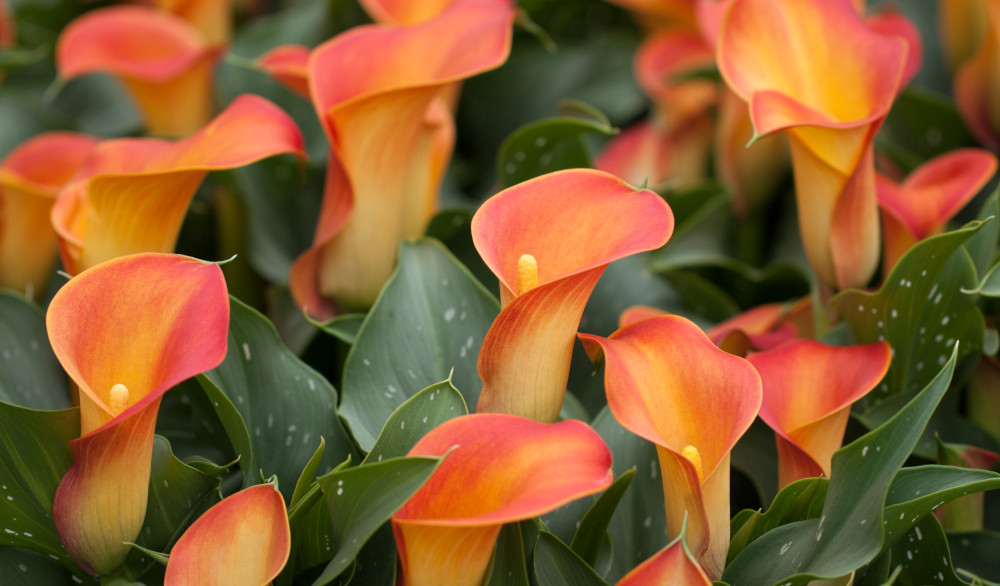
Zantedeschia is a genus of flowering plants from the family Araceae and is native to southern Africa. With a rich history dating back to the Ancient Romans, these deciduous or semi-evergreen perennials have been used as a symbol of celebration. Zantedeschia was Named after Professor Giovanni Zantedeschia, an Italian botanist.
There are two main forms of Zantedeschia: hardy and tender. Hardy forms of the plant can be grown outdoors, enjoy moist soil and full sun or partially shaded conditions - these are known as Arum lilies. Tender forms of Zantedeschia prefer being grown in containers or pots and should be brought inside over the winter - these are known as Calla lilies.
With tuberous flora in all colours from whites, yellows and oranges to deep reds and purples, Zantedeschias are not to be overlooked in any garden, as long as they have sufficient sunlight to grow in.
Ready to learn more about growing Zantedeschia? Read on for all there is to know...
Key Information
Soil pH

Position

Hardiness


Where & when to plant Orlaya
Position - An open, sunny spot
Soil - Well-draining soil with a low nutrient content.
Flowering Period - Early summer until the first frosts
Hardiness - Hardy, rated H7 (-20°C and below)
We send our orlaya out as 4 centimetre young plants (also known as plugs) in spring. These are best potted up into 9 centimetre pots and grown on for a few weeks before being planted out in the garden. A cool greenhouse, conservatory, or cold frame are all ideal growing on spots, or somewhere sheltered from the worst of the elements outdoors. Be aware that the long tap root grows quickly and plants will resent spending too long in a container – try to get them planted as soon as they’ve filled out enough to hold their own amongst other planting.
Weave your orlaya throughout beds and borders or grow as drifts in wildlife gardens (hoverflies are particularly partial to the flowers). The long tap root means they’re far happier in the ground than in a container, though if you really want to have a go opt for the deepest pot you can find.
How to plant Orlaya
- For planting in the garden, dig the soil area removing any large stones and weeds and breaking up any lumps.
- Rake level and firm with your heels. Rake level again.
- Water plants well and allow to drain before planting.
- Dig a hole twice the width of the root-ball.
- Place the plant in the hole, ensuring the top of the root ball sits level with the surface of the soil. Too low and the plant may rot, too high and the roots can dry out.
- Backfill with soil and firm in gently.
- Soak well with water.
- For planting in a container, go for as deep a pot as you can to accommodate the long tap root. Ensure there are plenty of drainage holes in the bottom.
- If you are using a large or heavy pot, it can be a good idea to fill and plant it in situ to save yourself the trouble of moving once full.
- Use a good quality potting compost with some horticultural grit mixed in and, if not already present (check the labelling on the bag) some slow-release fertiliser granules.
- Start by partially filling the pot with compost; enough so that when placed on it the upper surface of the root ball is about 3 centimetres lower than the top of the pot.
- Fill around the plant with compost, firming down with your fingers then adding a little more so it is held tight.
- Pick up the container (if you can!) and lightly tap on the potting bench or ground a few times to help further settle the compost around the plant.
- Soak well with water.
- A mulch with horticultural grit will look attractive and help to prevent a ‘cap’ or crust forming on the top of the compost (something container plants can suffer due to the artificial nature of their watering).

What to plant with Orlaya
Team orlaya up with other hardy annuals such as ammi, nigella, cerinthe, and sweet peas, popping them in the ground wherever you see a gap. This one small act of planting each spring can make a surprising difference to the summer garden.


How to care for Orlaya
Pruning and Deadheading
Regular deadheading will help prolong flowering right up until the first frosts, though leave a few spent flowers intact from midsummer onwards if you wish to collect seed (more on this below).
As an annual, orlaya may simply be removed to the compost heap at the end of the growing season.
Watering
Water your orlaya a handful of times during the first couple of months in the ground, after which it is extremely drought-tolerant and largely self-sufficient. When watering, allowing the top few centimetres of soil to dry out between each time will help you avoid overdoing it. Wiggle your finger down into the soil to check this.
If you are growing orlaya in a container, aim for infrequent big soakings (rather than little and often), allowing the compost to almost fully dry out in between.
Feeding
Orlaya is happiest growing in nutrient-poor soils and so requires no additional feeding when grown in the ground.
In a container, good quality potting compost with some slow release fertiliser granules mixed in should be enough to support a year’s worth of growth.
Cold Protection
Though orlaya is a hardy annual, it can still be damaged by very harsh weather when young. If you garden in a frost pocket or northern part of the UK, it can be an idea to delay planting by a few weeks or protect new plantings with a cloche or fleece if a hard frost is forecast.
Pests and Diseases
Orlaya is considered trouble-free.
How to propagate Orlaya
Although in its native habitat orlaya self-seeds readily, in the UK this can be more erratic and it therefore pays to collet and sow your own seed.
Orlaya seeds germinate best when sown in autumn (results tend to be patchier in the spring). This can be done either under cover in pots, or direct in the ground if you live in a milder part of the country. If you are prone to very cold, wet winters we recommend direct sowing be left until spring.
- Seeds are typically ready for collecting in late summer when they have turned dry and dark and can be detached easily from the seedhead.
- Snip the seedheads from the plant using scissors or secateurs. Try to do this in dry conditions, and shake the seeds into a small, labelled paper bag or envelope. Store somewhere cool and dry until you are ready to sow in either autumn or spring.
To sow direct:
- Clear the area of weeds, and rake over the surface until you have a fine tilth.
- Scatter seeds thinly.
- Lightly rake over to incorporate with the soil.
- Water with a watering can fitted with a fine rose.
- When seedlings are large enough to handle, thin out to a spacing of approximately 20-30 centimetres.
To sow in a container:
· We advise sowing orlaya in a module tray to minimise root disturbance (something most umbels resent due to their tap rooting habit).
· Fill with a well-draining compost mix, tapping lightly on the bench to settle.
· Sprinkle a small pinch of seeds per module.
· Use a garden sieve to cover with a thin layer of compost.
· Water with a fine spray until the compost is evenly moist but not waterlogged.
· Place the seed tray or pots anywhere light, warm, and protected, such as a windowsill or greenhouse. The quickest results will come from a heated propagation unit set at 18-21°C, though remove from here once seeds have germinated.
· When the seedlings have grown large enough to handle, thin out to just one strong seedling per module.
· Grow on for a week or so, then pot each module up into a 9 centimetre pot filled with a well-draining mix. Continue to grow on in a frost-free environment.
· Keep moist, never soggy.
· Grow on until ready to plant out as above.
* Many plants carry Plant Breeders Rights and cannot be propagated for commercial purposes.
Common Orlaya Questions
Does orlaya make a good cut flower?
Yes, it does. With a vase life of seven to ten days this flower is a popular component of summer bouquets.
Does orlaya need support?
When grown in its preferred lean, mean conditions – no. However, in rich, garden soil it is likely to grow large and require some form of support to prevent it flopping over in the wind. Whether canes and string, metal link stakes, or a network of cut branches inserted into the soil and woven together, it is best to get the support in place early in the season. That way, the plant can grow up and through its support naturally, rather than looking unpleasantly hoiked into place!
