


How to grow Abies
Also known as fir (and specifically referred to as silver fir in the UK and Ireland), abies is a genus of evergreen conifer found growing on cool hills and mountain ranges throughout the northern hemisphere. Typically forming a neat, conical shape clothed in lustrous foliage, abies is a handsome tree which generally looks symmetrical and healthy (unlike many other conifers, which can become prone to scruffiness). It has striking, often blue-grey cones, which are widely considered to be the most attractive of those of all the conifers.
Abies are some of the world’s tallest trees and are popular for forestry, screening, and large landscaped gardens such as parkland and arboretums. A few smaller, slow-growing species are suitable for domestic gardens, most notably Abies koreana (Korean fir), which takes around 50-60 years to reach the relatively modest height of 9 metres.
All that said, there’s a good chance you are reading this in relation to abies as a Christmas tree. Abies nordmannia, or the Nordmann fir, is the UK’s favourite festive tree of choice, owing to its soft, family friendly, non-dropping needles (its main rival, Picea abies or the Norway spruce, has sharp needles which drop when the tree is brought indoors). Abies nobilis (Noble fir) is another species often used as a Christmas tree, its icy blue-grey needles a paler alternative to the dark green of the Nordmann fir.
This growing guide will offer advice on how to best care for your abies, whether it is being grown as a garden or Christmas tree.

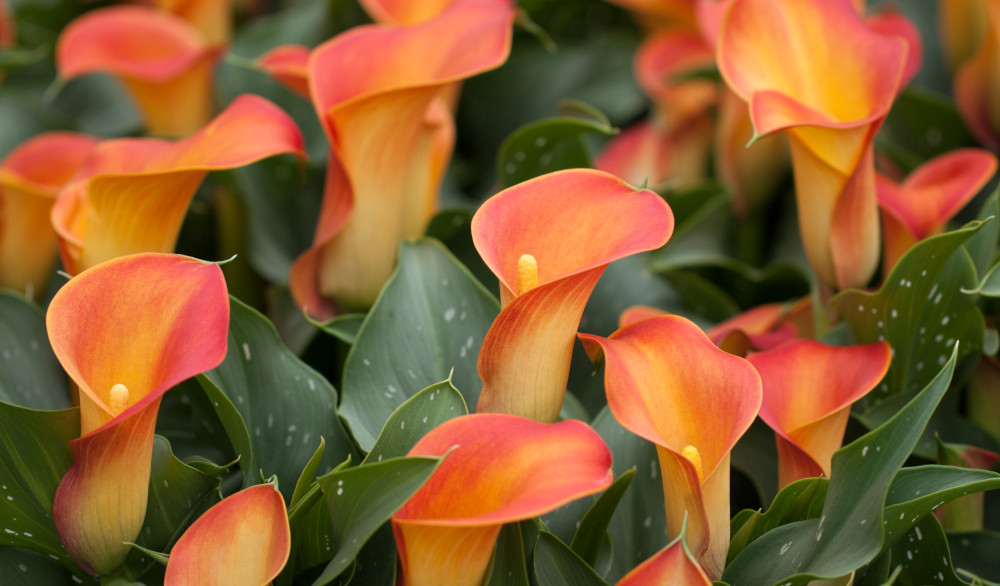
Zantedeschia is a genus of flowering plants from the family Araceae and is native to southern Africa. With a rich history dating back to the Ancient Romans, these deciduous or semi-evergreen perennials have been used as a symbol of celebration. Zantedeschia was Named after Professor Giovanni Zantedeschia, an Italian botanist.
There are two main forms of Zantedeschia: hardy and tender. Hardy forms of the plant can be grown outdoors, enjoy moist soil and full sun or partially shaded conditions - these are known as Arum lilies. Tender forms of Zantedeschia prefer being grown in containers or pots and should be brought inside over the winter - these are known as Calla lilies.
With tuberous flora in all colours from whites, yellows and oranges to deep reds and purples, Zantedeschias are not to be overlooked in any garden, as long as they have sufficient sunlight to grow in.
Ready to learn more about growing Zantedeschia? Read on for all there is to know...
Key Information
Soil pH

Position

Hardiness


Where & when to plant Abies
Position - Outdoors: a sunny spot is best, with shelter from cold winds. Shade will be tolerated, especially when the tree is young (in its natural habitat it would spend its juvenile years in the shade of mature trees).
Indoors: as bright as you can, away from radiators or fires.
Soil - Fertile, moist, and well-draining, with a neutral to acidic pH.
Hardiness - As hardy as it gets, rated H7 (-20°C and below)
To grow your abies as a permanent tree in the garden, plant it out anytime from autumn to early spring. Many species can get very large over time, so make sure you check the eventual height and choose a spot where this isn’t likely to cause a problem in the future. Note that while many other conifers are popular for use as hedging, abies is typically too slow growing for this purpose.
For those who have bought a pot-grown abies as a reusable Christmas tree, we recommend keeping it outdoors until the last possible moment. We’ve found twelve days is about the most a tree like this can exist comfortably indoors, though let the tree be your guide. If it is looking unhappy sooner than this, move it back out.
For best results, we recommend making the return to outdoors a gradual process so that the leap from centrally heated home to cold, January garden is not too much of a shock. You can do this by standing it in a cool yet protected environment for a few days, such as an unheated greenhouse or porch. Alternatively, move it outside during the day then back in at night, then permanently outside but with a fleece covering or similar overnight. After a couple of nights like this you should be safe to leave it uncovered outside full time.
Once your tree has been gradually acclimatised to the conditions outdoors there are two methods to choose from. The first is to plant it into the open ground, then dig it up and pot it the following Christmas. Although this requires minimal input when it comes to feeding and watering over the spring to autumn period, it is something you’ll only get away with doing once, and will mean disposing of the tree afterwards. The second option involves more maintenance, though will gain you a few extra years use. Having moved your tree outdoors after Christmas, pot up into a slightly larger container no more than twice the diameter of the original. Keep on top of feeding and watering throughout the growing season (detailed advice on this below). Repeated annually, this method should mean you get three to four Christmases out of your tree, though after this it is likely to struggle with the confines of a container. The options then are to either to dispose of the tree, or plant it out into the open ground as a permanent feature.
How to plant Abies
- For planting in the ground, dig the soil area removing any large stones and weeds and breaking up any lumps. Mix in some organic matter such as manure, garden compost, or leaf mould. Rake level and firm with your heels. Rake level again.
- Water the root ball well and allow to drain before planting.
- Dig a hole twice the width of the root-ball.
- Place the plant in the hole, ensuring the top of the root ball sits level with the surface of the soil. To high and the roots can dry out, too low and the trunk can rot.
- Backfill with soil and firm in gently with your foot.
- Soak well with water.
- Mulch around the base with well-rotted organic matter.
- For planting in a container, choose a pot several centimetres larger than the one it is in currently. Ensure there are plenty of drainage holes in the bottom.
- If you are using a large or heavy pot, it can be a good idea to fill and plant it in situ to save yourself the trouble of moving once full.
- Use a good quality, loam-based compost (John Innes No. 3 is ideal), mixing in some slow-release fertiliser granules if these are not already contained.
- Start by partially filling the pot with compost; enough so that when placed on it the upper surface of the root ball is about 3 centimetres lower than the top of the pot.
- Infill all the space surrounding the root ball with compost, firming down with your fingers then adding a little more so the plant is held tight.
- Pick up the pot (if you can!) and lightly tap on the potting bench or ground a few times to help further settle the compost around the plant.
- Soak well with water.
- A mulch with horticultural grit will look attractive and help to prevent a ‘cap’ or crust forming on the top of the compost (something container plants can suffer due to the artificial nature of their watering).

What to plant with Abies
In the garden, make your abies look at home by positioning it among other evergreens and winter-interest plants such as mahonia, sarcococca, cornus, hamamelis, and callicarpa. A smattering of early-flowering bulbs over the ground will complete the picture – we love winter aconites and snowdrops for this.


How to care for Abies
Pruning and Deadheading
No pruning is required for abies, and in fact is likely to spoil its natural form. If there are any dead, diseased, or damaged branches, these may be removed in spring.
Watering
Like all woody plants, abies establishes best in the ground when regularly watered during its first two growing seasons. After this it should be largely self-sufficient and may be left to its own devices in all but the hottest and driest weather.
In a container, water regularly throughout each growing season. Aim for consistently moist but not soggy compost – allowing the top few centimetres to dry out before you give a deep, thorough soaking is best practice.
When brought indoors for Christmas, pot-grown abies will need watering every couple of days. Again, the goal is moist yet not soggy compost.
Feeding
On healthy, fertile soil, abies should exist quite happily without any additional feeding.
In a container, pot up each spring using a good quality compost with slow-release granules mixed in. This generally provides enough nutrients for six weeks, after which a monthly dose of balanced liquid feed throughout the rest of the growing season (spring to autumn) will help maintain a healthy, thriving tree.
Cold Protection
Abies is as hardy as it gets and should survive a UK winter without the need for additional protection.
Pests and Diseases
Abies can be prone to adelgids, aphid-like insects which target conifers. Telltale signs are woody parts of the tree becoming encrusted with a white, woolly wax. In most cases this is tolerated by the tree and the insects can be considered as part of a balanced garden ecosystem, however large populations can cause bud failure and twig enlargement.
The most effective and sustainable mode of defence is to encourage natural predators into the garden, including ladybirds, ground beetles, birds, hoverflies, parasitoid wasps and earwigs. To boost populations, grow a wide range of pollinator-friendly plants, eliminate use of chemicals, and provide a range of undisturbed habitats.
How to propagate Abies
Abies is best propagated by seed – a process so exacting and fiddly most gardeners opt to simply buy a young plant instead. However for those who welcome a challenge, the method is as follows:
· Collect cones when they are ripe though not yet opened (the seeds fall out as the cone opens). The moment for this is usually late summer to early autumn. Note that abies tends to produce cones mainly towards the top of the tree, meaning a ladder may be required for larger specimens.
· Spread the cones somewhere warm, dry, and in direct sunlight to encourage opening.
· Once open, shake the seeds out onto a level surface.
· Mix the seeds with slightly damp sand in a polythene bag, aiming for around three parts sand to one part seed. Seal and label the bag, and pop into the fridge for 21 days. This period of cold stratification is an important part of aiding germination.
· Fill a seed tray or several small pots with a well-draining compost mix, compressing the surface lightly with a flat piece of wood or the bottom of another pot.
· Sprinkle the seeds evenly over the surface of the compost, aiming for a spacing of 3-5 centimetres between each.
· Either use a garden sieve to cover with a fine layer of compost, or sprinkle over a layer of vermiculite by hand.
· Water with a fine spray until the compost is evenly moist but not waterlogged.
· Place the seed tray or pots in a cold frame, or in a cool, well-ventilated greenhouse. Alternatively, put somewhere outdoors yet protected from the elements, such as in the lee of a wall or hedge.
· Germination should start a few weeks later. When the seedlings have grown large enough to handle, pot each into individual 2 litre containers.
· Grow these on in the same environment in which they germinated. Once a seedling has produced three sets of small branches, place it outside uncovered, and start feeding with a balanced liquid feed diluted to a quarter of the recommended strength. Do this until the end of the growing season (mid autumn).
· Plants will need to be grown on in this way for two to four years before they are ready to be planted out as above.
* Many plants carry Plant Breeders Rights and cannot be propagated for commercial purposes.
Common Abies Questions
Which makes the better Christmas tree, Nordmann fir (Abies nordmannia) or Norway spruce (Picea abies)?
While Nordmann fir wins when it comes to softer, longer lasting needles, it is somewhat lacking in aroma. Those dead set on the traditional pine scent are best opting for the pricklier, needle-dropping Norway spruce.
How do you tell a fir and a spruce apart?
These two conifers can look very similar, even to botanists, who rely on a clever trick to distinguish them. When pulled away from the branch, the needle of a fir (abies) has a little round sucker pad on the end, while that of a spruce (picea) tears a small strip of bark with it.
Why is the new growth on my abies a different colour to the rest?
This is usual behaviour. The young, spring growth flushes bright green, contrasting against the darker foliage. Over time, it will deepen to the same colour.
Which is more sustainable, an artificial or real Christmas tree?
When reused or recycled (local councils often provide a Christmas tree recycling service), a real tree is the greener option. Artificial trees are generally made using petroleum-based plastic and tend to have a significant transportation footprint, while real trees are from a regenerative source and provide a habitat for wildlife whilst they grow large enough for sale (usually around seven years).
It has been estimated that an artificial tree would need to be used for at least ten years before it achieves the sustainability of a real tree. Even then the issue of disposal remains for what are usually non-recyclable items.
