


How to grow Buxus
Whilst in the wild this evergreen is a large shrub or small tree, when grown in gardens it tends to be trimmed into a topiary shape or low hedge. Its centuries-long popularity for this use is due to its leaves, which are so small and densely produced that impressively sharp detail can be achieved with clipping. Add to this a slow growth-rate (meaning it keeps its shape with just one or two cuts per year), and an ability to grow in almost any situation.
There are around 70 species of buxus, though UK gardeners are likely to be most familiar with our native species, Buxus sempervirens. Of this, there are hundreds of cultivated forms, offering variations such as dwarf size (e.g. ‘Suffruticosa’), variegated leaves (‘Marginata’, ‘Elegantissima’, ‘Latifolia Marginata’), and a columnar, upright habit (‘Graham Blandy’). Other species popular for garden use include B. microphylla (Japanese box), said to have a greater heat tolerance than B. sempervirens, and B. sinica (Korean box), an extremely hardy and small species often used for bonsai. The slightly less hardy B. balearica (Balearic box) has the largest leaves of all species, each growing up to 4 centimetres long.
Due to its slow growth rate box wood is extremely hard, and was traditionally used to make cabinets, tool handles, musical instruments, and (yes, you guessed it) boxes.

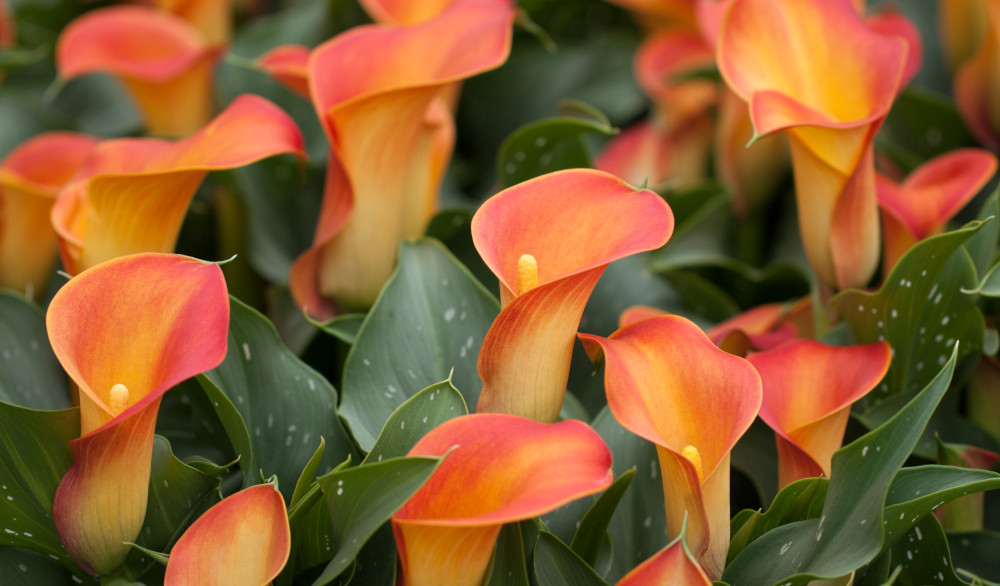
Zantedeschia is a genus of flowering plants from the family Araceae and is native to southern Africa. With a rich history dating back to the Ancient Romans, these deciduous or semi-evergreen perennials have been used as a symbol of celebration. Zantedeschia was Named after Professor Giovanni Zantedeschia, an Italian botanist.
There are two main forms of Zantedeschia: hardy and tender. Hardy forms of the plant can be grown outdoors, enjoy moist soil and full sun or partially shaded conditions - these are known as Arum lilies. Tender forms of Zantedeschia prefer being grown in containers or pots and should be brought inside over the winter - these are known as Calla lilies.
With tuberous flora in all colours from whites, yellows and oranges to deep reds and purples, Zantedeschias are not to be overlooked in any garden, as long as they have sufficient sunlight to grow in.
Ready to learn more about growing Zantedeschia? Read on for all there is to know...
Key Information
Soil pH

Position

Hardiness


Where & when to plant Buxus
Position - Will grow in any light level, from deep shade to full sun. The caveat is that full sun must be combined with reliably moist soil – if buxus dries out in this aspect the foliage can become poor, dull, and even scorched.
Soil - Any fertile, well-draining soil. Avoid soil prone to waterlogging. Buxus is drought tolerant apart from when grown in full sun.
Flowering Period - Spring. Flowers are small and insignificant, though popular with bees.
Hardiness - Hardy. Usually rated H6 (-15 to -20°C).
B. balearica is rated H4 (-5 to -10°C).
For best results, plant in autumn or spring. An autumn planting can be done by those gardening in mild conditions (and broadly speaking, this is the southern half of the UK). For those liable to cold winters, it is best to wait until spring (generally the northern half of the UK). A summer planting is best avoided for woody plants, as they struggle to establish well from this.
Dwarf species are good for small shapes and container-growing, while columnar forms are well-suited to low hedging. If you’re aiming for a cone or spiral, go for a cultivar with a naturally pyramidal shape such as ‘Handsworthiensis’. For topiary or hedging on a larger scale, the straight B. sempervirens species is ideal.
In terms of choosing a spot in the garden, buxus is extremely versatile and is equally as happy beneath dense trees as it is in an open, sunny border.
How to plant Buxus
· For planting in the ground, dig the soil area removing any large stones and weeds and breaking up any lumps. Mix in some organic matter such as manure, garden compost, or leaf mould. Rake level and firm with your heels. Rake level again.
· Water the root ball well and allow to drain before planting.
· Dig a hole two to three times the width of the root-ball, as this will encourage the roots to spread quickly.
· Place the plant in the hole, ensuring the top of the root ball sits level with the surface of the soil. To high and the roots can dry out, too low and the trunk can rot.
· Backfill with soil and firm in gently with your foot.
· Soak well with water.
· Mulch around the base with well-rotted organic matter.
· To grow buxus as hedging, space plants 30-40 centimetres apart (compact cultivars can go more like 10-15 centimetres apart). Expect plants to knit together within three to five years.
- For planting in a container, choose a pot just a few centimetres larger than the nursery pot. Buxus is slow-growing, which means it is important to not ‘overpot’ it. If the container is too large there will be lots of unused compost sitting wet around the plant – not good news for healthy root growth. Ensure there are plenty of drainage holes in the bottom.
- If you are using a large or heavy pot, it can be a good idea to fill and plant it in situ to save yourself the trouble of moving once full.
- Use a good quality, loam-based compost (John Innes No. 3 is ideal), mixing in some slow-release fertiliser granules if not already present.
- Start by partially filling the pot with compost; enough so that when placed on it the upper surface of the root ball is about 3 centimetres lower than the top of the pot.
- Infill all the space surrounding the root ball with compost, firming down with your fingers then adding a little more so the plant is held tight.
- Pick up the pot (if you can!) and lightly tap on the potting bench or ground a few times to help further settle the compost around the plant.
- Soak well with water.
- A mulch with horticultural grit will look attractive and help to prevent a ‘cap’ or crust forming on the top of the compost (something container plants can suffer due to the artificial nature of their watering).

What to plant with Buxus
Buxus is a plant which fits into almost any planting style, from paired back minimalism to country cottage garden. We particularly enjoy its neat, clipped form contrasted against loose, informal, naturalistic planting – think clouds of nepeta, alchemilla, and salvia; the upright accents of verbascum and digitalis; and open, daisy like blooms from things like kalimeris and echinacea. Try having these spill out from within a low, clipped box hedge or punctuated by some neat box balls. Designer perfection!


How to care for Buxus
Pruning and Deadheading
The best time to prune buxus depends on the age of the plant, along with what it is being used for.
Young plants can be given ‘establishment pruning’ in May, whereby stems are cut back by a third to promote bushy growth. Further trimming can be carried out between then and August as required.
Mature plants are best trimmed annually in August once the growth has started to slow. Trimming earlier than this results in a flush of soft growth which, as well as looking less ‘sharp’ over winter, is more vulnerable to weather damage and disease.
While traditional advice was to prune box twice a year for optimum density and definition, it is now widely agreed that a looser form (with increased airflow through the plant) means better plant health and less vulnerability to pests and diseases. That said, buxus grown as topiary may need trimming twice (spring and late summer) to maintain its shape, particularly in the case of more intricate forms such as spirals or figures.
A useful thing to known when dealing with buxus is that it will regrow from old wood. Whether rejuvenating an overgrown specimen by cutting the whole lot back to 15-30 centimetres above ground level, or drastically reshaping an existing hedge/ ball/ topiary, your plant should respond with plenty of fresh, new growth. This sort of hard prune can be done in late spring, and is best followed immediately with a feed, water, and mulch (see below).
Whichever type of pruning you’re carrying out on your buxus, there are a few steps which will help limit the accidental spread of pests and diseases:
· Always prune buxus on a dry day
· Use clean tools, disinfected between each plant
· Clear prunings away promptly (it can be a good idea to lay a sheet or some tarpaulin on the ground to catch them as you clip)
Watering
Like all woody plants, buxus establishes best when regularly watered during its first two growing seasons in the ground. After this it should be largely self-sufficient and may be left to its own devices in all but the hottest and driest weather.
In a container, water regularly throughout each growing season. Aim for consistently moist but not soggy compost. Allowing the top few centimetres to dry out before you give a deep, thorough soaking is best practice.
Feeding
It takes energy for plants to recover and regrow from trimming, and so it’s a good idea to get into the habit of feeding hedges and topiary shapes annually each spring. Apply a general purpose feed (blood, fish and bone is ideal), soak with water if the weather is dry, then cover with a mulch of well-rotted organic matter such as manure or garden compost. Don’t be tempted to skip the mulch – not only does it gradually release extra nutrients into the soil, but it also breaks down to improve soil structure, supresses weeds, and locks in moisture. Mulching really is the secret to healthy, sustainable plant growth.
Container-grown buxus relies even more on the gardener for nutrition. Get off to a flying start by making sure you use a good quality, loam-based compost with some slow-release fertiliser granules mixed in, then apply a monthly dose of balanced liquid feed throughout the growing season. Repotting every few years into fresh compost with slow-release granules is also beneficial, and when this is no longer feasible carry out a topdress each spring. Simply scrape away the top 5 centimetres of compost and replace with fresh. Finish with a good soak of water to settle the compost.
Cold Protection
Most species of buxus are hardy enough to withstand a UK winter without the need for additional protection.
B. balearica is a touch more tender than the rest and may need protection in a particularly harsh winter, particularly if grown in an exposed spot or a container. Cover with one of these handy fleece jackets and wrap the container in an insulating layer of bubblewrap, horticultural fleece, or hessian.
Pests and Diseases
Having been popular in UK gardens since the Roman times, buxus has, in recent years, sadly fallen victim to several serious problems, not least box blight and the box tree caterpillar.
Box blight is a fungal disease that causes bare patches, brown leaves, and dieback, and is especially prevalent in wet conditions.
The box tree caterpillar can completely defoliate entire plants in a matter of days. While relatively new to the UK, it has spread quickly, particularly in London and the surrounding areas.
The best form of defence is to grow healthy, thriving plants by following the advice above, and creating a balanced, thriving garden ecosystem by taking measures such as eliminating use of chemicals, providing food and habitat for wildlife, and growing a wide range of plants.
Quarantine any newly bought buxus plants for at least four weeks, keeping them away from the garden until you can be confident they are not harbouring blight.
If you spot signs of blight on existing plantings, it is important to act quickly to prevent spread. Dig out the affected plant entirely, along with the surrounding topsoil. Bag all waste up on the spot and dispose of off-site. Thoroughly clean and disinfect all tools, clothing, gloves, and shoes which are likely to be contaminated with blight spores. Moving forward, it’s best to avoid planting buxus in the same spot; opt instead for an alternative as suggested in our ‘Common Questions’ section below.
Box tree caterpillars can, where feasible, be removed by hand. For infestations which are less accessible or on a larger scale, a biological control known as ‘Fruit and Vegetable Protection’ may be effective. The RHS is keen to hear about all instances of this pest to help track its spread.
How to propagate Buxus
If you have a healthy existing buxus, it is a good idea to propagate new plants from this rather than risk introducing bought specimens into the garden.
Propagation is best done using semi-ripe cuttings taken in summer. Using a heated propagator will significantly speed up results: here the cuttings can be expected to root in around eight weeks, as opposed to the eight months you’ll get from a coldframe, unheated greenhouse, or windowsill.
· Look for current year’s growth which is firm and woody at the base while still flexible at the tip. You’re aiming for cuttings of 10 centimetres or less (any longer and they are more likely to dry out and fail). For best results, choose stems where the leaf nodes are close together rather than far apart.
· Using a sharp knife or secateurs, sever the cuttings from the plant and put in a plastic bag straight away to keep them from drying out.
· Fill a pot (or several, if you have a lot of cuttings) with a perlite-heavy compost mix (at least 50% perlite).
· Trim the end of the cutting to just below a node (point at which leaves grow).
· Remove lowest leaves, leaving at least four on the cutting.
· Insert the cuttings into the compost and water lightly. Several cuttings can be put in the same container if there is enough space to do this without them touching.
· Place in a propagating unit with gentle bottom heat if you have one, or covered with a plastic bag in a coldframe, greenhouse, or on a windowsill if not (out of direct sunlight).
· Keep the cuttings misted and occasionally watered until they root. You will know this has happened when roots emerge out of the bottom of the container.
· Gently remove rooted cuttings and pot them into individual pots. Grow on in a cool yet frost-free environment such as an unheated conservatory, greenhouse, or cold frame. Pinch out the growing tips regularly to encourage bushy growth.
· In autumn or spring, find a sheltered, spare patch of ground in which to plant and grow on your young plants (spacing them 30-45 centimetres apart). After three or four years they should be large enough to move to their final position.
* Many plants carry Plant Breeders Rights and cannot be propagated for commercial purposes.
Common Buxus Questions
What is a good alternative to buxus?
If your buxus has succumbed to a pest or disease, it is usually best to replace it with a different plant or risk the same fate being repeated. Ilex crenata (box-leaved holly), Euonymus japonicus (Japanese spindle), Lonicera nitida (boxwood honeysuckle), Podocarpus nivalis (mountain totara), or Pittosporum tenuifolium are all fine substitutes.
Is buxus poisonous?
Buxus can be toxic if ingested and contact with its sap may irritate skin.
Does buxus have good wildlife value?
Very much so. As well as its flowers providing valuable sustenance for bees, its dense, evergreen leaves offer year-round shelter for birds, small mammals, and insects.
Does buxus need acid growing conditions?
No, it will grow in any reasonable garden soil.
