


How to grow Cardiocrinum
Also known as giant lily, cardiocrinum is one of the most spectacular perennials of all. This enormous, bulbous member of the lily family hails from woodland in the Himalayas, Japan, and China, and is cultivated for its huge, highly scented, trumpet-shaped flowers and veined, heart shaped leaves. Towards the end of summer, the flowers give way to large, decorative seedpods, which are an attractive feature in their own right and may be dried to live on as part of an indoor arrangement.
Cardiocrinum takes on average 5 years to flower and then dies once it has done so, leaving numerous offsets behind. The trick to ensure annual flowering is to plant a few new plants each year (eventually you’ll be able to use the offsets for this), which will see you build up an impressive and ever-increasing clump. Yes, you’ll need patience in those initial few years, but once flowering gets going, you should, in theory, never be without it again.
Cardiocrinum has a reputation for requiring lots of effort while offering a relatively short window of reward, however as this growing guide will prove, this really isn’t the case. Providing it is given the right conditions to grow in and the briefest bit of attention now and again, cardiocrinum is simple, straightforward, and well-worth the initial wait.

Zantedeschia is a genus of flowering plants from the family Araceae and is native to southern Africa. With a rich history dating back to the Ancient Romans, these deciduous or semi-evergreen perennials have been used as a symbol of celebration. Zantedeschia was Named after Professor Giovanni Zantedeschia, an Italian botanist.
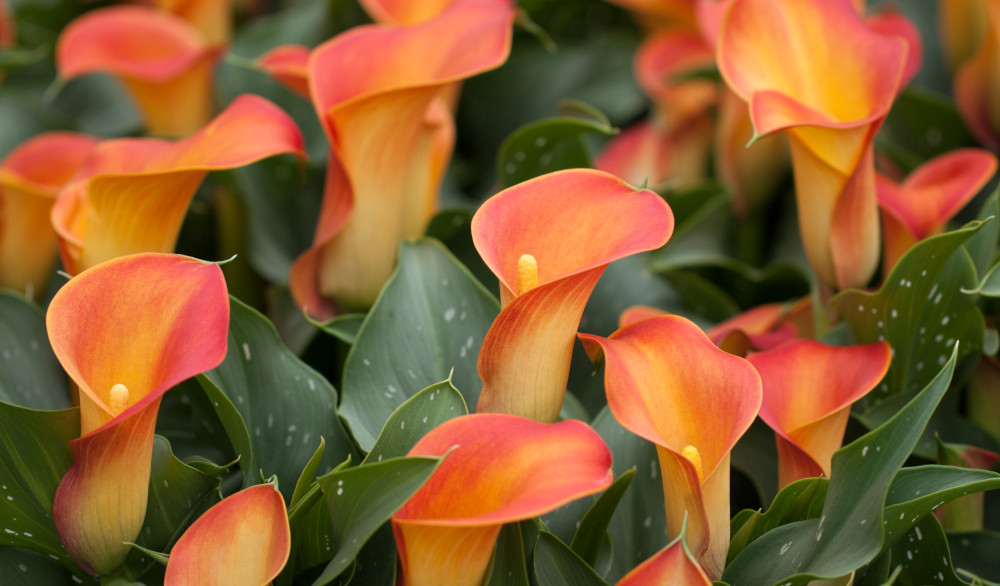
There are two main forms of Zantedeschia: hardy and tender. Hardy forms of the plant can be grown outdoors, enjoy moist soil and full sun or partially shaded conditions - these are known as Arum lilies. Tender forms of Zantedeschia prefer being grown in containers or pots and should be brought inside over the winter - these are known as Calla lilies.
With tuberous flora in all colours from whites, yellows and oranges to deep reds and purples, Zantedeschias are not to be overlooked in any garden, as long as they have sufficient sunlight to grow in.
Ready to learn more about growing Zantedeschia? Read on for all there is to know...
Key Information
Soil pH

Position

Hardiness


Where & when to plant Cardiocrinum
Key Information
Position - A cool, partially shaded, sheltered site.
Soil - Deep, fertile, humus-rich, moist but well-draining. Avoid anywhere prone to becoming waterlogged or very dry.
Flowering Period - Summer
Hardiness - Hardy, rated H5 (-10 to -15°C)
Cardiocrinum usually comes as a pot grown plant and is best planted in autumn or spring. An autumn planting can be done by those gardening in mild conditions (and broadly speaking, this is the southern half of the UK). For those liable to cold, wet winters, it is best to wait until spring (generally the northern half of the UK, or those with very heavy soil). Planting can also be carried out in summer, though be prepared to water regularly.
When choosing a spot for your cardiocrinum, keep in mind the need to recreate its natural woodland habitat as closely as possible. Rich, leafy soil beneath deciduous trees is ideal, or a tucked away, partially shaded border that has been improved with leaf mould. Cardiocrinum won’t tolerate hot or dry conditions, so don’t waste your time trying it in full sun or free-draining soil. Waterlogging is another death sentence, ruling out boggy areas or heavy, clay soil.
Cardiocrinum much prefers life in the open ground, however if you do wish to try it in a container make it the deepest one you can find.
The scent of cardiocrinum flowers becomes much stronger in the evenings, so where possible try to locate your plants where this may be fully appreciated, such as near a seating area or doorway.
How to plant Cardiocrinum
· For planting in the garden, dig the soil area removing any large stones and weeds and breaking up any lumps. Now is the time to improve the soil by incorporating some well-rotted organic matter. Leaf mould is ideal, though manure or garden compost will also do if this is all you have. Rake level and firm with your heels. Rake level again.
· Water your potted cardiocrinum well and allow it to drain before planting.
· Dig a hole twice the width of the root-ball. Unlike other bulbs, this one should sit just below the surface, so don’t be tempted to plant it any lower than it was in the nursery pot.
· Place the plant in the hole, ensuring the top of the root ball sits level with the surface of the soil. Too low and the plant may rot, too high and the roots can dry out.
· Backfill with soil and firm in gently.
· Soak well with water.
· Mulch around the base with well-rotted organic matter.
· For planting in a container, first choose an appropriately sized pot; one several centimetres larger than the nursery pot and as deep as you can find. Ensure there are plenty of drainage holes in the bottom.
· Use a good quality potting compost with a generous of leaf mould added in and mixed. Start by partially filling the pot; enough so that when placed on it the upper surface of the root ball is about 3 centimetres lower than the top of the pot.
· Fill around the plant with compost, firming down with your fingers then adding a little more so it is held tight.
· Pick up the container and lightly tap on the potting bench or ground a few times to help further settle the compost around the plant.
· Soak well with water.
· A mulch with horticultural grit will look attractive and help to prevent a ‘cap’ or crust forming on the top of the compost (something container plants can suffer due to the artificial nature of their watering).

What to plant with Cardiocrinum
Other plants which grow well in the same moist, cool, woodland-esque conditions include hemiboea, meconopsis, blechnum, and clethra.


How to care for Cardiocrinum
Pruning and Deadheading
For its first few years in the ground, cardiocrinum will produce nothing more than a rosette of leaves. As is the case with all bulbs, these should be left to die back naturally to boost energy stores in the bulb for the following year.
In its flowering year, do not be tempted to cut off the flower stem as it fades, as doing so will rob you of the highly attractive seed pods to follow. Allow the whole lot to die back and wither before pulling out entirely. Tease apart the offsets likely to have formed around the original bulb, and replant these at least 30 centimetres apart from each other. The bulb and its withered top growth may then be discarded on the compost heap.
Watering
Water cardiocrinum freely in dry periods, though don’t allow the soil (or compost) to become waterlogged.
Feeding
Cardiocrinum will benefit from a little attention in the feeding department. Applying a balanced liquid feed two or three times during the growing season will encourage the development of offsets, and therefore play a vital role in your continuing display year on year.
An annual mulch of leaf mould is also strongly advisable. As well as boosting the nutrient content of the soil, this has the added benefit of suppressing weeds and locking in moisture. Mulching is best carried out in autumn or spring.
Cold Protection
Whilst overall cardiocrinum is hardy, it still benefits from being covered with a pile of deep winter mulch to protect the delicate new spring growth from frost damage. This is in addition to the leaf mould mulch recommend above, and should be something dry such as bracken, bark chips, or straw. Remove in late spring once risk of frost has passed.
Pests and Diseases
As a member of the lily family, cardiocrinum can be subject to the unwanted attentions of the lily beetle. Look out for shredded leaves and bright red beetles on the plant, which fortunately are slow moving and can be easily picked off and disposed of by hand.
Slugs can be another foe, particularly on young, tender growth early in the growing season. Encouraging natural predators into your garden, such as birds, frogs, toads, and hedgehogs can make a big difference. Torchlight searches after dark (when slugs are at their most active) are also effective, allowing you to collect the offending molluscs in a bucket and dispose of as you see fit. Relocating to a nearby woods or bagging up and putting in your freezer before popping them in the bin are said to be the most humane approaches.
How to propagate Cardiocrinum
While it’s possible to collect and sow the seed of cardiocrinum, the results can take up to seven years to reach flowering maturity. Much speedier is to use the offsets, which get there between two and four years sooner.
Simply tease away from the parent bulb once this has completely died back after flowering. Replant each offset at least 30 centimetres apart from one another, just below the surface of the soil, and then follow our watering, feeding, and mulching advice above. Alternatively, pot offsets up into individual 9 centimetre pots and grow on in a cold frame or unheated greenhouse.
* Many plants carry Plant Breeders Rights and cannot be propagated for commercial purposes.
Common Cardiocrinum Questions
Why can’t I just cut the spent flower stalk off at ground level and leave the offsets to grow undisturbed?
You can, though without being moved further apart they are unlikely to grow as well and may therefore take longer to flower.
How many species of cardiocrinum are there?
Just three. The most commonly cultivated is Cardiocrinum giganteum.
