


How to grow Erythronium
Elegant Erythronium, native to California, are bulbous easy-going perennials that are certain to brighten up a shady spot, whatever your style of garden.
Large, glossy ovate leaves and bare stems fashion star-shaped flowers with curved petals. Flourishing profusely during the spring, these plants look fantastic as part of your borders, under-planting for roses and shrubs, in a wildflower meadow, cottage garden or part of a modern plant scheme in containers. Known as Dog’s Tooth Violet, because of the shape of the bulb, looking like a canine tooth, they are reliably hardy and will naturalise well in the right conditions.

Key Information
Soil pH

Position

Hardiness

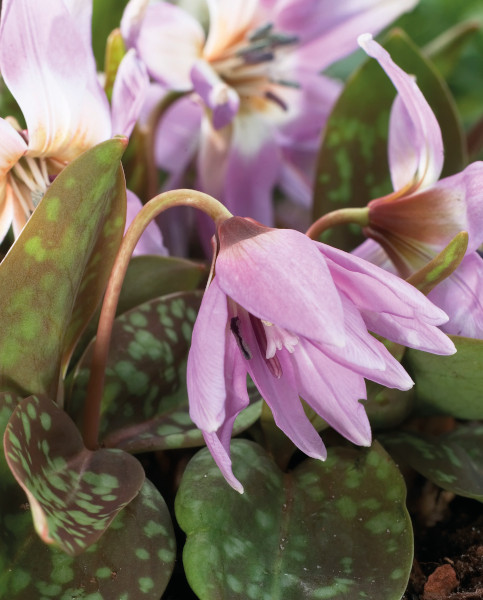
Where & when to plant Erythronium
Erythronium bulbs are long, pointed and white are best planted in fertile, humus rich, moist but well-drained soil, around 15cm deep with the pointed end upwards. You may wish to add organic matter or horticultural grit to you soil to give the bulbs the best conditions.
You may wish to plant Erythronium under deciduous trees or shrubs where they are in a position of part shade and protected from adverse weather conditions – this is where they will thrive best. Be sure not to plant near delicate plants and shrubs as Erythronium can multiply and spread if happy in its location.
How to plant Erythronium
For a natural display, grow in random groups. Gently toss a handful of bulbs onto the area as if you were skimming a stone, and plant them where they fall, as long as they are no closer than 10cm to each other to allow room to spread.
Dig a hole around 15cm deep so that the top of the bulb is around 10cm below the soil surface. Place a bulb in each hole, pointed end upwards and back fill in with soil. Alternatively, if growing in a pot, use good quality multi-purpose compost and plant as above, although a little closer as long as they are not touching each other or the side of the pot.
After planting, ensure that you water your Erythronium thoroughly to settle the soil and the bulbs. Give the bulbs the best conditions by adding humus or leaf mould.
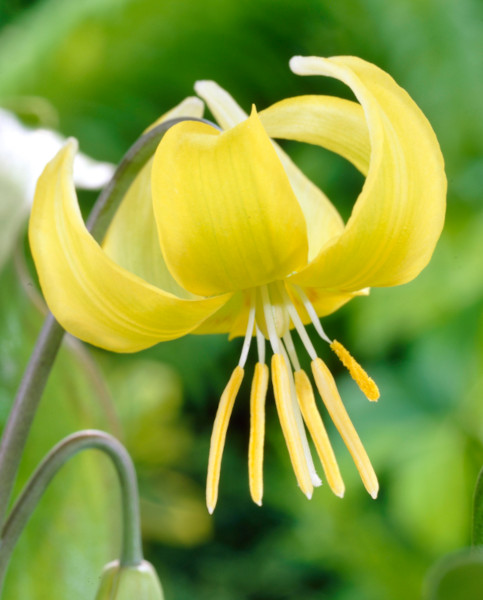
What to plant with Erythronium
Erythronium make an eye-catching display when planted ‘en masse’ as a single genus. However, companion planting can create equally incredible displays. When choosing plants to grow with Erythronium, consider the height, colours and growing preferences of the plant and the overall effect you want to create.
For an elegant but relaxed feel, the shape and colour of Erythronium White Beauty, with swept back petals is a contrasting companion to the dark bell-shaped blooms of Fritillaria uva-ulpis.
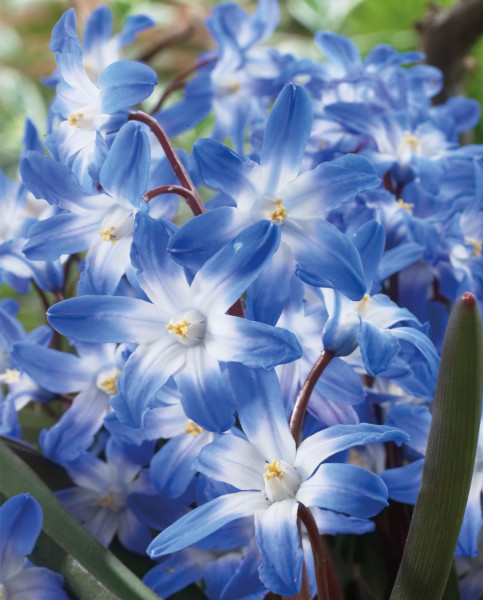
Vibrant colours really light up a shady spot. The bright yellow blooms of Erythronium Pagoda pick up the golden yellow flecks held on the royal-blue flowers of Iris reticulata.
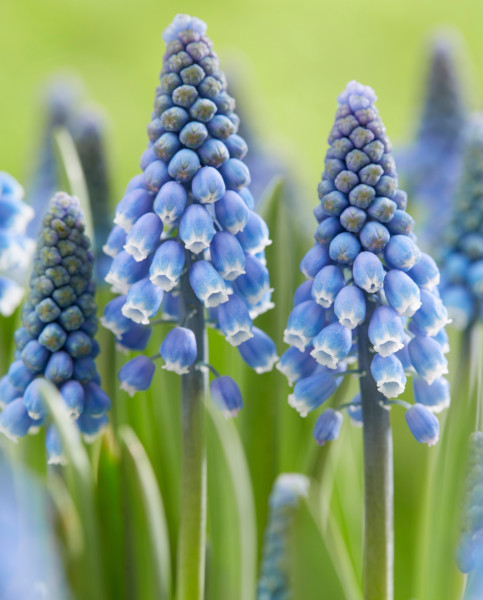
You may want to grow perennials or plants that bloom as a different time of the year as companions. They will happily take over and fill the space left, once your Erythronium have become dormant in late spring, for the summer.

How to care for Erythronium
Do not allow the soil to dry out as Erythronium require reliably moisture retentive soil of a neutral to slightly acidic pH.
After the flowering period, dead-head the faded blooms but leave the foliage in place so that it can continue to photosynthesise and gain all the nutrients and energy it can to store back in the bulb for subsequent seasons – there is little or no need to prune. Throughout active growth ensure that you water your plants when necessary, increasing the volume in periods of drought.
Erythronium will naturally form clumps over time, slowly multiplying and spreading to form drifts if left undisturbed. It is possible to propagate Erythronium by lifting the clumps, splitting them by division and re-planting in another area of your garden where needed. Also helping to prevent congestion, this should be done after the flowering period has finished and is best undertaken every three to four years.
Erythronium should not require any feeding or liquid fertiliser, however every autumn, they would benefit from a mulch of well-rotted compost or leaf mould, which will help retain moisture in the soil while giving some extra nutrients.
Erythronium are fully hardy bulbous perennials that do not require any frost protection in most of the UK. Should winter be exceptionally hardy you may wish to cover with horticultural fleece during the coldest periods.