


How to grow Euonymus
This useful genus of shrubs is popular with gardeners for its ease of cultivation and diversity. Evergreen species have glossy, attractive leaves and tend to remain relatively small. Deciduous species are often larger and are grown for their spectacular autumn colour and sometimes brightly coloured fruit.
Euonymus can also be known by the common name of spindle.

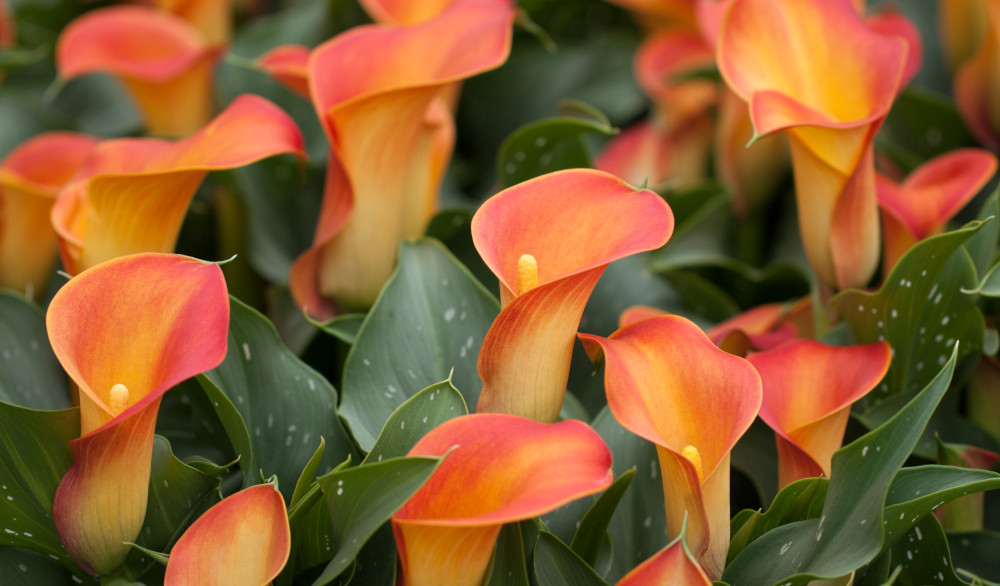
Zantedeschia is a genus of flowering plants from the family Araceae and is native to southern Africa. With a rich history dating back to the Ancient Romans, these deciduous or semi-evergreen perennials have been used as a symbol of celebration. Zantedeschia was Named after Professor Giovanni Zantedeschia, an Italian botanist.
There are two main forms of Zantedeschia: hardy and tender. Hardy forms of the plant can be grown outdoors, enjoy moist soil and full sun or partially shaded conditions - these are known as Arum lilies. Tender forms of Zantedeschia prefer being grown in containers or pots and should be brought inside over the winter - these are known as Calla lilies.
With tuberous flora in all colours from whites, yellows and oranges to deep reds and purples, Zantedeschias are not to be overlooked in any garden, as long as they have sufficient sunlight to grow in.
Ready to learn more about growing Zantedeschia? Read on for all there is to know...
Key Information
Soil pH

Position

Hardiness


Where & when to plant Euonymus
Position - Full sun to partial shade (variegated evergreens, or those with pure yellow or white new growth, are best in partial shade)
Soil - Any soil except for bone dry or waterlogged
Flowering Period - Spring (tends to be insignificant on evergreen species and slightly more noticeable on deciduous species)
Hardiness - Hardy
For best results, plant in autumn or spring. An autumn planting can be done by those gardening in mild conditions (and broadly speaking, this is the southern half of the UK). For those liable to cold winters, it is best to wait until spring (generally the northern half of the UK). Planting can also be carried out in summer, though be prepared to water regularly.
Euonymus alatus is a large, deciduous shrub with fiery autumn colour and unusual corky, ridged stems. Grow as a freestanding shrub or as part of a shrubbery.
Euonymus europaeus is our native species and a slightly smaller deciduous shrub, distinctive for its eye-catching pink and orange fruits in autumn. Again, grow as a specimen shrub or as part of a mixed shrubbery.
Euonymus fortunei is a low-growing, evergreen shrub with a spreading habit and makes an excellent ground cover plant. It can also be trained to grow up a wall or support. Its often variegated foliage is useful for brightening a partially shaded spot.
Euonymus japonicus is another low-growing evergreen species, though has a more narrow and upright habit which lends itself to use as a low hedge. It is equally suitable as a container shrub, or as a source of evergreen structure in a mixed border. E. japonicus ‘Green Spire’ makes an excellent box substitute.
How to plant Euonymus
In the ground
· Clear the chosen area of weeds.
· Dig a planting hole several times larger than the root ball. Now is the time to give your soil a boost by mixing in generous amounts of well-rotted organic matter, and, if it is on the heavy side, some horticultural grit.
· Place the plant in the hole, ensuring the top of the root ball sits level with the surface of the soil. Too low and the plant may rot, too high and the roots can dry out.
· Backfill with soil and firm in gently.
· Soak well with water.
· Mulch with well-rotted organic matter.
In a container
· Choose an appropriate container, ensuring there are plenty of drainage holes in the bottom.
· Use a good quality potting compost with plenty of horticultural grit mixed in, and, if not already present in the compost (check the description on the bag) some slow-release fertiliser granules.
· It can be a good idea to pot up larger containers in situ to save yourself the trouble of moving once full.
· Start by partially filling the pot with compost; enough so that when placed on it the upper surface of the root ball is about 3cm lower than the top of the pot.
· Infill all the space surrounding the root ball with compost, firming down with your fingers then adding a little more so the plant is held tight.
· Pick up the pot (if you can!) and lightly tap on the potting bench or ground a few times to help further settle the compost around the plant.
· Soak well with water.
· A mulch with horticultural grit will look attractive and help to prevent a ‘cap’ or crust forming on the top of the compost (something container plants can suffer due to the artificial nature of their watering).

What to plant with Euonymus
Deciduous species come into their own during autumn, and so are at their most effective alongside other autumn-interest companions. For equally fiery foliage think along the lines of liquidambar, acer, cornus, and parthenocissus, and for late season flowers try asters, rudbeckia, and Japanese anemone. Throw in some soft, golden grasses such as miscanthus, stipa, and pennisetum, and your glowing autumn display is complete!


How to care for Euonymus
Pruning and Deadheading
Deciduous species require little to no pruning apart from the removal of any dead, diseased, or damaged growth which should be carried out from late winter to early spring.
Evergreen species grown as a low hedge should be trimmed two to three times between May and September each year. Neglected Euonymus japonicus can be rejuvenated with a hard prune in April – simply remove a few of the oldest branches down to the ground.
Watering
Water until established (and this generally means throughout the first growing season in the ground), after which euonymus tends to be fairly drought tolerant.
Container grown euonymus should be watered and fed regularly throughout the growing season.
Cold Protection
Euonymus is hardy and able to withstand the average UK winter without the need for additional protection.
Pests and Diseases
Euonymus tends to be relatively trouble-free, although in the past few decades euonymus scale insect has become more prevalent, particularly throughout southern England. These pests appear as small, raised, white scales on branches, leaves, and stems, and their feeding can cause yellowish mottling on the foliage, followed in extreme infestations by significant dieback.
Light populations can be tolerated by the plants, though in severe cases they may need to be replaced. Encouraging natural predators into the area is the most sustainable method of tackling the problem. These include ladybirds and birds.
How to propagate Euonymus
Evergreen euonymus can be propagated by cuttings taken in mid to late summer.
1. Find non-flowered shoots 5-10cm long and snip off the plant.
2. Put them in a plastic bag straight away to prevent drying out.
3. Fill a container with a compost mix which is at least 50% perlite (or if you prefer, as we do, 100% perlite).
4. Trim the end of the cutting to just below a node (point at which leaves grow).
5. Remove the lowest third of leaves.
6. If the remaining leaves are large, cut them in half with a sharp knife (to reduce water lost through transpiration).
7. Insert the cuttings into the compost and water lightly. Several cuttings can be put in the same container if there is enough space to do this without them touching.
8. Place in a greenhouse or propagating unit if you have one or covered with a plastic bag on a windowsill if not (out of direct sunlight).
9. Keep the cuttings misted and occasionally watered until they root. You will know this has happened when roots emerge out of the bottom of the container.
10. Gently remove rooted cuttings and pot them into individual pots. Grow on in a cool yet frost-free environment such as an unheated conservatory, greenhouse, or cold frame, until they are large enough to be planted out.
Deciduous species can be easily propagated by seed collected in autumn.
1. Remove the fleshy, orange aril.
2. Sow straight away into a pot or tray filled with well-draining compost, lightly covering with a layer of compost approximately the same depth as the seed.
3. Cover with a thin layer of fine grit.
4. Place the pot or tray outdoors, where the cold temperatures of winter will trigger germination the following spring.
5. It can be useful to protect pots or trays with chicken wire or similar to deter mice.
6. Once seedlings are large enough to handle, prick out and pot on into individual pots, growing on outside until they are ready to be planted.
Common Euonymus Questions
How fast does euonymus grow?
Euonymus has a moderate to fast growth rate, depending on the species.
Does euonymus need sun or shade?
Most euonymus can cope with either full sun or partial shade (try to avoid deep shade), though variegated forms, or those with yellow or white new growth such as Euonymus japonicus ‘El Dorado’, prefer partial shade.
