


How to grow Ficus (Fig)
A large shrub or small, spreading tree with large, rounded, lobed decorative leaves. Insignificant green flowers emerge in summer, followed by edible fruit that ripen to shades of green and purple over August to October.
In general terms, Ficus can be evergreen or deciduous trees, shrubs or climbers, with often leathery, simple, entire or lobed leaves and tiny flowers borne within a hollow receptacle which enlarges to form the fruit. Whilst there are nowadays many cultivated varieties, all have been developed from Ficus carica – the common fig – and should be grown with the basic understanding and information below in mind. We currently supply ‘Brown Turkey’ and a compact variety, ‘Little Miss Figgy’.
Native to southwest Asia and the eastern Mediterranean this was one of the first plants that were cultivated by humans. The fig is an important harvest worldwide for its dry and fresh consumption, providing a source of calcium, sugar, iron, copper, carbohydrates, potassium, and vitamin A. There is evidence to suggest that some 10,000 years ago figs were planted directly outside caves giving occupants ready access to the fruit without the need to worry about attacks from predators! Since then, they have been cultivated anywhere in the world where summers are warm and dry, and winters are cool enough to sustain these wonderful shrubs.

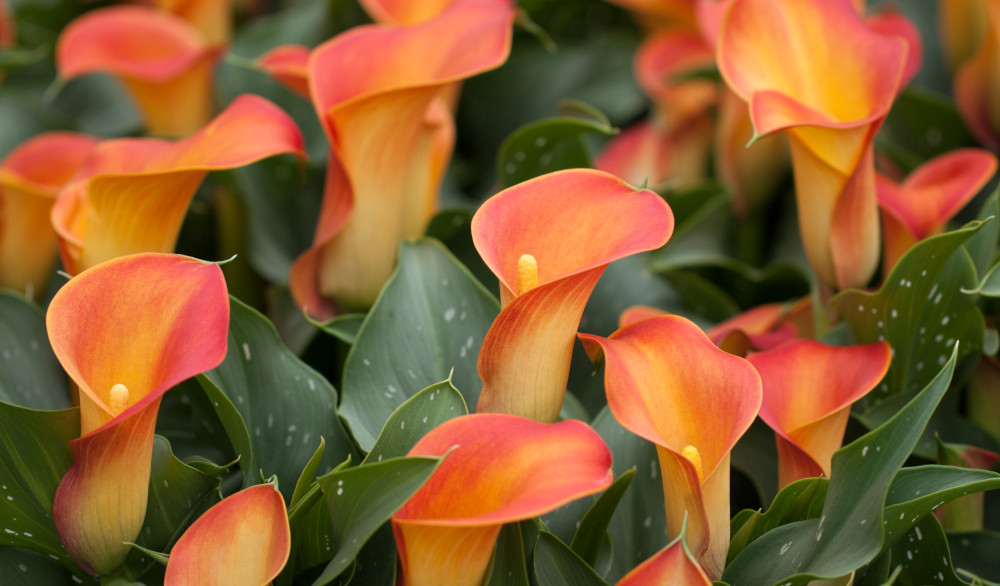
Zantedeschia is a genus of flowering plants from the family Araceae and is native to southern Africa. With a rich history dating back to the Ancient Romans, these deciduous or semi-evergreen perennials have been used as a symbol of celebration. Zantedeschia was Named after Professor Giovanni Zantedeschia, an Italian botanist.
There are two main forms of Zantedeschia: hardy and tender. Hardy forms of the plant can be grown outdoors, enjoy moist soil and full sun or partially shaded conditions - these are known as Arum lilies. Tender forms of Zantedeschia prefer being grown in containers or pots and should be brought inside over the winter - these are known as Calla lilies.
With tuberous flora in all colours from whites, yellows and oranges to deep reds and purples, Zantedeschias are not to be overlooked in any garden, as long as they have sufficient sunlight to grow in.
Ready to learn more about growing Zantedeschia? Read on for all there is to know...
Key Information
Soil pH

Position

Hardiness


Where & when to plant Ficus
Position - Full sun with south or west facing aspect in a sheltered location
Soil - Happy in any soil which is well-drained so heavy is clay is best avoided or adjusted accordingly.
Flowering Period - June to August
Hardiness - A hardy (H4 and H5), deciduous shrub or tree
A shallow, fibrous rooted plant which is happy in a large container or in open ground and can even be pruned as a climber against a warm, sheltered wall. Plants thrive in areas with moderate levels of humidity. Ficus carica requires some dry months, particularly when flowering and fruiting, along with a degree of cold over the winter. With regard to light levels, plants need around eight hours of sunshine or more per day so plant in full sun. Surprisingly, a soil depth 1m to 1.5m is sufficient for growth and Ficus carica will even grow in rocky soil and at high altitude (up to 1,700m above sea level).
The best time to plant your Ficus carica is in late spring, after the frosts have passed, as this will give your young plant time to acclimatise to warm days and cooler nights before the weather turns cold. If your plant is very young it may be wise to grow it in a container for the first couple of years as this provides an opportunity to protect it from cold when it is immature and more susceptible to frost die back.
How to plant Ficus
Dependent on where you garden in the UK your Ficus carica can either be planted in open ground or in a suitably sized pot. Ideally, if your plant is relatively young and smaller on arrival, it is best nurtured in a pot whilst it establishes a good root structure as protecting it from the elements will be much easier. However, if you garden in a mild area it will be fine planted directly into the ground against a protective wall or other suitable structure for some support.
- For planting in containers, first choose an appropriately sized pot and ensure that you do not swamp your plant by choosing too large a container.
- If you are using a large or heavy pot, it can be a good idea to fill and plant it in situ to save yourself the trouble of moving once full.
- Use a good quality all-purpose compost, and, if not already present in the compost (check the description on the bag) some suitable slow-release fertiliser granules with a few handfuls of horticultural grit for good winter drainage.
- Start by partially filling the pot with compost; enough so that when placed on it the upper surface of the root ball is about 3cm lower than the top of the pot.
- Infill all the space surrounding the root ball with compost, firming down with your fingers then adding a little more so the plant is held tight.
- Pick up the container and lightly tap on the potting bench or ground a few times to help further settle the compost around the plant.
- Water well to both settle the soil and give the plant a good drink.
- A mulch with horticultural grit will look attractive and help to prevent a ‘cap’ or crust forming on the top of the compost (something container plants can suffer due to the artificial nature of their watering).
- For planting in the garden, dig the soil area removing any large stones and weeds and breaking up any lumps. Mix in some organic and a generous helping of horticultural grit if soil is not well-drained.
- Rake level and firm with your heels. Rake level again.
- Water plants well and allow to drain before planting. A good tip is to dig a hole twice the size of the root-ball. Fill with water and allow to drain before placing in the plant.
- Place the plant in the hole, ensuring the top of the root ball sits level with the surface of the soil. Too low and the plant may rot, too high and the roots can dry out.
- Backfill with soil and firm in gently with your foot.
- If you have purchased a more mature tree, then stabilise by using a tree stake at a 45° angle to the trunk and a soft tie so as not to rub the bark. This will prevent too much rocking until a good root structure has established as an anchor.
- Soak well with water.
- Mulch around the base with well-rotted organic matter.

What to plant with Ficus
As a shrub or tree which has presence and impact in the garden your Ficus carica will fit in well to an ornamental garden, a potager or even into a fruit and vegetable garden. Its surroundings are key to which other plants work with it well. However, taking into account the large, deep green, shiny leaves and its love of full sun you may like to consider Crocosmia, Agapanthus and Hosta.


How to care for Ficus
Pruning and Training
Your Ficus carica should be pruned to shape in the early years. Bear in mind fruit is borne on the previous year’s wood so avoid heavy pruning as this will sacrifice your fruit crop. Thin out stems to ensure good air circulation and prevent cross-rubbing or overcrowding. Wear gloves as the milky sap from branches can irritate the skin.
Free-standing shrubs
Allow free-standing shrubs to grow naturally if there is sufficient space. If pruning is needed then remove any crossing, rubbing or badly placed shoots for aesthetics and any dead, diseased or damaged ones to maintain a healthy shrub.
Renovate older shrubs where appropriate by cutting back plants gradually over three to four years, forming a low framework of branches. This pruning will promote a spurt of vigorous growth which will need thinning out to the strongest, best-placed shoots (with others removed).
Wall-training shrubs
Ficus carica is idea for training against a warm wall, either as an espalier or a fan:
Cut the plant back to the desired number of framework branches before planting. Tie these framework branches to bamboo canes, then attach these in the required shape to horizontal wires on the wall in the first instance.
Cut back any sideshoots that grow out from the wall and tie in well-placed new shoots to extend the framework and fill any gaps. Use extra bamboo canes if necessary.
Watering
Water your new plant regularly for at least the first two years. Once established, it should cope well without extra watering, except in particularly hot, dry spells. Bear in mind if your Ficus carica is trained as a wall shrub, it may need regular watering if rainfall does not quite reach it due to overhang. Ensure, however, that soil does not become waterlogged – particularly over the colder months as plants may rot away.
Feeding
Ficus carica don’t generally need feeding, except in very poor soil, throughout the year. A generous mulch of compost topped with some straw should be sufficient annually and is best done at the end of autumn. Overfeeding can result in larger foliage and less fruit.
Pests and Diseases
Problems here usually indicate that your tree is under stress. In some cases, a young, healthy fig tree undergoes proper pollination and fruit set, then drops all its fruit suddenly. This phenomenon is usually caused by overfeeding. Avoid using shop bought liquid feeds and being overzealous in the hope of an abundant crop.
Additionally, plants may be susceptible to red spider mite, thrips, mealybugs and scale insects if kept in a greenhouse – treat each as recommended. Branches are also susceptible to honey fungus – remove and destroy any infected branches buy burning to prevent spreading the spores.
How to propagate Ficus
This can be done from hardwood cuttings, layering or from suckers.
- Select vigorous healthy shoots that have grown in the current year.
- Remove the soft tip growth.
- Cut into sections 15-30cm (6in-1ft) long, cutting cleanly above a bud at the top, with a sloping cut to shed water and as a reminder which end is the top.
- Cut straight across at the base below a bud or pair of buds and dip the lower cut end in a hormone rooting compound.
- Prepare a trench outdoors in a sheltered site with well-drained soil. Dig in a bucketful of garden compost or other organic matter every square metre or yard.
- Insert the cuttings into the ground or pot with two-thirds of the cutting below the surface, with a layer of sand in the base. The roots will form along the stem. A few buds remain above the ground to allow the plant to grow away in spring.
- Allow 10-15cm between cuttings and 40cm between trenches.
- Check the trench after frosts and firm back if required.
- Cuttings should be left in place until the following autumn ensuring that they do not dry out in dry periods in summer
*Many plants carry Plant Breeders Rights and cannot be propagated for commercial purposes.
Common Ficus questions
Is Ficus carica easy to grow?
Yes, it is relatively trouble free if provided with warmth, shelter and not allowed to become waterlogged in winter.
Will my Ficus carica last?
This is a long lasting shrub or tree which matures over 10-20 years and can last for up to 200 years once established.
What does the fig fruit taste like?
Figs have a jam-like quality and taste like a mix between a strawberry, currant and date. Underlining these flavours are notes of honey, flowers and nuts. They are suitable for use in both sweet and savoury dishes and can be eaten fresh from the tree.
