


How to grow Gentiana
This is a large genus of flowering plants best known for its intense, azure-blue, trumpet-shaped flowers, though there are also a few species in white, yellow, and red. Gentians, as they are commonly known, grow mostly in cool, mountainous habitats and are widely distributed throughout the world. There are a few species native to the UK, though these are rare and their range tends to be limited to specific sites. Gentians can be annual, biennial, or perennial. Some are evergreen, others deciduous.
Although most species of gentian are difficult to grow outside of their natural habitat, a few have been found to be more adaptable and are available for garden cultivation. That’s not to say they’ll grow just anywhere, though! The key is to try and emulate their alpine origins as closely as possible, meaning that, in the UK, they tend to do best in cooler, moisture regions where the sun is not too strong. Where summers are warm and dry, most will need a spot which is shaded from the midday sun though receives light the rest of the day. Soil preference is equally specific (see next section), and if your garden doesn’t match this you may achieve better results with container growing.
Having said all this, don’t let these words of caution put you off! Gentians are some of the most intensely blue flowers in existence and can make spectacular additions to the garden. It’s simply a case of understanding where they originate and making them feel as at home as possible.

Zantedeschia is a genus of flowering plants from the family Araceae and is native to southern Africa. With a rich history dating back to the Ancient Romans, these deciduous or semi-evergreen perennials have been used as a symbol of celebration. Zantedeschia was Named after Professor Giovanni Zantedeschia, an Italian botanist.
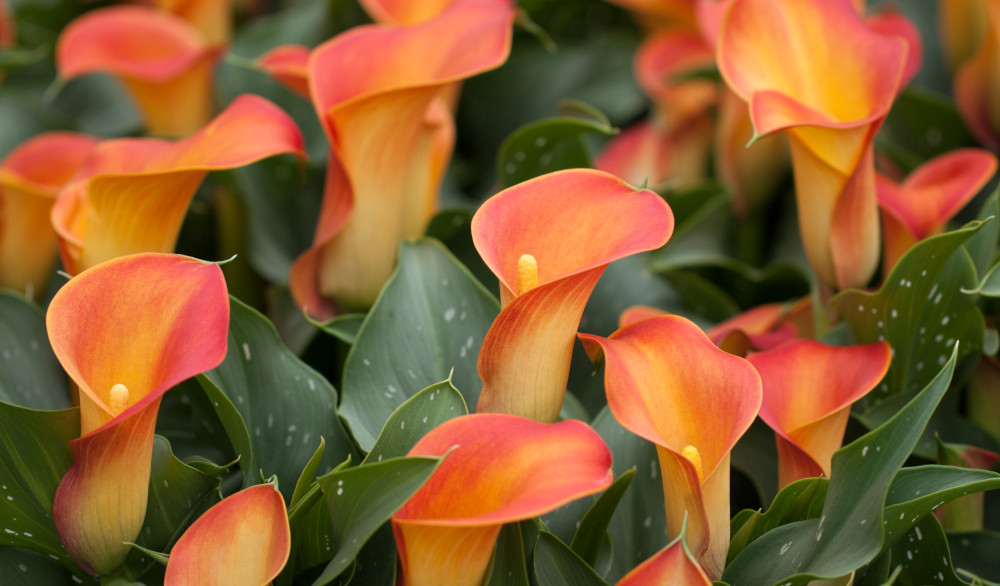
There are two main forms of Zantedeschia: hardy and tender. Hardy forms of the plant can be grown outdoors, enjoy moist soil and full sun or partially shaded conditions - these are known as Arum lilies. Tender forms of Zantedeschia prefer being grown in containers or pots and should be brought inside over the winter - these are known as Calla lilies.
With tuberous flora in all colours from whites, yellows and oranges to deep reds and purples, Zantedeschias are not to be overlooked in any garden, as long as they have sufficient sunlight to grow in.
Ready to learn more about growing Zantedeschia? Read on for all there is to know...
Key Information
Soil pH

Position

Hardiness


Where & when to plant Gentiana
Key Information
Position - Cool, damp, and bright.
In cooler, moister regions, a spot in full sun will be fine. Otherwise, try to find a location that receives shade from the midday sun but sun the rest of the day.
The exception to this is Gentiana asclepiadea (willow gentian), which thrives in partial shade.
Soil - Light, humus-rich (i.e., plenty of leaf mould added over the years), and reliably moist yet well-draining. While there are a few lime-loving species, most prefer a neutral to acidic pH. Check individual descriptions when choosing.
Flowering Period - Can be from spring to autumn
Hardiness - Hardy, usually rated H4 (-5 to -10°C) or H5 (-10 to -15°C)
Gentiana is best planted in autumn or spring. An autumn planting can be done by those gardening in mild conditions (and broadly speaking, this is the southern half of the UK, or coastal or urban locations). For those liable to cold, wet winters, it is best to wait until spring (generally the northern half of the UK, or those with very heavy soil). Planting can also be carried out in summer, though be prepared to water regularly.
There are some small, low-growing species which are suitable for rock gardens and alpine troughs. Others are taller and can be grown at the front of borders.
How to plant Gentiana
- For planting in the garden, dig the soil area removing any large stones and weeds and breaking up any lumps. Now is the time to mix in some organic matter; leaf mould is ideal if you have it, otherwise manure or garden compost.
- Rake level and firm with your heels. Rake level again.
- Water plants well and allow to drain before planting.
- Dig a hole twice the width of the root-ball.
- Place the plant in the hole, ensuring the top of the root ball sits level with the surface of the soil. Too low and the plant may rot, too high and the roots can dry out.
- Backfill with soil and firm in gently.
- Soak well with water.
- Mulch around the base with well-rotted organic matter.
- For planting in a container, first choose an appropriately sized pot. You may wish to grow your gentiana on its own in a pot, or as part of a larger, mixed container display. Either way, ensure there are plenty of drainage holes in the bottom.
- If you are using a large or heavy pot, it can be a good idea to fill and plant it in situ to save yourself the trouble of moving once full.
- Use a good quality potting compost with a generous amount of horticultural grit mixed in (aim for around a third grit) and, if not already present (check the labelling on the bag) some slow-release fertiliser granules.
- Start by partially filling the pot with compost; enough so that when placed on it the upper surface of the root ball is about 3 centimetres lower than the top of the pot.
- Fill around the plant with compost, firming down with your fingers then adding a little more so it is held tight.
- Pick up the container (if you can!) and lightly tap on the potting bench or ground a few times to help further settle the compost around the plant.
- Soak well with water.
- A mulch with horticultural grit will look attractive and help to prevent a ‘cap’ or crust forming on the top of the compost (something container plants can suffer due to the artificial nature of their watering).

What to plant with Gentiana
Gentiana combines well with similarly low-growing drainage lovers – think alpine phlox, creeping thyme, aubrieta, and helianthemum.
Shade loving G. asclepiadea associates beautifully with ferns such as dryopteris and athyrium, and shade-dwelling grasses like luzula and carex.


How to care for Gentiana
Pruning and Deadheading
Gentiana dislikes disturbance, so is best left to its own devices apart for an annual cut back during dormancy. Some species have overwintering rosettes and are classed as semi-evergreen – just cut back spent top growth and leave this basal foliage intact.
Watering
Gentiana enjoys moist conditions and so, when grown in the ground, benefits from a good watering in on planting and then regular soakings until established. After this and providing it is grown in the right conditions with an annual mulch (more on this next), it should need watering only in prolonged periods of hot, dry weather.
Grown in a container, gentiana can be watered freely throughout the growing season (roughly March to September), aiming for consistently moist but not soggy compost. Be aware that in hot weather, containers may need watering more often than you might think (particularly smaller or very full containers). From mid-autumn, the British climate tends to take over watering needs, though do remember to step in in the event of an unseasonably dry spell.
Feeding
On healthy, fertile soil, an annual mulch of well-rotted organic matter (i.e., a layer of leaf mould, manure, or garden compost applied to the soil around the plant) should provide adequate nutrients for your gentiana. This has the added benefit of suppressing weeds and locking in moisture, and is best done in autumn or spring.
For container-grown specimens, try to use a good quality compost with slow-release granules mixed in. This generally provides enough nutrients for six weeks, after which a monthly dose of balanced liquid feed will help maintain a healthy, thriving plant. It is also a good idea to get into the routine of repotting into fresh compost every couple of years, going up slightly in pot size each time. When this is no longer feasible, an annual topdress is advisable. Scrape away the top 5 centimetres of compost and replace with fresh (always containing slow-release feed!).
Cold Protection
When grown in the right spot and in well-draining soil, gentiana should be hardy enough to withstand winter throughout most of the UK without the need for additional protection. In regions where winters are particularly harsh, it can be worth protecting young plants (particularly those rated H4) with a deep, dry winter mulch such as straw, bracken, or bark chips. Mound this over the plant in autumn, then remove in late spring.
Like all plants, those grown in containers can be more vulnerable to the cold. Wrapping pots with hessian or fleece is a useful winter habit to establish. As well as insulating roots, this protects the pot from cracking.
Pests and Diseases
You may find your resident slugs and snails develop a taste for the foliage of gentiana, particularly when it is young and fresh. Encouraging natural predators into your garden, such as birds, frogs, toads, and hedgehogs makes a big difference. Torchlight searches after dark (when slugs and snails are at their most active) are also effective, allowing you to collect the offending molluscs in a bucket and dispose of as you see fit. Relocating to a nearby woods or bagging up and putting in your freezer before popping them in the bin are said to be the most humane approaches.
Gentian rust fungus can also be an issue, appearing as dark brown pustules on the leaves. Cut off and dispose of any affected parts as soon as possible.
How to propagate Gentiana
Straight species (e.g., G. asclepiadea or G. cruciata) can be propagated by seed, which should be collected and sown as soon as it is ripe:
1. Seeds are typically ready for collecting in mid to late summer when they’ve hardened and turned dark in colour.
2. Snip the seedheads from the plant using scissors or secateurs. Try to do this in dry conditions, and shake or separate the seeds into a small, labelled paper bag or envelope.
3. Sow as soon after this as you can. Fill a seed tray or pot with a well-draining compost mix, compressing the surface lightly with a flat piece of wood or the bottom of another pot.
4. Sprinkle the seeds thinly (i.e., spaced apart) over the surface of the compost.
5. Use a garden sieve to cover with a fine layer of compost.
6. Water the compost gently with a fine spray until it is evenly moist but not waterlogged.
7. Place the seed tray or pot in an open coldframe or sheltered outdoor position, such as in the lee of a wall. Keep evenly moist but not soggy.
8. In spring, prick out seedlings and pot into individual 9 centimetre pots. Grow on and plant out as above.
Named cultivars (i.e., those with a commercial-sounding component to their name, such as G. ‘White Magic’, or G. ‘Crystal’) tend not to come true from seed and are best propagated by division instead. Remember that gentiana dislikes disturbance, therefore carefully teasing an outer portion (offset) away from the plant is preferable to lifting and splitting the whole clump. Do this in spring, and replant or pot up as desired. Try not to do this too often; you’ll need to allow a minimum of three or four years for the parent plant to recover each time.
* Many plants carry Plant Breeders Rights and cannot be propagated for commercial purposes.
Common Gentiana Questions
Does gentian have any uses?
Yes, its roots are used as a bitter flavouring in drinks such as Aperol and Angostura bitters.
Are all gentians blue-flowered?
Most species are blue, and these predominate in the Northern hemisphere. A few red-flowered species grow in the Andes, and a handful of white-flowered species grow largely in New Zealand.
