


How to grow Hedera
There are around 22 naturally occurring species of this evergreen climber, with hundreds more cultivated forms. Also known as ivy, hedera is a popular plant for covering walls, buildings, and fences, and is valued for its ability to thrive in almost any situation. Another key attribute is its self-clinging nature, meaning it requires no wires, fixings, or other form of support.
When dealing with hedera it is useful to understand its two distinct growing phases. Initially, there are the juvenile years which see it growing rapidly upwards, clinging on to surfaces using small roots produced along the stems. In this phase its leaves are lobed. After around ten years it reaches adult maturity, in which the growth becomes shrubby, the leaves less lobed, and production of flowers and berries commences. Regular pruning can keep a hedera in its juvenile phase, though it is the adult phase which is most beneficial to wildlife. Choosing the right hedera for the situation is key – size and vigour can vary greatly between species and cultivars, so try to choose one that won’t see you forever hacking it back to fit the space.
There are a few non-climbing cultivars which have been propagated to bypass the juvenile stage and instead form dense, low shrubs. ‘Arborescens’ and ‘Ice Cream’ are two popular examples, offering the benefits to wildlife without needing much space.
A note here on ‘damage’. Hedera is sometimes unfairly maligned for harming buildings and trees. The truth is that by clinging on (rather than penetrating), it is incapable of directly damaging its host. However, loose mortar or paintwork can be dislodged in its removal, and it can make underlying health issue on trees (such as a pest infestation or disease) harder to spot. An already ailing tree is more easily overwhelmed, giving the impression that the hedera has caused its demise.
The wildlife benefits of hedera are so great that most gardeners consider them enough to outweigh these drawbacks. Its dense, evergreen leaves provide a year-round habitat for many species of insects, birds, and small mammals, and its leaves are a vital food source for the caterpillars of various butterflies and moths. The flowers are a valuable source of nectar late in the year when supplies are scarce, and the nutrient-rich berries that follow are feasted on by hungry birds during winter. People benefit too – hedera has been found to keep buildings cool in summer and less damp in the winter, and its leaves trap tiny particulates of air pollution, making the air we breathe cleaner.
Having said all this, there is one situation in which we do advise its removal. Young, newly planted trees are vulnerable to being choked by vigorous hedera growth, so if you see any making a beeline for saplings or newly planted hedges, it’s time to intervene!
Note that all parts of hedera can cause severe discomfort if ingested and contact with its sap can irritate skin.

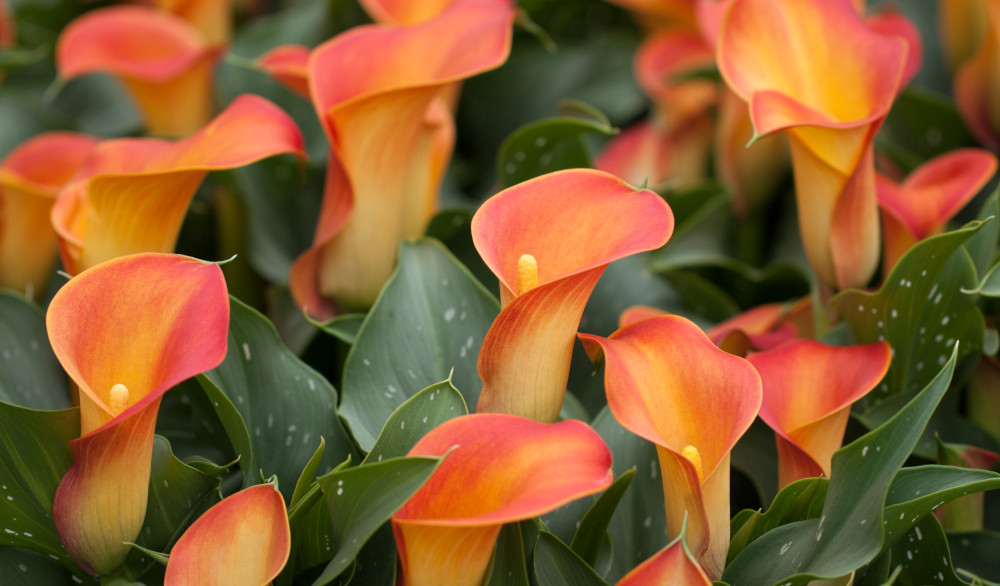
Zantedeschia is a genus of flowering plants from the family Araceae and is native to southern Africa. With a rich history dating back to the Ancient Romans, these deciduous or semi-evergreen perennials have been used as a symbol of celebration. Zantedeschia was Named after Professor Giovanni Zantedeschia, an Italian botanist.
There are two main forms of Zantedeschia: hardy and tender. Hardy forms of the plant can be grown outdoors, enjoy moist soil and full sun or partially shaded conditions - these are known as Arum lilies. Tender forms of Zantedeschia prefer being grown in containers or pots and should be brought inside over the winter - these are known as Calla lilies.
With tuberous flora in all colours from whites, yellows and oranges to deep reds and purples, Zantedeschias are not to be overlooked in any garden, as long as they have sufficient sunlight to grow in.
Ready to learn more about growing Zantedeschia? Read on for all there is to know...
Key Information
Soil pH

Position

Hardiness


Where & when to plant Hedera
Position - Any light level from full sun to full shade. Variegated forms tend to prefer more light.
Soil- Tolerates a range of conditions, though happiest in moderately fertile, humus-rich, moist, well-draining soil.
Flowering Period- Autumn
Hardiness- Hardy, rated H4 (-5 to -10°C) to H6 depending on the species/ cultivar.
Horticultural divisions- A quick rundown of some of the most popular hedera species used in gardens:
Hedera helix (English ivy/ common ivy)
H. colchica (Persian ivy)
H. algeriensis (Algerian ivy)
H. hibernica (Irish ivy)
Hedera is best planted in autumn or spring. An autumn planting can be done by those gardening in mild conditions (and broadly speaking, this is the southern half of the UK). For those liable to cold, wet winters, it is best to wait until spring (generally the northern half of the UK, or those with very heavy soil). Planting can also be carried out in summer, though be prepared to water regularly.
Hedera is one of the most versatile plants there is. It can be used to cover a wall or fence – making an effective backdrop for other planting or brightening a shady corner (particularly variegated forms). Hedera can also be grown as dense, green groundcover (useful in dry shade where little else will grow), or used in hanging baskets and containers. It can even be kept indoors as a houseplant. For containers use compact forms such as ‘Pittsburgh’ or ‘Dyinnii’, or young plants of larger forms (these will want planting in the ground after a couple of years).
Hedera grown indoors will do best in bright indirect to low light (i.e., anywhere but in the full glare of the sun).
How to plant Hedera
· For planting in the garden, dig the soil area removing any large stones and weeds and breaking up any lumps. Rake level and firm with your heels. Rake level again.
· Water plants well and allow to drain before planting.
· Dig a hole twice the width of the root-ball.
· Place the plant in the hole, ensuring the top of the root ball sits level with the surface of the soil. Too low and the plant may rot, too high and the roots can dry out.
· Backfill with soil and firm in gently with your foot.
· Soak well with water.
· Mulch around the base with organic matter.
· Although hedera doesn’t require support or training, if you want it to cover a vertical surface it can be worth tying it to a short cane angled cane to point it in the right direction. Remove tie and cane once it has found its way.
· For planting in a container, first choose an appropriately sized pot. You may wish to grow your hedera on its own (in which case use one just a few centimetres larger than the nursery pot) or spilling out of a mixed container. Always ensure there are plenty of drainage holes in the container.
· Use a good quality loam-based compost (such as John Innes No. 3) with a little horticultural grit mixed in and, if not already present (check the labelling on the bag) some slow-release fertiliser granules.
· Start by partially filling the pot with compost; enough so that when placed on it the upper surface of the root balls is about 3 centimetres lower than the top of the pot.
· Fill around the plant with compost, firming down with your fingers then adding a little more so it is held tight.
· Pick up the container and lightly tap on the potting bench or ground a few times to help further settle the compost around the plant.
· Soak well with water.
· A mulch with horticultural grit will look attractive and help to prevent a ‘cap’ or crust forming on the top of the compost (something container plants can suffer due to the artificial nature of their watering).

What to plant with Hedera
If, like many gardeners, you’ve decided to grow hedera for its ability to thrive in dry shade, other similarly hard-as-nails companions may include liriope, Euphorbia amygdaloides var. robbiae, Japanese anemone, lily of the valley, epimedium, hellebore, and ferns such as dryopteris and polystichum.


How to care for Hedera
Pruning and Deadheading
Hedera is wonderfully straightforward to prune. Simply trim back any excess growth as and when required. Mid-spring is the optimum moment, though it can be done at most other times of the year with no ill effects – just avoid frozen, sub-zero days. We recommend wearing gloves, long sleeves, and trousers when doing so to prevent direct contact with the sap.
Overgrown hedera can be regenerated by cutting it back hard (i.e., to just above ground level). This is best done in early spring.
Some more tips for specific forms:
· Cultivars with variegated, coloured, or unusually shaped leaves can occasionally revert, producing plain green leaves. Simply remove these shoots as you spot them.
· Hedera colchica is less self-clinging than other species, producing fewer roots along its stems. This means it can be blown off its supporting structure more easily in strong winds. Pruning annually to keep it from becoming top heavy is the best mode of defence.
Watering
Soak newly planted hedera a handful of times during its first couple of months in the ground. After this, it is drought tolerant and should be self-sufficient in all but the most prolonged periods of hot, dry weather.
If you are growing hedera in a container, remember it will have less access to moisture and therefore need regular watering throughout the growing season. Water freely during the growing season, scaling back during winter; giving just enough water to keep the compost moist.
Feeding
There is no need to feed hedera grown in the ground, however an annual mulch of well-rotted organic matter (i.e., a layer of leaf mould, manure, or garden compost applied to the soil around the plant) will keep the soil healthy and certainly won’t do the plant any harm.
Container-grown plants are different as they rely solely on the gardener for nutrition. Get off to a flying start by making sure you use a good quality compost with slow-release granules mixed in. These generally provide nutrients for around 6 to 8 weeks, after which a monthly application of balanced liquid feed will keep your hedera in top health. Feed during the growing season only.
Cold Protection
Hedera is hardy enough to withstand an average UK winter without the need for additional protection. Those at the less hardy end of the scale (i.e., with a rating of H4, such as H. helix ‘Overig Bont Besteld’, and ‘Green Ripple’) may be damaged by a hard winter, though will usually recover in spring.
Pests and Diseases
Although it is easy to grow, hedera can be affected by a handful of issues. Things to look out for include aphid, scale insects, and vine weevils (most likely when grown in a container), as well as leaf spot.
Growing healthy, thriving plants is the first line of defence, which means:
- Keeping well-watered until the plant is established
- Practising good garden hygiene, i.e., collecting and removing fallen leaves and detritus from around the plant
- Nourishing the soil with an annual mulch
- Creating a balanced garden ecosystem by avoiding chemicals and encouraging a broad spectrum of wildlife
- Providing sufficient water and nutrients to plants grown in containers
How to propagate Hedera
Hedera can be easily propagated using semi-ripe cuttings in summer. Use adult growth to create non-climbing, shrubby plants, or juvenile growth for climbing or trailing plants:
· Look for current year’s growth which is firm and woody at the base while still flexible at the tip. You’re aiming for a cutting of 10 centimetres or less (any longer and they are more likely to dry out and fail). For best results, choose stems where the leaf nodes are close together rather than far apart.
· Using a sharp knife or secateurs, sever the cutting from the plant and put in a plastic bag straight away to keep it from drying out.
· Fill a pot (or several, if you have a lot of cuttings) with a perlite-heavy compost mix (at least 50% perlite).
· Trim the end of the cutting to just below a node (point at which leaves grow).
· Remove lowest leaves, leaving 2-4 on the cutting.
· If the remaining leaves are large, cut them in half with a sharp knife to reduce water lost through transpiration.
· Insert the cuttings into the compost and water lightly. Several cuttings can be put in the same container if there is enough space to do this without them touching.
· Place in a propagating unit with gentle bottom heat if you have one, or covered with a plastic bag on a windowsill if not (out of direct sunlight).
· Keep the cuttings misted and occasionally watered until they root. You will know this has happened when roots emerge out of the bottom of the container.
· Gently remove rooted cuttings and pot them into individual pots. Grow on in a cool yet frost-free environment such as an unheated conservatory, greenhouse, or cold frame, until they are large enough to be planted out as above.
* Many plants carry Plant Breeders Rights and cannot be propagated for commercial purposes.
Common Hedera Questions
· What plant family is hedera in?
Hedera belongs to Araliaceae (the gingseng family), along with other garden favourites fatsia and tetrapanax.
· Is hedera related to poison ivy?
No. Poison ivy (Toxicodendron radicans) is a completely different plant belonging to the sumac family (Anacardiaceae).
· What is the best way to remove unwanted hedera?
Cut through the base of the main stem and wait for the plant to die off naturally. It should then come away from whatever it has been clinging to more easily, though there will inevitably be some stem roots remaining. Brush these off with a stiff brush.
Note that weedkiller tends to be ineffective on hedera due to its glossy, impenetrable leaves. Don’t waste your time and effort attempting this method!
