


How to grow Helianthus
Better known as sunflowers, helianthus hail from North and Central America, Chile, and Peru. Though most of us will probably think of the traditional tall, single-stemmed, yellow-flowered variety, there are actually around 80 different species (and many more cultivated forms), and far more to this genus than you may think. Available also in shades of red, rusty brown, and creamy lemon, sunflowers can be dwarf, giant, and every height in between, and either single-stemmed or branching. Some are annual (i.e., live for just one growing season), while others are perennial and will come back year after year. Helianthus annuus is the most widely grown annual, of which there are many hundreds of cultivars. Perennial species are less well-known in the UK, though those with good garden value include H. salicifolius (willow-leaved sunflower), H. decapetalus (thin-leaved sunflower), H. pauciflorus, H. x laetiflorus, and H. tuberosus (the edible crop, Jerusalem artichoke).
Sunflowers are fun and easy to grow, and offer bold, colourful, long-lasting flowers. A quick germination and growth rate mean the annual forms are popular for growing with children, though gardeners of all ages enjoy these cheerful, dependable plants.

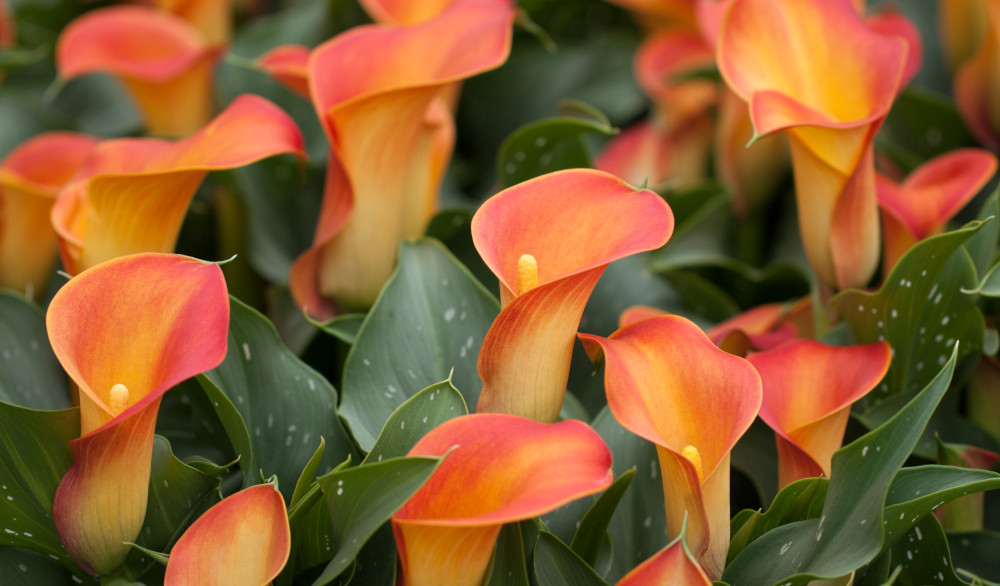
Zantedeschia is a genus of flowering plants from the family Araceae and is native to southern Africa. With a rich history dating back to the Ancient Romans, these deciduous or semi-evergreen perennials have been used as a symbol of celebration. Zantedeschia was Named after Professor Giovanni Zantedeschia, an Italian botanist.
There are two main forms of Zantedeschia: hardy and tender. Hardy forms of the plant can be grown outdoors, enjoy moist soil and full sun or partially shaded conditions - these are known as Arum lilies. Tender forms of Zantedeschia prefer being grown in containers or pots and should be brought inside over the winter - these are known as Calla lilies.
With tuberous flora in all colours from whites, yellows and oranges to deep reds and purples, Zantedeschias are not to be overlooked in any garden, as long as they have sufficient sunlight to grow in.
Ready to learn more about growing Zantedeschia? Read on for all there is to know...
Key Information
Soil pH

Position

Hardiness


Where & when to plant Helianthus
Position - Full sun (the clue’s in the name!). Most types of sunflower will produce weak, lopsided growth in the shade as they search for the light, though a handful have been found to be more tolerant. These include the annual cultivars ‘Buttercream’, ‘Sonja’, and ‘Garden Statement’.
Soil - Moderately fertile, humus-rich, moist but well-draining soil.
Flowering Period - Summer to autumn
Hardiness - Hardy, though annual species are vulnerable to the cold when young.
When growing your own annual sunflowers from seed, you have two options when it comes to timing. Either sow directly in the ground in April/ May, or get them going earlier (i.e., February/ March) in pots. Keep these somewhere bright and warm for a couple of months, then plant out once risk of frost has passed (this varies from region to region though tends to be around late May). The benefit to giving your sunflowers this head start is that by the time they go outdoors they are tough enough to stand up to slugs and snails (it’s the fresh, tender new shoots which are the real delicacy for these garden molluscs). Another plus, of course, is that being further ahead in growth, they will flower earlier in the season.
If you’ve ordered sunflowers from us, we’ll have taken care of the headstart and will send them out as garden-ready plants from late spring onwards. We recommend that those in 4 centimetre format be potted up and grown on for a few weeks. Those already in 9 centimetre pots can be planted out straight away.
In terms of choosing a location, go for a sunny, sheltered spot (less wind equals straighter stems and less chance of late season flopping). The height of your variety will determine the best position; tall types do best at the back of a border or against a wall or fence, while smaller, dwarf forms can be woven through the front of a border or grown in a container.
Perennial sunflowers are best planted in autumn or spring. An autumn planting can be done by those gardening in mild conditions (and broadly speaking, this is the southern half of the UK, or coastal or urban locations). For those liable to cold, wet winters, it is best to wait until spring (generally the northern half of the UK, or those with very heavy soil). Planting can also be carried out in summer, though be prepared to water regularly.
This type of sunflower tends to form sizeable, branching clumps and be of medium height. They are suitable for herbaceous borders, and go particularly well in naturalistic, prairie-style schemes or wild gardens.
How to plant Helianthus
- For planting in the garden, dig the soil area removing any large stones and weeds and breaking up any lumps. Sunflowers enjoy rich soil, so now is the time to dig in some well-rotted organic matter such as manure or garden compost.
- Rake level and firm with your heels. Rake level again.
- Water plants well and allow to drain before planting.
- Dig a hole twice the width of the root-ball.
- Place the plant in the hole, ensuring the top of the root ball sits level with the surface of the soil. Too low and the plant may rot, too high and the roots can dry out.
- Backfill with soil and firm in gently.
- Soak well with water.
- Mulch around the base with well-rotted organic matter.
- For planting in a container (remember, dwarf forms are best for this), first choose an appropriately sized pot. You may wish to grow your sunflower on its own in a pot, or as part of a larger, mixed container display. Either way, ensure the pot is deep enough to provide sufficient anchorage, and that there are plenty of drainage holes in the bottom.
- If you are using a large or heavy pot, it can be a good idea to fill and plant it in situ to save yourself the trouble of moving once full.
- Use a good quality potting compost with some horticultural grit mixed in for drainage and, if not already present (check the labelling on the bag) some slow-release fertiliser granules.
- Start by partially filling the pot with compost; enough so that when placed on it the upper surface of the root ball is about 3 centimetres lower than the top of the pot.
- Fill around the plant with compost, firming down with your fingers then adding a little more so it is held tight.
- Pick up the container (if you can!) and lightly tap on the potting bench or ground a few times to help further settle the compost around the plant.
- Soak well with water.
- A mulch with horticultural grit will look attractive and help to prevent a ‘cap’ or crust forming on the top of the compost (something container plants can suffer due to the artificial nature of their watering).
Note that single-stemmed annuals are likely to need cane support as they get bigger, particularly tall varieties. Choose a tall, strong, straight cane, push deeply into the soil a few centimetres away from the stem, and tie the two together. When tying, remember the stem will thicken considerably over the growing season, so leave sufficient slack to allow for this.

What to plant with Helianthus
Annual sunflowers go well with almost anything, though it’s hard to beat seeing them alongside fellow cottage garden classics such as zinnias, dahlias, cosmos, nicotiana, and phlox. The added bonus of using short to medium companions such as these is that they cover the less attractive lower parts of the sunflowers.
Perennial species look most at home with ornamental grasses and similarly naturalistic flowering perennials. Think stipa, pennisetum, and miscanthus for the grasses, and perennials such as verbena, echinacea, veronicastrum, salvia, stachys, knautia, and echinops.


How to care for Helianthus
Pruning and Deadheading
Annual sunflowers produce masses of seeds that are feasted on by birds – in particular, finches – during the winter months. Leave faded flowerheads intact for as long as possible, then once the birds have had their fill, pull the whole plant out and put on the compost heap. Remember to chop the thick stems up to help them break down in the compost.
If you can’t bear the untidiness of dead annuals remaining into winter, an alternative is to cut off the seedheads and use string or wire to hang them around the garden as bird feeders.
Perennial species produce far fewer seeds and therefore hold less value to birds through the winter. Having said this, their stems provide a habitat for overwintering insects, so still delay cutting back until spring if you can. Chop the whole lot back to just above the base, just before new shoots emerge in in mid spring.
Watering
Although annual sunflowers will tolerate dry conditions, they need plenty of water to reach full potential (especially the very tall types). Give a good soak on initial planting, and then in any prolonged periods of dry weather following this. To avoid overdoing it, water only once the top few centimetres of soil have dried out.
Perennial species should be watered as above as they establish during their first growing season in the ground. From year two onwards, they may be considered self-sufficient and left to their own devices.
Sunflowers in containers should be kept regularly watered when in growth. Again, allowing the top few centimetres of compost to dry out is a good rule of thumb to prevent overwatering, though be aware that this can happen quickly during the height of summer and during very hot spells you may find yourself watering as often as every day.
Feeding
On healthy, fertile soil, a mulch of well-rotted organic matter (i.e., a layer of manure or garden compost applied to the soil around the plant) should provide adequate nutrients for your sunflower. This has the added benefit of suppressing weeds and locking in moisture, and is best done immediately after planting (then again each autumn or spring for perennial species). That said, if you are growing your sunflowers for height, a fortnightly dose of balanced liquid feed will help deliver the most impressive results.
This advice also goes for those grown in containers (whether you’re trying to grow giants or not!). These have less access to nutrients and so benefit from being fed fortnightly throughout the growing season.
Cold Protection
While sunflowers are hardy, like many plants they can be damaged by frost when very young. This means annual species are best planted out once all risk of frost has passed in your area.
Pests and Diseases
You may find slugs are partial to the foliage of your sunflowers, particularly when it is young and fresh. Encouraging natural predators into your garden, such as birds, frogs, toads, and hedgehogs makes a big difference. Torchlight searches after dark (when slugs and snails are at their most active) are also effective, allowing you to collect the offending molluscs in a bucket and dispose of as you see fit. Relocating to a nearby woods or bagging up and putting in your freezer before popping them in the bin are said to be the most humane approaches.
Powdery mildew can also be an issue. This appears as a white, powder-like coating on foliage and is generally a sign that a plant is stressed. Causes can include poor airflow (i.e., too closely planted to others), an excess of nutrients, or insufficient sunlight or water.
Prune off and dispose of any affected leaves and if necessary, thin out surrounding plants to improve airflow and light levels. Soak well with water if the soil is dry, locking this in with a layer of mulch if you have it to hand.
How to propagate Helianthus
Annual sunflowers may be propagated by seed collected when ripe then sown the following spring. It is important to note, however, that named cultivars hybridise freely and are unlikely to come true to the parent plant. If you wish to grow the same form again, it is best to buy fresh seed each year.
1. Seeds are typically ready for collecting in mid to late summer when they’ve turned hard and black. Rub them off the seedhead and into a paper bag.
2. Spread the seeds out to dry for a few days on some kitchen roll, then store in a labelled paper bag somewhere cool and dry until it is time to sow the following spring.
3. In Feb/ Mar, fill several 9 centimetre pots with a well-draining compost mix.
4. Push two seeds per pot into the compost – not too far down, a centimetre or two is ideal.
5. Top with a little more compost to fill the gap, then tap the pot lightly on the potting bench or table to settle it.
6. Water gently with a fine spray until it is evenly moist but not waterlogged.
7. Place the seed tray or pots in a heated propagation unit if you have one (set at 16°C), or cover pots with clingfilm if not. Position in indirect light.
8. As soon as the seeds begin to germinate, take out of the propagation unit or remove the clingfilm.
9. When the seedlings have grown large enough to handle, remove the weakest one from each pot. Continue to grow the remaining one on in a warm, bright environment.
10. Keep just moist, never soggy.
11. Plant out once all risk of frost has passed, following our ‘How to plant helianthus’ section above. Gradually acclimatise seedlings to outdoor temperatures over a few days prior to planting out.
Alternatively, sow directly into the ground in April/ May.
The quickest way to propagate perennial species is by dividing in autumn or spring. As well as providing new plants, it is an effective way of breathing new vigour into clumps and is recommended as a routine maintenance practice every three to four years. Try not to do it more frequently than this, as plants need time to re-establish:
1. Choose a day when the soil is not frozen or waterlogged.
2. Dig the plant out of the ground and shake off any excess soil.
3. Separate into sections using either swift, cutting blows with a sharp spade, or two forks inserted back-to-back with tines touching, handles then pushed together to prise the plant apart.
4. Discard old, damaged, or surplus pieces, keeping healthy, vigorous material with roots attached.
5. Replant decent-sized pieces where desired, and any smaller bits can be potted up.
6. Water well until fully established.
* Many plants carry Plant Breeders Rights and cannot be propagated for commercial purposes.
Common Helianthus Questions
My sunflower hasn’t reached its promised height, why not?
These are potential rather than guaranteed heights, and dependent on a few variables. Keeping your sunflowers watered, fed, sheltered from wind, and free of weeds (they dislike close competition) will boost the chance of them reaching the greatest height possible.
Can you harvest sunflower seeds for eating and cooking?
You can, though bear in mind they will need to be removed from their tough seed coat first. One of the most effective ways to do this is to place the seeds in a polythene bag, bash with a rolling pin until they have all split open, then empty the lot into a bowl or pan of water. The shells should float to the surface and can be removed with a slotted spoon. The seeds will remain at the bottom of the water; extract by pouring into a sieve, then spread over kitchen paper to dry out.
Do sunflowers turn throughout the day to follow the sun?
When young, yes. Once mature they tend to stay in one position.
