


How to grow Impatiens
There are two main types of impatiens widely available to UK gardeners. Impatiens walleriana is better known as busy lizzie, a popular and traditional summer bedding plant. For a couple of decades, this species largely disappeared from nurseries and garden centres due to a problem with downy mildew, though in the last few years the emergence of disease resistant forms has seen it becoming widely available once again. Busy lizzies are valued for their long, prolific flowering period and ability to bring bright, bold colour to shady spots. Though not technically annuals, these tender plants do not overwinter well and are typically discarded at the end of each growing season.
I. hawkeri is an altogether larger, chunkier plant known as the New Guinea Group. It is equally as tender, though does overwinter well indoors and can be kept for several years. It can be grown as a permanent houseplant or temporarily moved outside as part of a summer bedding display. Like I. walleriana it is happy in partial shade, though will also grow in full sun.
There is also a small handful of hardy species, though these are less well-known and much less easy to come by. This growing guide will therefore focus on the tender busy lizzie and New Guinea Group types.

Zantedeschia is a genus of flowering plants from the family Araceae and is native to southern Africa. With a rich history dating back to the Ancient Romans, these deciduous or semi-evergreen perennials have been used as a symbol of celebration. Zantedeschia was Named after Professor Giovanni Zantedeschia, an Italian botanist.
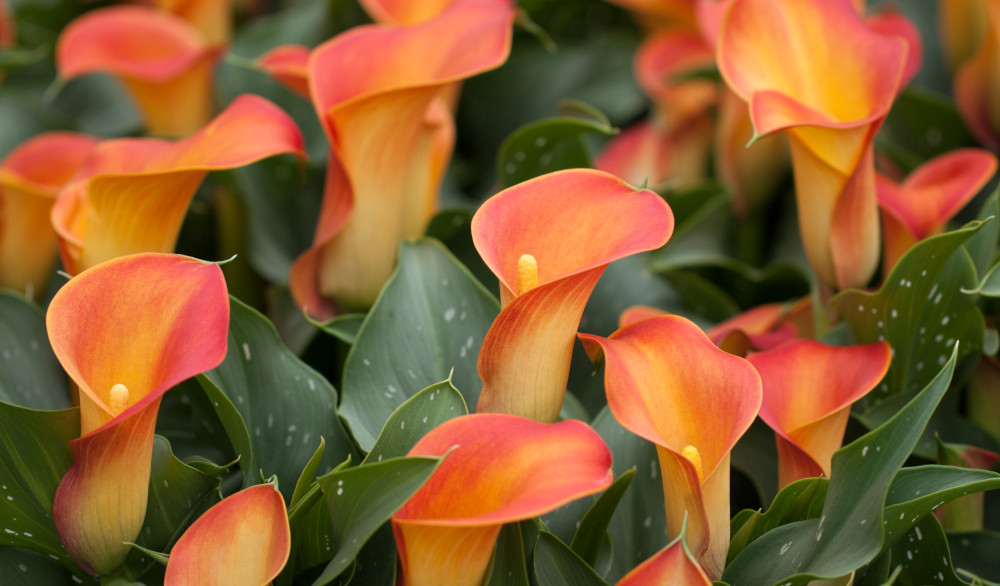
There are two main forms of Zantedeschia: hardy and tender. Hardy forms of the plant can be grown outdoors, enjoy moist soil and full sun or partially shaded conditions - these are known as Arum lilies. Tender forms of Zantedeschia prefer being grown in containers or pots and should be brought inside over the winter - these are known as Calla lilies.
With tuberous flora in all colours from whites, yellows and oranges to deep reds and purples, Zantedeschias are not to be overlooked in any garden, as long as they have sufficient sunlight to grow in.
Ready to learn more about growing Zantedeschia? Read on for all there is to know...
Key Information
Soil pH

Position

Hardiness


Where & when to plant Impatiens
Position - Outdoors: a partially shaded, sheltered spot (impatiens have brittle, fleshy stems which are easily damaged in strong wind). New Guinea group impatiens will also tolerate full sun.
Indoors: bright filtered light and plenty of humidity.
Soil- Open ground humus-rich, moist, well-draining.
Container: any good quality potting compost
Flowering Period- Summer and autumn (often up until the first frosts)
Hardiness- Tender, rated H2 (1 to 5°C)
Impatiens hails from warmer climes than ours and can only survive outside in the UK once all risk of frost has passed. This varies from region to region, though tends to be mid to late May. If your plants arrive before it is safe to go outdoors, keep them in a bright, frost-free environment until the time is right. A greenhouse, conservatory, cold frame, or sunny porch or windowsill are all ideal. Just make sure you don’t let them dry out. Small plug plants are best potted up if they’re going to spend time in a ‘holding zone’ such as this – either into 9 centimetre pots, or if you have room, straight into their eventual display container/ hanging basket/ window box.
Another important thing to note with tender plants like impatiens is the need to gradually harden them off, rather than suddenly move them outside. This slow toughening up reduces the chances of them going into ‘shock’, which can severely check growth.
The easiest way to do this is by using a cold frame opened in gradual increments over the course of a week or two. Keep the lid closed at night until the last couple of days of the hardening off period.
If you don’t have a cold frame, a bit of horticultural fleece combined with a spot of ‘musical pots’ works just as well. A couple of weeks before you anticipate planting your impatiens out, wrap the plants in a couple of layers of fleece and place outside during the day (moving back into a warm, protected environment at night). Do this for a few days then reduce the fleece to one layer. After a few more days like this, remove the fleece completely. If it’s warm enough you can leave outside at night too, though reapply the fleece for this. Towards the end of the hardening off period, leave your plants outside completely uncovered for a couple of days and nights before planting out as below. It’s a bit arduous, but worth the effort to ensure your summer display hits the ground running.
When it comes to choosing a spot, impatiens is one of the top choices for a summer bedding display in a shady spot. You could also plant it in the open ground, perhaps to spill over the edge of a dimly lit wall or raised bed. Impatiens grown as a permanent houseplant (remember, New Guinea Group types are best for this) will need plenty of brightness, though no direct light during the summer months.
How to plant Impatiens
- For planting in a container, space multiple plants 15 to 30 centimetres apart depending on the size of the variety. Alternatively grow in individual containers with a diameter similar to the expected eventual size.
- Use a good quality potting compost with plenty of horticultural grit mixed in and, if not already present (check the labelling on the bag) some slow-release fertiliser granules.
- Start by partially filling the pot with compost; enough so that when placed on it the upper surface of the root balls are about 3 centimetres lower than the top of the pot.
- Fill around the plants with compost, firming down with your fingers then adding a little more so they are held tight.
- Pick up the container (if you can!) and lightly tap on the potting bench or ground a few times to help further settle the compost around the plant.
- Soak well with water.
- A mulch with horticultural grit will look attractive and help to prevent a ‘cap’ or crust forming on the top of the compost (something container plants can suffer due to the artificial nature of their watering).
· For planting in the garden, dig the soil area removing any large stones and weeds and breaking up any lumps. Now is your chance to improve the soil by mixing in some organic matter such as manure or garden compost. Rake level and firm with your heels. Rake level again.
· Water plants well and allow to drain before planting.
· Dig a hole twice the width of the root-ball.
· Place the plant in the hole, ensuring the top of the root ball sits level with the surface of the soil. Too low and the plant may rot, too high and the roots can dry out.
· Backfill with soil and firm in gently.
· Soak well with water.
· Mulching is not essential, though will help lock water into the soil and minimise the need for watering later in the season.

What to plant with Impatiens
For a thriving, professional-looking display, combine with other shade tolerant bedding plants, such as foxglove, begonia, fuchsia, lobelia, and aquilegia.


How to care for Impatiens
Pruning and Deadheading
Regularly deadheading impatiens (once or twice a week) helps prevent the formation of grey mould, while also encouraging more blooms. Trim back any straggly shoots to maintain a pleasing, bushy shape.
If treating your impatiens as an annual, simply remove to the compost heap at the end of the growing season. To overwinter a New Guinea Group impatiens, cut back by a third as you move it indoors for winter (more on this in ‘Cold Protection’). Give another light tidy in spring, removing any tatty or dead foliage.
Watering
Impatiens enjoys consistent moisture levels, though it is important not to over or under water it. Overwatering will cause rot, while underwatering can result in dramatic and sudden wilting.
To avoid problems, water whenever the top 2-3 centimetres of compost or soil feel dry. Always soak thoroughly rather just wetting the top.
A saucer placed underneath the container can be a great help in maintaining moisture in the compost, though even with this in place be aware that watering can be needed as often as once a day when conditions are hot (sometimes more if the container is very small or full).
In the ground, a generous layer of mulch on planting is an effective way of locking water in the soil (see next section).
Impatiens grown indoors as houseplants enjoy a humid environment. Humidity is best achieved by locating the plant in a room which gets steamy, such as a bathroom or kitchen. Other ways include grouping several plants together, keeping your plant on a saucer filled with pebbles and water, or regular blasts from a good old-fashioned spray bottle.
Feeding
To get the most out of hungry summer bedding plants such as impatiens, regular feeding is a must – particularly when grown in a container.
In a container, use a good quality compost with slow-release fertiliser granules mixed in. These generally provide enough nutrients for around 6 weeks, after which a monthly liquid feed can make a big difference to performance. Go for one high in potassium (such as tomato food) to encourage maximum flowering.
In the open ground, mulch newly planted impatiens with a decent layer of well-rotted organic matter, i.e., manure or garden compost applied to the soil around the plant. As well as boosting the nutrient content of the soil, this has the added benefit of suppressing weeds and locking in moisture. After this, you can either leave the plant to its own devices (fine on healthy, fertile soil), or apply a high potassium liquid feed as described above (beneficial on poor or sandy soil).
Cold Protection
Busy lizzie types don’t overwinter well and are best discarded at the end of the growing season.
New Guinea Group types can spend the winter indoors to be used again the following year. Simply cut the plant back by around a third when temperatures drop below 13°C (usually September/ October), water, then move into a warm, bright, frost-free environment such as a heated greenhouse or well-lit windowsill. Check now and again, watering just enough to prevent the compost drying out completely. In spring, repot into a slightly larger container, tidy any tatty leaves, and give a good soak to trigger a return to growth. Harden off and move outside as above.
Another option is to take cuttings and grow your own replacement plants. See ‘Propagation’ for how to do this.
Pests and Diseases
The older, legacy cultivars of busy lizzie are vulnerable to downy mildew, however these days you will usually only find the newer, resistant forms for sale (certainly that’s all we stock at Hayloft). New Guinea Group types are naturally immune to the fungal disease.
Grey mould (botrytis) can affect the flower buds of all impatiens, particularly if conditions are too damp. Deadhead regularly to improve airflow through the plant, and try to avoid overwatering.
Otherwise, impatiens are relatively trouble-free when grown outdoors. Indoors, the usual issues of spider mite, aphid, whitefly, and mealybug can crop up. Keeping plants as healthy as possible is the key to warding off problems, and by this we mean proper ventilation, adequately spaced plants (for good air flow), keeping everything well-watered and fed, and repotting into larger containers when necessary. Thoroughly cleaning the indoor environment every winter can also help to remove overwintering populations of pests.
Where infestations do take hold, try introducing biological controls (often sachets or tubes containing miniscule natural predators), or in the worst cases, remove the affected plant/s altogether.
How to propagate Impatiens
Busy lizzies can be propagated by seed, though their need for a lengthy spell in a heated and well-lit growing environment means it is usually more practical and cost effective to buy young plants.
New Guinea Group types can be propagated more easily using softwood cuttings in spring or early summer:
1. In the morning (plants are more turgid at this time and less likely to wilt during the process), take 10 centimetre cuttings from the soft tips of new, non-flowering shoots. Snip off just above a bud using sharp, clean secateurs.
2. Place in a clean plastic bag in which to transport the cuttings back to a potting bench or garden table.
3. Fill a container with a well-draining compost mix.
4. Trim the end of the cutting to just below a node (point at which leaves grow), and snip off the soft tip as well.
5. Remove the lowest third of the leaves.
6. Insert the cuttings into the compost and water lightly. Several cuttings can be put in the same container if there is enough space to do this without them touching.
7. Place in a propagating unit with bottom heat if you have one, or covered with a plastic bag on a warm windowsill if not (out of direct sunlight). If using a plastic bag, remove it a couple of times a week for around ten minutes. This will ensure the cuttings remain well-ventilated and don’t rot.
8. Keep the cuttings misted and occasionally watered until they root. You will know this has happened when roots emerge out of the bottom of the container.
9. Gently remove rooted cuttings and pot them into individual pots. Grow on in a protected environment such as a conservatory, greenhouse, or that windowsill again, before potting up or planting out as above.
* Many plants carry Plant Breeders Rights and cannot be propagated for commercial purposes.
Common Impatiens Questions
· How much sun does impatiens require?
As a general rule, impatiens prefers partial shade. This means between three and six hours of sunlight per day in midsummer (ideally morning and/ or evening rather than the hotter, midday sun). You may also see this referred to as semi-shade, or part sun part shade.
New Guinea Group types will also grow in full sun.
· How do you keep impatiens blooming?
Impatiens is a naturally floriferous plant and, with regular deadheading, should continue to produce flowers for many months. If you are finding yours lacking in this department, the problem is likely to be one of three things. Firstly, think about how much light your plant receives. Impatiens is often chosen for its ability to thrive in a shady spot, however it does still need some light and does not perform well in total shade. Secondly, is it hungry? It takes energy to power the impressive flowering impatiens is known for, and it is the gardener’s job to provide adequate nutrients. See our ‘Feeding’ advice above. Thirdly, have you got the watering right? There’s a fine line to tread between too much and not enough, both of which can affect flowering. Again, follow our ‘Watering’ advice above to strike the perfect balance.
