


How to grow Lobularia
Also known as Sweet Alyssum (or Sweet Alison in the US), lobularia is a member of the mustard family which forms low, slightly spreading mounds. Of the five different species, Lobularia maritima is the most widely cultivated, and a popular garden plant around the world. Hailing from the Canary Islands and the Mediterranean, it is usually grown as annual bedding in the UK though in milder regions may be a short-lived perennial. Lobularia is valued for its masses of white, scented flowers held in compact, rounded clusters, often in such profusion that the leaves are barely visible. There are also cultivated forms available in shades of pink and purple.
Lobularia is pretty, dainty, and needs little attention once established. It also self-seeds well, meaning that planted once it should keep you in ready supply year after year (note that the offspring of pink or purple forms usually revert to white).
Despite its common name, Lobularia is not to be confused with Alyssum. Though related (and indeed, formerly grouped together), the two are distinct genera, having been separated over two centuries ago. As a general rule, alyssum is a taller plant and includes yellow-flowering species.

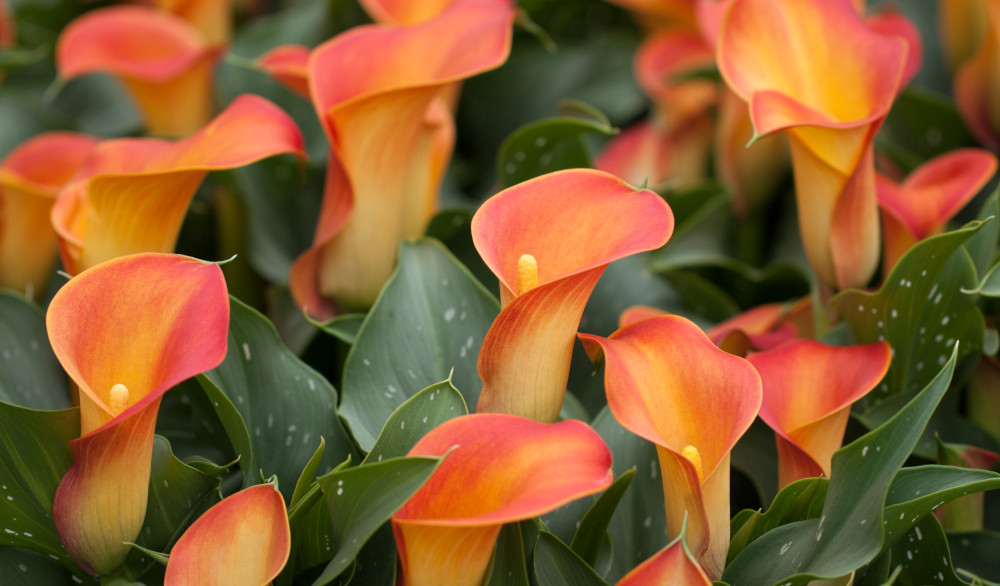
Zantedeschia is a genus of flowering plants from the family Araceae and is native to southern Africa. With a rich history dating back to the Ancient Romans, these deciduous or semi-evergreen perennials have been used as a symbol of celebration. Zantedeschia was Named after Professor Giovanni Zantedeschia, an Italian botanist.
There are two main forms of Zantedeschia: hardy and tender. Hardy forms of the plant can be grown outdoors, enjoy moist soil and full sun or partially shaded conditions - these are known as Arum lilies. Tender forms of Zantedeschia prefer being grown in containers or pots and should be brought inside over the winter - these are known as Calla lilies.
With tuberous flora in all colours from whites, yellows and oranges to deep reds and purples, Zantedeschias are not to be overlooked in any garden, as long as they have sufficient sunlight to grow in.
Ready to learn more about growing Zantedeschia? Read on for all there is to know...
Key Information
Soil pH

Position

Hardiness


Where & when to plant Lobularia
Position - Full sun is best, though light shade will be tolerated.
Soil - Will grow in any reasonable garden soil that doesn’t become waterlogged. At home in coastal conditions, i.e., sandy or rocky soil.
Flowering Period - Summer to early autumn. Typically at least three months solid blooming.
Hardiness - Usually half-hardy (H3, i.e., minimum temperature of 1 to -5°C)
Lobularia comes from warmer climes than ours and should only go outside in the UK once risk of a hard frost has passed. This varies from region to region, though tends to be mid to late May. If your plants arrive before it is safe to go outdoors, keep in a bright, frost-free environment until the time is right. A greenhouse, conservatory, coldframe, or sunny porch or windowsill are all ideal. Just make sure you don’t let them dry out! Small plug plants are best potted up into 9 centimetre pots if they’re going to spend time in a ‘holding zone’ such as this. Harden your lobularia off for a few days before you plant them out for good. This means leaving them outside during the day and returning to the indoor environment at night.
When it comes to choosing a spot, lobularia is ideal for a summer container display, hanging basket, or window box, where it can be used either as a standalone plant or spilling out from amongst other bedding plants. It can also be grown in the open ground, perhaps cascading over the edge of a wall or raised bed, edging a path or border, or filling cracks and crevices in paving and walls. Another popular use for lobularia is as a companion plant for fruit and vegetables, as it draws in large quantities of pollinators and other beneficial insects.
How to plant Lobularia
· For planting in the garden, dig the soil area removing any large stones and weeds and breaking up any lumps. If your soil is poor, now is a good chance to improve it by mixing in organic matter such as manure or garden compost. Rake level and firm with your heels. Rake level again.
· Water plants well and allow to drain before planting.
· Dig a hole twice the width of the root-ball.
· Place the plant in the hole, ensuring the top of the root ball sits level with the surface of the soil. Too low and the plant may rot, too high and the roots can dry out.
· Backfill with soil and firm in gently.
· Soak well with water.
- For planting in a container, first choose an appropriately sized pot or hanging basket, ensuring there is plenty of drainage.
- If you are using a large or heavy pot, it can be a good idea to fill and plant it in situ to save yourself the trouble of moving once full.
- Use a good quality potting compost with a little horticultural grit mixed in and, if not already present (check the labelling on the bag) some slow-release fertiliser granules.
- Start by partially filling the pot with compost; enough so that when placed on it the upper surface of the root ball is about 3 centimetres lower than the top of the pot.
- Fill around the plant with compost, firming down with your fingers then adding a little more so it is held tight.
- Pick up the container and lightly tap on the potting bench or ground a few times to help further settle the compost around the plant.
- Soak well with water.
- A mulch with horticultural grit will look attractive and help to prevent a ‘cap’ or crust forming on the top of the compost (something container plants can suffer due to the artificial nature of their watering).

What to plant with Lobularia
For a generous, vibrant summer container display, pair lobularia with other patio favourites such as begonia, diascia, nemesia, calibrachoa, fuchsia, and petunia.
In the ground, you might like to team lobularia up with other keen self-seeders such as Verbena bonariensis, aquilegia, Erigeron karvinskianus, Stipa tenuissima, Alchemilla mollis, digitalis, and eryngium. Plant this gang once and, provided they’re happy with the conditions, they will do the rest. A garden bursting with life from every nook and cranny awaits!


How to care for Lobularia
Pruning and Deadheading
Though not essential, a light shearing after the first flush of flowers can enhance further blooming.
In mild regions, it can be worth cutting lobularia back the end of the growing season and leaving in the ground to see if they will regrow the following spring. Otherwise, remove the faded, dry plants to the compost heap.
Watering
In the open ground, lobularia should be given a good soaking on planting, then a handful of times after this over the coming few weeks. Once established it should be largely self-sufficient, needing watering only in prolonged periods of hot, dry weather.
Container-grown lobularia will need watering regularly. A good rule of thumb to avoid overdoing it is to water only once the top few centimetres of compost have dried out. Be aware, however, that in the height of summer this can happen in as little as 24 hours – particularly for small or very full containers.
Feeding
On healthy, fertile soil, an annual mulch of well-rotted organic matter should provide sufficient nourishment for your lobularia (manure or garden compost are ideal). As well as boosting the nutrient content of the soil, mulch has the added benefits of locking in moisture and suppressing weeds. This last point is important, as it can be tricky to weed through lobularia once it has grown into a thick, flowering mat.
In a container, try to use a good quality compost with slow-release granules mixed in. This generally provides enough nutrients for six weeks, after which a fortnightly dose of balanced liquid feed will help maximise performance.
Cold Protection
Unless grown in a frost-free microclimate (perhaps in a coastal or urban location, or with the protection of a sunny, south-facing wall), lobularia tends not to survive a UK winter outdoors and is usually confined to the compost heap once flowering finishes in mid to late autumn.
While technically a perennial and possible to overwinter with protection, better results tend to come from starting afresh with new plants each spring. These are widely available to buy or can be propagated at home (see ‘Propagation’ section below).
Pests and Diseases
Downy mildew can be an issue on lobularia, identifiable by discoloured blotches on the upper side of the leaf with corresponding patches of mould underneath. This fungal disease usually strikes plants which are stressed through inadequate water or poor airflow. As soon as you spot the problem, prune off and dispose of affected leaves, give the plant a good soak, and thin out neighbouring plants to improve air circulation. In severe cases, it can be best to remove the entire plant.
Slugs can be another problem, particularly when growth is young and fresh. Encouraging natural predators into your garden, such as birds, frogs, toads, and hedgehogs makes a big difference. Torchlight searches after dark (when slugs and snails are at their most active) are also effective, allowing you to collect the offending molluscs in a bucket and dispose of as you see fit. Relocating to a nearby woods or bagging up and putting in your freezer before popping them in the bin are said to be the most humane approaches.
How to propagate Lobularia
Such is its propensity to self-seed that the best way of attaining new plants for your garden is usually to do nothing! Leave flowers intact until the end of the growing season so they have chance to produce and drop seed, and take care not to weed any ensuing offspring out that autumn or spring.
If you do wish to propagate manually, you can collect and store seed as follows:
1. Seeds are typically ready for collecting towards the end of the flowering period when the flowers have browned and dried.
2. Snip from the plant using scissors or secateurs. Try to do this in dry conditions, catching in a small, labelled paper bag or envelope held underneath. Store somewhere cool and dry until it is time to sow the following spring.
3. For UK gardeners to get the most out of lobularia, it pays to get a head start by sowing under cover in early spring (rather than waiting until it is warm enough to sow direct).
4. In March, fill a module tray with a well-draining compost mix. Tap lightly to settle the compost and remove any air pockets. Top up with more compost if needed.
5. Sprinkle a small pinch of two or three seeds in each module.
6. Use a garden sieve to cover with a fine layer of compost.
7. Water the soil gently with a fine spray until it is evenly moist but not waterlogged.
8. Place the module tray in a heated propagator or greenhouse if you have one, or on a sunny windowsill if not.
9. Once seedlings are large enough to handle, thin out each module to the strongest one.
10. Allow the remaining seedlings to grow a little larger, then pot into individual 9 centimetre pots. Grow on and plant out as above.
* Many plants carry Plant Breeders Rights and cannot be propagated for commercial purposes.
Common Lobularia Questions
Is lobularia easy to grow?
Exceptionally. In fact, it is often recommended as a good starter plant for children and amateurs.
Where won’t lobularia grow?
Avoid deep shade, or anywhere prone to the extremes of very dry or waterlogged.
