


How to grow Myosotis
Commonly known as forget me nots, there are 50 or more species of this starring member of the borage family (Boraginaceae). They can be annuals, biennials, or perennials and are widespread across the world, with species native to Europe, Asia, Australasia, and South America. Best known in the UK are a couple of species seen growing both in the wild and in gardens. The first is Myosotis sylvatica, or garden forget me not; the one you’ll see erupting in clouds of airy blue during spring. This is technically a garden escapee rather than a UK native, though it has been widespread for so long (the first record of it growing wild was in the 1600s) many think of it as the latter. Out in the wild it favours woodland edges, hedgerows, and verges, and in gardens you will often see it in flower borders, rose gardens, and as a companion plant for tulips. The short-lived perennial is generally treated as a biennial (i.e., seed sown in summer for flowers the following spring, after which it is discarded). Such is its propensity to self-seed, however, that once you introduce it to the garden you may well never need to plant it again – a characteristic thought to be the inspiration behind the common name.
The second is M. scorpioides (synonym M. palustris), also known as water forget me not. This UK native is a marginal aquatic plant which can grow both above and below the water line. More reliably perennial than the garden species, it has a gently expanding, low-growing habit and benefits from being divided every few years. Its form varies depending on the situation – slightly submerged in water it can become a floating raft, whereas in a more terrestrial environment it adopts a more mound-like habit. The flowers come a little later than the garden variety, and last further into summer.

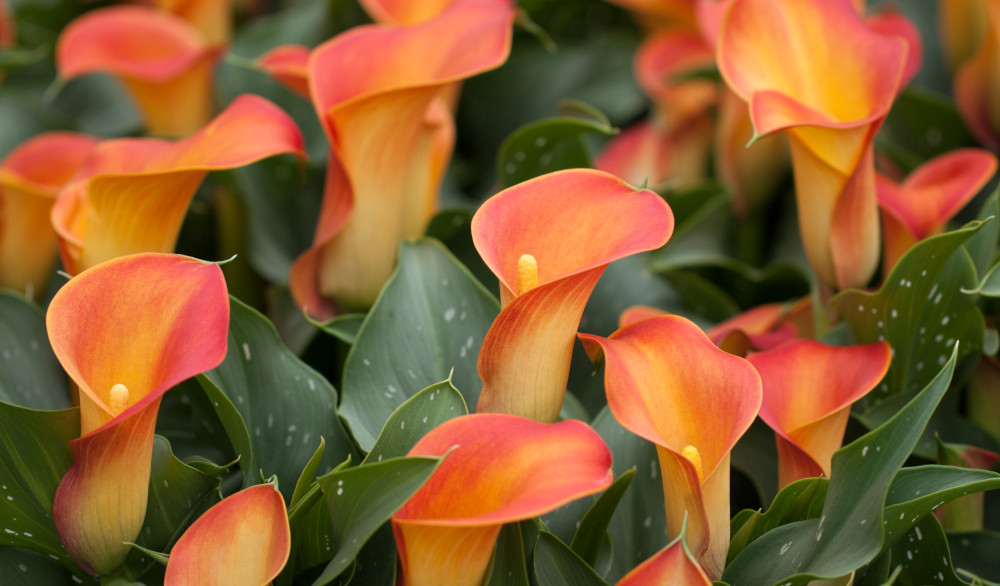
Zantedeschia is a genus of flowering plants from the family Araceae and is native to southern Africa. With a rich history dating back to the Ancient Romans, these deciduous or semi-evergreen perennials have been used as a symbol of celebration. Zantedeschia was Named after Professor Giovanni Zantedeschia, an Italian botanist.
There are two main forms of Zantedeschia: hardy and tender. Hardy forms of the plant can be grown outdoors, enjoy moist soil and full sun or partially shaded conditions - these are known as Arum lilies. Tender forms of Zantedeschia prefer being grown in containers or pots and should be brought inside over the winter - these are known as Calla lilies.
With tuberous flora in all colours from whites, yellows and oranges to deep reds and purples, Zantedeschias are not to be overlooked in any garden, as long as they have sufficient sunlight to grow in.
Ready to learn more about growing Zantedeschia? Read on for all there is to know...
Key Information
Soil pH

Position

Hardiness


Where & when to plant Myosotis
Position - Partial shade, or full sun with some midday shade
Soil - Moderately fertile or poor, moist but well-drained. Rich soil can result in the plants becoming coarse (especially alpine species such as M. alpestris).
Flowering Period - Late spring and/ or summer
Hardiness - Hardy, usually rated either H6 (-15 to -20°C) or H7 (-20°C and below).
Like all aquatic and marginal plants, the water forget me not M. scorpioides should be planted as the water begins to warm up in late spring to early summer (May/ June).
It can be grown in the shallows of a pond or lake, in water no deeper 10 centimetres (this refers to the distance between soil level or the top of the compost and the surface of the water). In steep-sided water features without this kind of gentle gradient, an aquatic planting basket placed on bricks can be used to achieve the desired depth.
As well as growing in standing water, this versatile species is equally happy in soil that remains consistently moist throughout the year, such as a swamp, bog, or permanently damp border.
Garden species such as M. sylvatica are best planted out in spring. Larger, ‘garden ready’ plants cope fine with a light frost and can go straight out into the garden. Younger, 4 centimetre plug plants are a little less robust, and we recommend instead growing these on for a while in 9 centimetre pots somewhere protected and frost-free, such as a greenhouse, conservatory, coldframe, or even a sunny porch or windowsill. Keep them here for a few weeks until they have beefed up a little and risk of frost has passed (usually mid to late May). At this point, they can be planted out or potted up as required.
Use this type of myosotis to fill any springtime gaps in the border, as well as underplanting later-interest shrubs and perennials. It can also be used as spring bedding, both in the garden and container displays (we love popping a few in the top of an autumn-potted tulip container).
How to plant Myosotis
(aquatic/ marginal species)
- If planting directly into soil, choose a spot in the shallows where the water is less than 10 centimetres deep, or in a bog garden or permanently damp border.
- Clear the area of weeds.
- Dig a planting hole several times larger than the root ball, putting any spoil in a bucket.
- Place the plant in the hole, ensuring the top of the root ball sits level with the surface of the soil.
- Backfill with the spoil and firm in gently.
- If submerged in water, place rocks, pebbles, or a layer of fine gravel around the base of the plant to weigh it down until its roots establish.
- If using an aquatic planting basket, choose one either with a very fine mesh or line it with hessian or polypropylene fabric to prevent the compost from washing out. Alternatively, a hessian bag makes a plastic-free alternative to a planting basket.
- Part fill with a specialist aquatic compost. Resist the temptation to use normal potting compost, as this contains fertilisers which will leach out into the water and harm the aquatic ecosystem.
- Place the plant onto the compost then infill around it, firming in as you go. The finished result should see the plant potted at the same height as it was in the nursery pot.
- Mulch with grit or fine gravel to prevent the surface of the compost becoming stirred up into the water.
- Submerge into the water, ensuring the top of the basket or bag sits no more than 10 centimetres beneath the surface of the water. You may need to weigh it down with rocks until the compost becomes fully saturated, after which it should remain in place.
(garden species)
For planting in the garden, dig a hole twice the width of the root-ball, removing any large stones and weeds and breaking up any lumps.
Water your plant well and allow to drain before planting.
Place the plant in the hole, ensuring the top of the root ball sits level with the surface of the soil. Too low and the plant may rot, too high and the roots can dry out.
Backfill with soil and firm in gently.
Soak well with water.
For planting in a container, first choose an appropriately sized pot. You may wish to grow your myosotis on its own (in which case a diameter of around 30 centimetres should do fine) or as a filler in a mixed container. While it’s tempting to cram several myosotis close together for quick results, this tends to result in powdery mildew later in the season. Far better to give each plant plenty of room to develop healthily. Always ensure there are plenty of drainage holes in whatever container you use.
Use a good quality compost with a little horticultural grit mixed in and, if not already present (check the labelling on the bag) some slow-release fertiliser granules.
Start by partially filling the pot with compost; enough so that when placed on it the upper surface of the root ball is about 3 centimetres lower than the top of the pot.
Fill around the plant with compost, firming down with your fingers then adding a little more so it is held tight.
Pick up the container and lightly tap on the potting bench or ground a few times to help further settle the compost around the plant.
Soak well with water.
A mulch with horticultural grit will look attractive and help to prevent a ‘cap’ or crust forming on the top of the compost (something container plants can suffer due to the artificial nature of their watering).

What to plant with Myosotis
The water forget me not, M. scorpioides, can be combined with other flowering aquatics and marginals for a rich and varied display at the water’s edge. We love Persicaria amphibia, Pontederia cordata, and Butomus umbellatus. Alternatively, check out our Pond Perfecting Collection, Serene Aquatic Collection, or Aquatic Perennial Collection, for some easy, ready-to-go combinations.
Garden species such as M. sylvatica can be planted in conjunction with other fast-growing gap fillers to inject life, colour, and texture into patchy, bare gardens. Our favourite secret weapons include ammi, cosmos, lathyrus, orlaya, echium, and cerinthe. These don’t take long to plant out and you’ll be amazed at the difference they make!


How to care for Myosotis
Pruning and Deadheading
The water forget me not, M. scorpioides, can be cut back after flowering. It will also benefit from division in late spring/ early summer every few years to prevent it becoming large and unwieldy. See ‘How to Propagate Myosotis’ section for more.
Garden species such as M. sylvatica tend to start to look past their best once flowering has finished, and most gardeners rip them out at some point during summer. By this point they are likely to have set plenty of seed – if you wish to prevent self-seeding get them out much earlier, i.e., as soon as the flowers begin to fade.
A quick note on disposing of myosotis. It is not a good idea to put spent plants on the compost heap once they have started to produce seed, as these will remain viable and you are likely to unwittingly spread them all over your garden in the compost. Treat them instead as you would pernicious weeds such as bindweed or creeping buttercup. This might mean putting them in a council collected garden waste bin (which is usually heat treated) or bagging up and disposing of at the local recycling centre.
Watering
The water forget me not, M. scorpioides, needs reliably damp conditions and will not tolerate drying out. Keep an eye on the water level of ponds and water features, topping up if necessary (preferably with harvested rainwater). Bog gardens should also be monitored and may need watering during very hot, dry spells.
Garden species such as M. sylvatica are less demanding. After the initial soaking on first planting, water again in any dry spells during the first few weeks, after which they should be largely self-sufficient. Those grown in containers will need watering throughout their growing season. To avoid overdoing it, water only once the top few centimetres of compost have dried out. When you do, go for a deep soak rather than a ‘little and often approach’, as the latter encourages roots to form only near the surface and is not conducive to healthy growth.
Feeding
There is no need to feed myosotis. The water forget me not, M. scorpioides, gets enough nutrients from the pond or bog water or damp soil in which it is grown, and garden species such as M. sylvatica are perfectly happy with moderate to low nutrients. If anything, the thing to avoid is excessively rich soil.
Cold Protection
Myosotis is hardy enough to withstand a UK winter without the need for additional protection.
Pests and Diseases
Myosotis can be prone to powdery mildew in summer. This appears as a white, powder-like coating on foliage and is generally a sign that a plant is stressed. Causes can include poor airflow (i.e., too closely planted to others), an excess of nutrients, or insufficient sunlight.
Prune off and dispose of any affected leaves and if necessary, thin out surrounding plants to improve airflow and light levels.
You may also find your resident slugs and snails develop a taste for myosotis foliage, though the plants usually recover. If these pests are an enduring problem in your garden, try encouraging natural predators such as birds, frogs, toads, and hedgehogs. Torchlight searches after dark (when slugs and snails are at their most active) are also effective, allowing you to collect the offending molluscs in a bucket and dispose of as you see fit. Relocating to a nearby woods or bagging up and putting in your freezer before popping them in the bin are said to be the most humane approaches.
How to propagate Myosotis
The easiest way to propagate the water forget me not, M. scorpioides, is to divide in late spring to early summer. Allow at least 2-3 years between each division so plants may sufficiently re-establish.
1. Choose a day when conditions are not frozen.
2. Dig the plant out of the ground or remove it from the planting basket.
3. Shake off any excess soil.
4. Separate the plant into sections using either by teasing apart with your hands, or two forks inserted back-to-back with tines touching, handles then pushed together to prise the plant apart. If the rootball is very congested, a sharp serrated knife can be used to cut it into pieces, ensuring each has a growing tip and good amount of roots.
5. Discard old, damaged, or surplus pieces, keeping healthy, vigorous material.
6. Replant or repot selected pieces as above.
Garden species such as M. sylvatica are so adept at self-seeding they rarely need a helping hand when it comes to propagation. To introduce to other areas of the garden, simply dig up self-sown clumps in spring, tease apart into individual plants, and replant or pot up as desired.
* Many plants carry Plant Breeders Rights and cannot be propagated for commercial purposes.
Common Myosotis Questions
Is myosotis invasive?
The enthusiasm with which myosotis self-seeds (particularly M. sylvatica) has led to its being classed as an invasive weed in some parts of the world (midwest North America being one example). The problem tends to occur, however, in great expanses of wilderness where the plant is allowed to spread unchecked. In a garden environment it is easy enough to weed out any unwanted plants (the roots aren’t pernicious like some vigorous colonisers), and the way in which it effortlessly plugs gaps tends to be welcomed.
If such naturalising is unwanted, simply cut back or remove plants before they have a chance to set seed.
The water forget me not, M. scorpioides, is less invasive than its terrestrial relatives.
Are forget me nots easy to grow?
Spectacularly so. These ‘self-gardening’ plants are often suggested as starter plants for children and amateurs.
How long do forget me nots take to grow?
The water forget me not, M. scorpioides, takes 2-5 years to reach full size. Garden species such as M. sylvatica are much quicker, usually reaching full flowering maturity in their second year. Young plants sold in spring are usually at the start of this second year and so can be expected to flower that same summer. Their self-sown replacements will flower the following summer, and so it goes on!
Are forget me nots poisonous?
Myosotis has no toxic effects reported and is considered a safe plant to grow around children and animals.
Are there other plants that resemble forget me nots?
Plenty! Several other members of the borage family bear remarkably similar flowers. Brunnera, omphalodes, pentaglottis, and cynoglossum are a few well-known lookalikes.
