


How to grow Myrtus
Until relatively recently, the myrtus genus contained many different species, all aromatic, flowering, evergreen trees and shrubs from the Mediterranean and South America. In the 90s, however, slight differences in flower and fruit structure led all but one to be reclassified as different genera, including Luma, Ugni, and Amomyrtus. Only Myrtus communis remains, known better as common myrtle. No doubt this all makes perfect sense to the botanists, but we know it can be very confusing and so, for the most part, shall continue to use the names our customers know best. This growing guide will therefore include information and advice for not just common myrtle, but also for those species moved to the genera listed above.
What they all have in common is the fact that the UK climate is at the edge of their ‘comfort zone’. Growing them in the open tends to be successful only in milder regions or warm microclimates (M. luma is widespread throughout Cornish gardens, for example). Where it gets chillier, they are best given the protection of a warm, sunny wall or even a conservatory or greenhouse. This is especially true for M. ugni, the edible fruits of which are much more likely to fully ripen in a protected environment.
Gardeners may choose to grow myrtus for its handsome foliage, aromatic flowers, attractive peeling bark (M. luma), or edible fruit (M. ugni). They may also be drawn to its folklore and symbolism, particularly common myrtle (M. communis) which has been significant throughout history. The Ancient Greeks viewed it as an aphrodisiac and symbol of love, and throughout the Middle East is it is used to depict love, devotion, romance, and beauty. Christianity sees it as a symbol of purity, with a sprig traditionally included in bridal bouquets or headdresses to convey innocence. There are royal connections too – Queen Victoria wrote of her love of the plant, and a sprig from her myrtle planting at Osborne House has been carried by almost every royal bride since the nuptials of her eldest daughter in 1858.

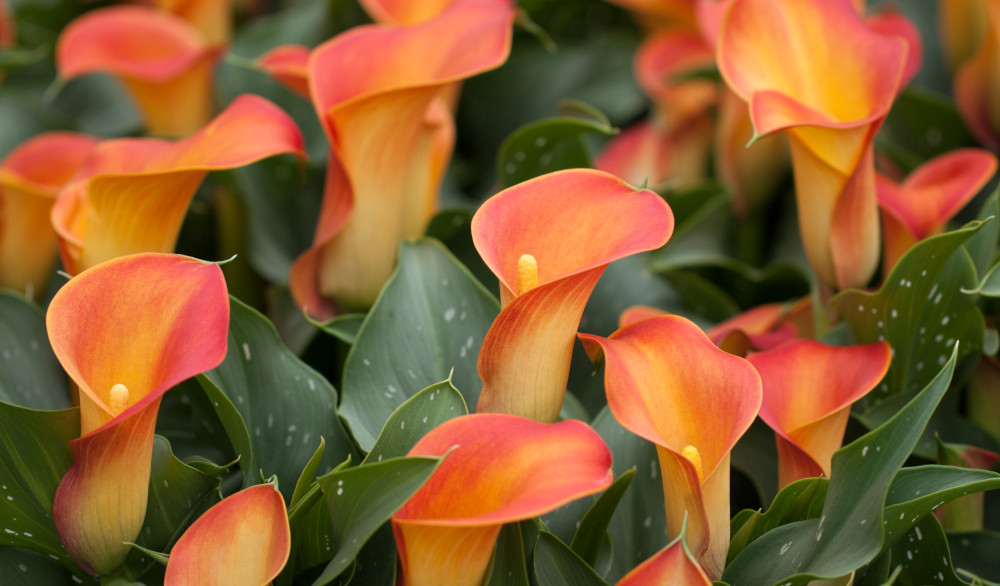
Zantedeschia is a genus of flowering plants from the family Araceae and is native to southern Africa. With a rich history dating back to the Ancient Romans, these deciduous or semi-evergreen perennials have been used as a symbol of celebration. Zantedeschia was Named after Professor Giovanni Zantedeschia, an Italian botanist.
There are two main forms of Zantedeschia: hardy and tender. Hardy forms of the plant can be grown outdoors, enjoy moist soil and full sun or partially shaded conditions - these are known as Arum lilies. Tender forms of Zantedeschia prefer being grown in containers or pots and should be brought inside over the winter - these are known as Calla lilies.
With tuberous flora in all colours from whites, yellows and oranges to deep reds and purples, Zantedeschias are not to be overlooked in any garden, as long as they have sufficient sunlight to grow in.
Ready to learn more about growing Zantedeschia? Read on for all there is to know...
Key Information
Soil pH

Position

Hardiness


Where & when to plant Myrtus
Position - Full sun. All but common myrtle (M. communis) will also tolerate partial shade.
Soil - Moderately fertile, moist, and well-draining.
Flowering Period - Can vary according to species, though mainly summer
Hardiness - Usually rated H4 (minimum temperature of -5 to -10°C)
Horticultural divisions-
Here is a rundown of the species most commonly grown in UK gardens:
Name | New name | Commonly known as | Description |
Myrtus communis | N/A | Common myrtle | Rounded, evergreen shrub with aromatic leaves and highly fragrant white flowers (summer to autumn). Eventual height usually around 3 metres. |
M. ugni | Ugni molinae | Strawberry myrtle/ Queen Victoria’s strawberries | Small, bushy, evergreen shrub with nodding, pink-tinged flowers (late spring). Spherical, dark red berries follow, tasting of a cross between strawberries and kiwis (a favourite of Queen Victoria). Eventual height 1.5 metres. |
M. luma | Luma apiculata | Temu | Evergreen tree, usually multi-stemmed, with aromatic leaves and white flowers (midsummer to mid-autumn). Distinctive cinnamon-brown bark peels away to reveal creamy white patches beneath. Vigorous and particularly keen to self-seed. Eventual height up to 12 metres. Anecdotally said to be the hardiest of all the myrtus species. |
M. lechleriana | Amomyrtus luma | Chilean myrtle | Similar to M. luma though smaller (eventual height 8 metres), and with an earlier, spring flowering period. The bark is equally peeling, though is a more subdued brown to M. luma’s vibrant, orangey tones. Can cope with slightly damper conditions. |
Myrtus usually comes as a pot grown plant. This means it can be planted at any time of year, though best results are achieved from a spring planting, which gives it time to settle in before being faced with the challenges of a UK winter. Planting can also be carried out in summer, though be prepared to water regularly. Autumn is another option if you live in a milder part of the country (generally the south and coastal areas).
Myrtus enjoys a sunny or lightly shaded spot which is sheltered from northerly and easterly winds. Against a protective wall or building is a good idea if you garden in anything other than an unusually mild region or microclimate (such as in the warmest, southern counties, along the western coastline, or in a walled or urban environment). Where winters are very harsh, it may be best to grow yours in a container in a cool conservatory or greenhouse. M. ugni ‘Kapow’ and M. communis ‘Tarentina’ are particularly well-suited to life in a container, both naturally compact and reaching no more than 1.5 metres in height.
How to plant Myrtus
· For planting into the ground, start by giving the plant a good soak a couple of hours before planting.
· Dig the soil area over, removing any large stones and weeds and breaking up any lumps. Mix in a generous amount of organic matter such as manure or garden compost.
· Rake level and firm with your heels. Rake level again.
· Dig a planting hole roughly twice the width of the rootball.
· Place the plant in the hole, ensuring the top of the rootball sits level with the surface of the soil. Too low and the stem can rot, too high and the roots can dry out.
· Backfill with soil and firm in gently with your foot.
· Soak well with water.
· Mulch around the base with well-rotted organic matter such as manure or garden compost.
· For planting in containers (remember, the more compact forms suggested above are best), first choose an appropriately sized pot. The best practice is to start just a few centimetres larger than the root ball and go up in size gradually every year or so. Always ensure there are plenty of drainage holes in the bottom.
· Again, water the roots thoroughly and allow to drain before potting.
· It can be a good idea to fill and plant your pot in situ to save yourself the trouble of moving it once full.
· Use a good quality, loam-based compost with plenty of horticultural grit mixed in, and, if not already present in the compost (check the description on the bag) some slow-release fertiliser granules.
· Start by partially filling the pot with compost; enough so that when placed on it the top of the roots sits about 3 centimetres lower than the top of the pot.
· Infill all the space surrounding the roots with compost, firming down with your fingers then adding a little more so the plant is held tight.
· Pick up the pot (if you can!) and lightly tap on the potting bench or ground a few times to help further settle the compost around the plant.
· Soak well with water.
· A mulch with horticultural grit will look attractive and help to prevent a ‘cap’ or crust forming on the top of the compost (something container plants can suffer due to the artificial nature of their watering).

What to plant with Myrtus
With aromatic leaves and fragrant flowers, common myrtle (M. communis) works well in a scent garden. Think of a courtyard or seating area filled with the intoxicating aromas of myrtle, honeysuckle (Lonicera), jasmine, mock orange, phlox, angel’s trumpet, and lilies. Heavenly!
Or, if you’re growing strawberry myrtle (M. ugni) for its edible fruits, other unusual fruiting trees to try may include pineapple guava (Acca sellowiana), goji berry (Lycium barbarum), and chokeberry (Aronia x prunifolia).


How to care for Myrtus
Pruning and Deadheading
Myrtus can either be left to its own devices, or pruned in spring (once risk of frost has passed). These trees and shrubs are quite tolerant of pruning (they will even grow from old wood), so you can be quite brave when it comes to shaping or restricting size. You may wish to trim shrubs into a neat dome, or perhaps cloud prune. Another approach is to ‘lift the crown’ to draw attention to the attractive, peeling stems.
Watering
Like all woody plants, myrtus establishes best when regularly watered during its first growing season in the ground. After this it should be largely self-sufficient.
Container-grown myrtus has less access to moisture so will need to be kept watered throughout every growing season. A useful rule of thumb to avoid overdoing it is to only water once the top couple of centimetres of compost have dried out. Be aware, however, that during the height of summer this can happen in as little as 24 hours. From mid-autumn, the British climate tends to take over watering needs, though do remember to step in in the event of an unseasonably dry spell.
Feeding
On healthy, fertile soil, an annual mulch of well-rotted organic matter (i.e., a layer of manure or garden compost applied to the soil around the plant) should provide adequate nutrients and has the added benefit of suppressing weeds and locking in moisture. This can be done in either autumn or spring, though we tend to go with autumn as the mulch then also acts as insulation for the roots against the winter cold and wet.
Container-grown plants rely more on the gardener for nutrition. Get off to a flying start by making sure you use a good quality, loam-based compost with some slow-release fertiliser granules mixed in, then apply a monthly dose of balanced liquid feed throughout the growing season. Repotting every few years into fresh compost with slow-release granules is also beneficial, and when this is no longer feasible carry out a topdress each spring. Simply scrape away the top 5 centimetres of compost and replace with fresh. Finish with a good soak of water to settle the compost.
Cold Protection
Myrtus is on the very edge of its comfort zone here in the UK, and doesn’t cope well with cold winds, very low temperatures, or excessive winter wet. Try to protect it from these as best you can; planting against a south or west-facing wall can make a big difference in all three respects. Otherwise, you may be better off growing yours in a container so you can bring it under cover during the winter months. A cool greenhouse, conservatory, or porch are all ideal spots, or even just under the south-facing eaves of a house with an insulating wrapping of hessian, fleece, or bubble wrap around the container.
Pests and Diseases
Myrtus is considered trouble free.
How to propagate Myrtus
Myrtus roots quite easily from semi-ripe cuttings taken in late summer. Bottom heat will significantly improve success rates:
· Look for current year’s growth which is firm and woody at the base while still flexible at the tip. You’re aiming for cuttings of 10 centimetres or less (any longer and they are more likely to dry out and fail). For best results, choose stems where the leaf nodes are close together rather than far apart.
· Using a sharp knife or secateurs, sever the cuttings from the plant and put in a plastic bag straight away to keep them from drying out.
· Fill a pot (or several, if you have a lot of cuttings) with a perlite-heavy compost mix (at least 50% perlite).
· Trim the end of the cutting to just below a node (point at which leaves grow).
· Remove lowest leaves, leaving at least four on the cutting.
· Insert the cuttings into the compost and water lightly. Several cuttings can be put in the same container if there is enough space to do this without them touching.
· Place in a propagating unit with gentle bottom heat if you have one, or covered with a plastic bag on a windowsill if not (out of direct sunlight).
· Keep the cuttings misted and occasionally watered until they root. You will know this has happened when roots emerge out of the bottom of the container.
· Gently remove rooted cuttings and pot them into individual pots. Grow on in a cool yet frost-free environment such as an unheated conservatory, greenhouse, or cold frame, until they are large enough to be planted out as above.
* Many plants carry Plant Breeders Rights and cannot be propagated for commercial purposes.
Common Myrtus Questions
· Is myrtus related to eucalyptus?
Yes, eucalyptus belongs to the same family (Myrtaceae) as myrtus, along with other notable plants such as guava, allspice, and clove. All are woody, evergreen, and contain aromatic oils.
· Can myrtus be used in cooking?
Yes, the leaves, bark, flowers, and berries of several myrtus species have culinary uses. In the Mediterranean, the smoke of common myrtle wood is used to flavour food (particularly in Sardinia and rural Italy), and its leaves and berries are macerated to make the liqueur mirto in Sardinia, Corsica, and Capraia. The fresh flowers have a warm, spicy flavour when added to pasta and rice (they’re quite strong so do so sparingly!), and young leaves can be used to flavour cooking in the same way as bay leaves.
Then of course, there is M. ugni, which is often grown specifically for its edible fruits. These need a long, hot summer to ripen fully, so this species is often grown as a greenhouse or conservatory plant in the UK.
