


How to grow Pontederia
Pontederia is an aquatic plant from the Americas. Of the handful of species just two are widely known, though each for a different reason. The hardy Pontederia cordata is a popular garden pond plant also known as pickerel weed, grown for its heart-shaped leaves, masses of blue flower spikes, and value to wildlife. Less benign is the tender Pontederia crassipes (formerly Eichhornia crassipes), also known as the water hyacinth and the most invasive aquatic plant in the world. This species is banned from sale in the EU and the UK.
This growing guide will focus on Pontederia cordata. Though nothing like as invasive as its infamous relative it does nevertheless have a spreading habit, and while happiest allowed to spread freely in the muddy margins of a pond or lake, it may be restricted with a planting basket if this is likely to pose a problem.

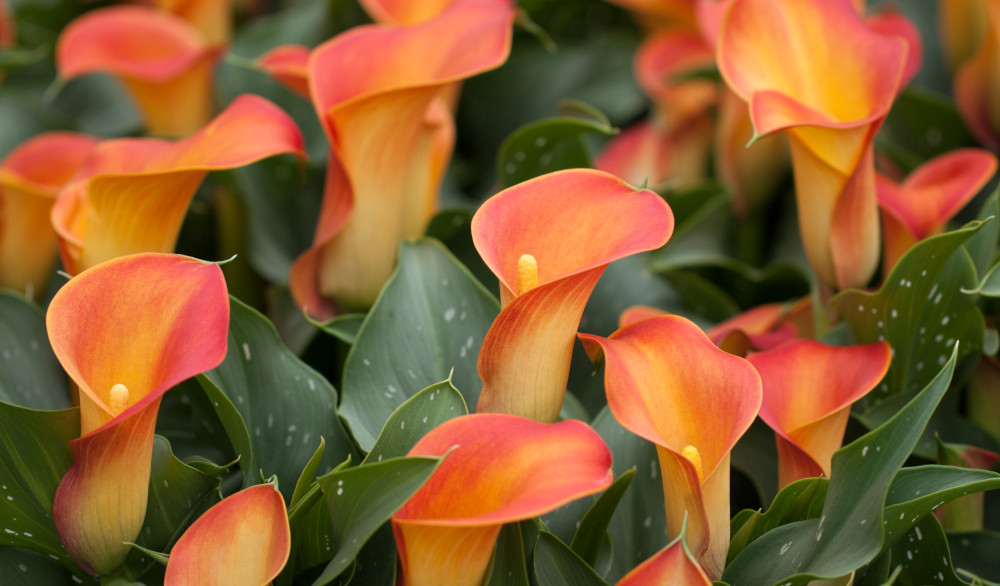
Zantedeschia is a genus of flowering plants from the family Araceae and is native to southern Africa. With a rich history dating back to the Ancient Romans, these deciduous or semi-evergreen perennials have been used as a symbol of celebration. Zantedeschia was Named after Professor Giovanni Zantedeschia, an Italian botanist.
There are two main forms of Zantedeschia: hardy and tender. Hardy forms of the plant can be grown outdoors, enjoy moist soil and full sun or partially shaded conditions - these are known as Arum lilies. Tender forms of Zantedeschia prefer being grown in containers or pots and should be brought inside over the winter - these are known as Calla lilies.
With tuberous flora in all colours from whites, yellows and oranges to deep reds and purples, Zantedeschias are not to be overlooked in any garden, as long as they have sufficient sunlight to grow in.
Ready to learn more about growing Zantedeschia? Read on for all there is to know...
Key Information
Soil pH

Position

Hardiness


Where & when to plant Pontederia
Key Information
Position - Full sun
Soil - Reliably wet, fertile loam.
Flowering Period - Late summer
Hardiness - Hardy, rated H5 (minimum temperature -10 to -15°C)
Like all aquatic plants, pontederia should be planted as the water begins to warm up in late spring to early summer (May/ June).
It can be grown in the shallows of a pond or lake, in water 10-12 centimetres deep (in relation to a planting basket, this refers to the distance between the uppermost level of the compost and the surface of the water). In steep-sided water features without a gentle gradient of this sort, the desired depth can be achieved by placing a planting basket on bricks.
As well as growing in standing water, pontederia is equally happy in soil which remains consistently moist throughout the year, such as a swamp or bog.
For gardens without any of these wet habitats, a large, water-filled tub on a sunny, sheltered patio is a perfectly good option.
How to plant Pontederia
- If planting directly into soil, choose a spot in the shallows where the water is no more than 10-12 centimetres deep, or in a bog garden or permanently damp border.
- Clear the area of weeds.
- Dig a planting hole several times larger than the root ball, putting any spoil in a bucket.
- Place the plant in the hole, ensuring the top of the root ball sits level with the surface of the soil.
- Backfill with the spoil and firm in gently.
- If submerged in water, place rocks, pebbles, or a layer of fine gravel around the base of the plant to weigh it down until its roots establish.
- If using an aquatic planting basket, choose one either with a very fine mesh or line it with hessian or polypropylene fabric to prevent the compost from washing out. Alternatively, a hessian bag makes a plastic-free alternative to a planting basket.
- Part fill with a specialist aquatic compost. Resist the temptation to use normal potting compost, as this contains fertilisers which will leach out into the water and harm the aquatic ecosystem.
- Place the plant onto the compost then infill around it, firming in as you go. The finished result should see the plant potted at the same height as it was in the nursery pot.
- Mulch with grit or fine gravel to prevent the surface of the compost becoming stirred up into the water.
- Submerge into the water, ensuring the top of the basket or bag sits no more than 12 centimetres beneath the surface of the water. You may need to weigh it down with rocks until the compost becomes fully saturated, after which it should remain in place.

What to plant with Pontederia
Pontederia dislikes close competition, so try to allow it plenty of elbow room. In a different part of the pond, you might like to grow Myosotis scorpioides (syn. Myosotis palustris), Persicaria amphibia, and Butomus umbellatus. Or why not check out our Pond Perfecting Collection, Serene Aquatic Collection, or Aquatic Perennial Collection, for some easy, ready-to-go combinations.
Shop Pond Perfecting CollectionSerene Aquatic Collection Aquatic Perennial Collection


How to care for Pontederia
Pruning and Deadheading
Pontederia has very simple pruning requirements. Simply cut it back after flowering and expect to see it regrow the following spring. It will also benefit from division every few years in late spring to prevent it becoming large and unwieldy. See ‘How to Propagate Pontederia’ section for more.
Watering
Pontederia needs reliably damp conditions and will not tolerate drying out. Keep an eye on the water level of ponds and water features, topping up if necessary (preferably with harvested rainwater). Bog gardens should also be monitored and may need watering during very hot, dry spells.
Feeding
There is no need to feed pontederia, which gets enough nutrients from the pond or bog water in which it is grown.
Cold Protection
Pontederia is hardy enough to withstand a UK winter as long as the crown of the plant doesn’t freeze. Throughout most of the UK, the recommended depth of 10-12 centimetres should be enough to avoid this, however in very cold regions it can be worth going slightly deeper (though no more than 30 centimetres).
Pests and Diseases
Pontederia is considered trouble free.
How to propagate Pontederia
The easiest way to propagate pontederia is to divide in late spring just as growth starts. Allow at least 2-3 years between each division so plants may sufficiently re-establish.
1. Choose a day when conditions are not frozen.
2. Dig the plant out of the ground or remove it from the planting basket.
3. Shake off any excess soil.
4. Separate the plant into sections using either by teasing apart with your hands, or two forks inserted back-to-back with tines touching, handles then pushed together to prise the plant apart. If the rootball is very congested, a sharp serrated knife can be used to cut it into pieces. Ensure each has a growing tip and good number of roots.
5. Discard old, damaged, or surplus pieces, keeping healthy, vigorous material.
6. Replant or repot selected pieces as above.
* Many plants carry Plant Breeders Rights and cannot be propagated for commercial purposes.
Common Pontederia Questions
How is pontederia beneficial to wildlife?
Dragonflies and damselflies both lay their eggs at the base of this plant (its presence has been found to increase their numbers in gardens), while newts use the submerged parts for cover and shelter. Some bee species also visit its flowers.
How tall does pontederia grow?
This species can reach up to 1.2 metres in height. Individual leaves are around 18 centimetres long.
How fast does pontederia grow?
This species (Pontederia cordata) has what is considered to be a moderate growth rate, taking five or so years to reach full size
Is pontederia a perennial?
Yes. Expect it to die back for winter and reappear each spring.
