


How to grow Rheum (Rhubarb)
Although technically a vegetable Rheum x hybridum is considered by many to be a fruit not only because of its sweet flavour but also because of its popularity for puddings and desserts. Even better it is incredibly easy to manage and ideal for novice vegetable growers, giving plentiful supplies once the plant has established.
A hardy perennial, Rheum x hybridum flourishes without too much attention, bearing delicious stalks to stew and eat with porridge at breakfast, or to use as an ingredient in crumbles and tarts. Stalks reach between 30-40cm and the best are light pink to red in colour, changing to green as they develop and mature.
Most varieties of Rheum x hybridus are ready to harvest in early spring, when there is little else available in the kitchen garden – perhaps this is why it has become one of the most prized crops in the vegetable garden. Couple this with the fact that it is best picked and cooked immediately so the stems remain succulent and it’s a ‘must have’ for any discerning vegetable grower.
Plants are thought to be native to China and records show that it was used as a laxative at least 5000 years ago. Roots were also an ingredient in Greek and Roman medicines some 2000 years ago. Widespread consumption of stalks began in the early 19th when it was used both in desserts and in wine making. Forcing rhubarb by growing it in the dark is still popular today as stems are said to be sweeter and more tender than those grown outdoors in daylight. Stylish terracotta containers with lids are available specifically for this purpose although an upturned dustbin or old compost bin is readily adapted to achieve similar results.
Rhubarb species can be grouped into two broad categories, all classified as members of the genus Rheum. In one category, sometimes collectively called Victoria, the stalk exteriors vary in colour from pure green to light red while the interior is green. The varieties in this category tend to be larger, more robust and relatively disease resistant. The second category consists of pure red rhubarb. These stalks are deep red inside and out. They tend to be smaller, less robust and more prone to diseases yet are sought after due to their flavour.

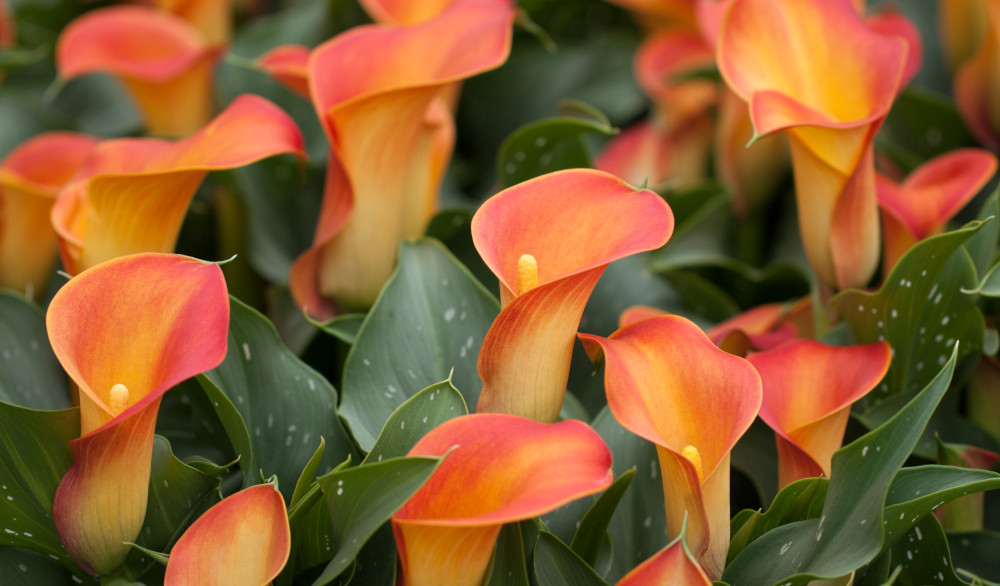
Zantedeschia is a genus of flowering plants from the family Araceae and is native to southern Africa. With a rich history dating back to the Ancient Romans, these deciduous or semi-evergreen perennials have been used as a symbol of celebration. Zantedeschia was Named after Professor Giovanni Zantedeschia, an Italian botanist.
There are two main forms of Zantedeschia: hardy and tender. Hardy forms of the plant can be grown outdoors, enjoy moist soil and full sun or partially shaded conditions - these are known as Arum lilies. Tender forms of Zantedeschia prefer being grown in containers or pots and should be brought inside over the winter - these are known as Calla lilies.
With tuberous flora in all colours from whites, yellows and oranges to deep reds and purples, Zantedeschias are not to be overlooked in any garden, as long as they have sufficient sunlight to grow in.
Ready to learn more about growing Zantedeschia? Read on for all there is to know...
Key Information
Soil pH

Position

Hardiness


Where & when to plant Rhubarb
Position - A sunny, sheltered, south-facing spot is best, though light, dappled shade will be tolerated. Plants need plenty of room to grow and do best when given their own, dedicated bed.
Soil - Moist, well-drained soil of any pH is fine.
Fruiting Period - Spring into summer
Hardiness - Hardy – generally rated H5 or H6 depending on the cultivar. This means plants should be fine in the average UK winter provided there is adequate drainage.
Plants grow best in an open, sunny site with fertile, moist but free-draining soil. Avoid ground that gets waterlogged, as plants are liable to rot. If your soil is heavy, we recommend planting in raised beds or large containers for best results. Although rhubarb is very hardy you should avoid sites which are prone to late frosts, as the young stems may be damaged. Alternatively, choose a later-cropping variety so that frost is not likely to be an issue.
Rhubarb can be bought either in pots or as dormant bare-root plants known as crowns. Both are planted in a similar way, although the timing varies: Containerised plants are sold all year round for planting at any time, although spring or autumn are best. Avoid planting in very hot, dry weather or when ground is frozen. Bare-root crowns are only available from mid-autumn to early spring and should be planted straight away, ideally in November or December, although again frozen ground should be avoided.
How to plant Rhubarb
- For planting in the garden, dig the soil area removing any large stones and weeds and breaking up any lumps.
- Mix in a generous amount of well-rotted manure, aiming for two bucketfuls every square metre.
- Dig a planting hole slightly larger than the roots and position so that the tip of the crown is just above the soil surface.
- Back fill around the roots and firm down then water well.
- For numerous plants – allow around a metre between so that plants can spread.
- For planting in a container, you’ll need to give each plant its own individual container (multiples don’t grow well together in the same pot) of at least 50-60cm width and depth. Ensure the container has plenty of drainage holes.
- It can be a good idea to fill and plant each pot in situ, to save yourself the trouble of moving them later. Locate in a sunny, sheltered position.
- Part fill with a well-draining, loam-based compost and, if not already present in the compost (check the label), add some slow-release general fertiliser granules.
- Place the crown on top of the soil, spread out the roots and cover with compost so the growing tip sits just above the surface.
- Soak well with water.

What to plant with Rhubarb
Grow a selection of perennial fruits and vegetables for a low maintenance, sustainable, long-lasting supply of edibles. Think along the lines of rhubarb, blueberries, cranberries, currants, raspberries, and figs, along with fruit trees such as apples and plums. Mouthwatering!


How to care for Rhubarb
Harvesting
It’s vital to allow plants sufficient time to establish before you begin to harvest. For plants bought and planted as bare root crowns, this means leaving them untouched for two years and, dependent upon the maturity of pot grown plants, the same rule should apply.
Only harvest your Rheum x hybridum a few stems at a time and ensure that you leave some attached to each crown. Twist and pull stems from the base rather than cutting them as this prevents residual stem rotting and impacting the crown. Once the fruiting window for your chosen variety has passed then leave the remaining stems to die back naturally and replenish the crown ready for next year.
Watering
Rheum x hybridum plants should be watered on initial planting, and then regularly throughout their first growing season in the ground. After this, they are relatively drought hardy and will need watering only in prolonged periods of hot, dry weather.
Rheum x hybridum in a container will need to be watered regularly throughout every growing season. Allow the top few centimetres of compost to dry out between soakings – a finger wiggled down until moisture can be felt is the best way of checking this. From mid-autumn onwards the UK weather tends to take over watering needs, though do remember to step in in the event of an unseasonably dry spell.
Feeding
Rheum x hybridum will benefit from an annual spring mulch of well-rotted organic matter which is 5-8cm deep. This feeds the soil and helps to retain moisture although care should be taken not to bury the crown tips.
Cold Protection
Rheum x hybridum is hardy enough to not need any additional winter protection.
Pests and Diseases
May be vulnerable to stem and bulb eelworm, swift moth caterpillar and to slugs and snails on new growth. Disease wise keep a watchful eye for honey fungus, downy mildews, grey moulds, crown rot and virus diseases.
How to propagate Rhubarb
The best and most beneficial way to propagate is to lift overcrowded or mature crowns between autumn and early spring. November is a good time for this task as the ground will not be frozen solid and soil should be moist enough to easily lift the plants. Dividing plants not only reinvigorates your stock, it provides you with more plants for your garden or for sharing with friends.
- Dig round the outside of the plant to loosen the roots and crown and then lift onto the soil surface.
- Use a spade to divide the crown into sections each retaining a portion of the rhizome (thickened root) and at least one growing point.
- Sections from the outer part are better than the centres of old plants.
- Discard any old or decayed parts of the crown.
- Replant straight away or wrap in damp sacking until ready to plant.
* Many plants carry Plant Breeders Rights and cannot be propagated for commercial purposes.
Common Rhubarb questions
What should not be planted near rhubarb?
Any vegetables from the Brassica family (broccoli, cabbage, cauliflower) should not be planted too close to your rhubarb patch.
Should I cut off rhubarb flowers?
Yes, do so immediately and remove as close to the base of the plant as possible. You will need a knife to do this as a flower stalk is too thick and hard to remove by pulling. Allowing a flower stalk to develop will draw precious nutrients away for the fruiting stems.
How often should you water rhubarb?
Once established plants in the ground should only need watering during prolonged dry spells. Container plants will need regular feeding and watering as they are more dependent upon the gardener.
Does rhubarb spread on its own?
Yes, plants will reach a spread of around 1 metre over time. At this point the crown may become woody to the centre and should be lifted and divided.
