


How to grow Silene
There are many hundreds of species of silene found growing wild throughout the northern hemisphere. While these may be annual or biennial, the species probably most familiar to UK gardeners is the perennial Silene dioica, known commonly as red campion. This native wildflower adds its distinctive flash of bright magenta to woodlands and roadside verges in late spring and early summer and is a popular inclusion in meadows and wildlife gardens. A sterile hybrid ‘Rollies Favourite’ offers particularly good garden value, with a more compact and extra floriferous habit than the wild species. Another common UK native is S. vulgaris or bladder campion, so-called for the blush-coloured bulge behind its delicate white flowers. This perennial is also widespread throughout the UK countryside, usually in grassland and along the base of hedgerows.
While these two native wildflowers are often grown by wildlife-conscious gardeners for their attractiveness to bees and butterflies, others benefit that equally vital pollinator, the moth. Also known as white campion, S. lactiflora is to all intents and purposes a white-flowered version of red campion, though it releases its scent at night. Another night-scented species is the less common S. noctiflora, an annual wildflower known as the night-flowering catchfly. This dainty little plant can be grown as part of a meadow mix, where it will perpetuate itself with self-sown seeds for many years.
For those without space for a meadow or naturalistic border, ‘Sibella’ is cultivated form of an annual trailing species (S. pendula), perfect for hanging baskets, window boxes, and container displays. Originating from Greece, Italy, and Turkey, this species is less hardy and should be treated similarly to tender bedding plants such as petunia and bidens.
Something worth pointing out at this stage is the close relation of silene to lychnis, and the interchangeability there can be when it comes to their names. For example, while the rose campion is technically a silene (Silene coronaria), throughout the world of horticulture it is still widely referred to as Lychnis coronaria. The same goes for ragged robin (Silene flos-cuculi), which largely continues to be known as Lychnis flos-cuculi (including by us!). Our advice, you’re ever searching for these online or in books, is to hedge your bets by trying both names.

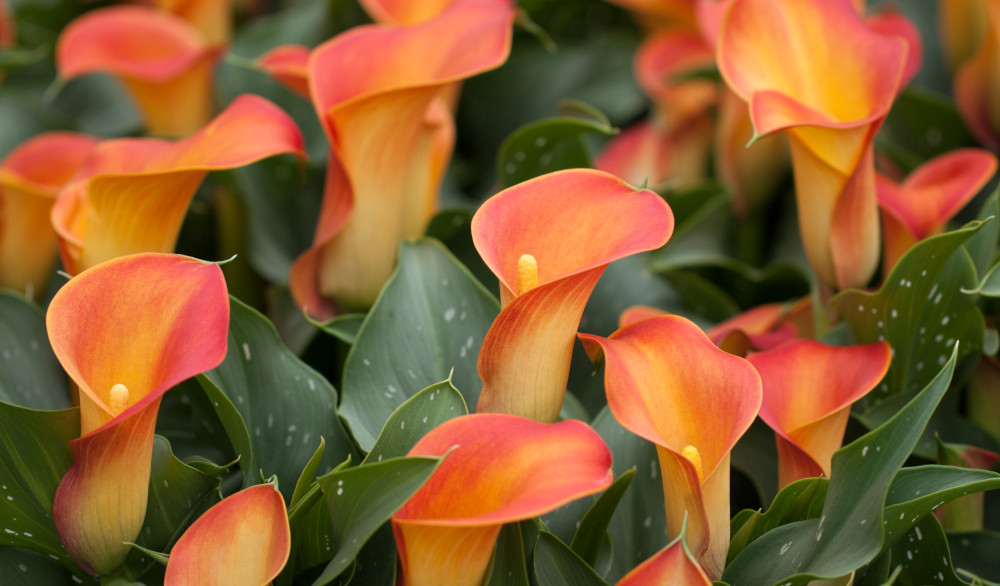
Zantedeschia is a genus of flowering plants from the family Araceae and is native to southern Africa. With a rich history dating back to the Ancient Romans, these deciduous or semi-evergreen perennials have been used as a symbol of celebration. Zantedeschia was Named after Professor Giovanni Zantedeschia, an Italian botanist.
There are two main forms of Zantedeschia: hardy and tender. Hardy forms of the plant can be grown outdoors, enjoy moist soil and full sun or partially shaded conditions - these are known as Arum lilies. Tender forms of Zantedeschia prefer being grown in containers or pots and should be brought inside over the winter - these are known as Calla lilies.
With tuberous flora in all colours from whites, yellows and oranges to deep reds and purples, Zantedeschias are not to be overlooked in any garden, as long as they have sufficient sunlight to grow in.
Ready to learn more about growing Zantedeschia? Read on for all there is to know...
Key Information
Soil pH

Position

Hardiness


Where & when to plant Silene
Position - Full sun or light dappled shade
Soil - Tolerant of most soil types, though can struggle in an acidic pH
Flowering Period - Usually from spring to summer
Hardiness - Varies depending on species.
Most of those mentioned above are very hardy, usually rated H6 (-15 to -20°C).
S. noctiflora is slightly less, rated H4 (-5 to -10°C), though this is an annual species so all this affects is the length of its growing season.
S. pendula ‘Sibella’ is tender, rated H2 (1 to 5°C).
Hardy species are best planted in autumn or spring. An autumn planting can be done by those gardening in mild conditions (and broadly speaking, this is the southern half of the UK). For those liable to cold, wet winters, it is best to wait until spring (generally the northern half of the UK, or those with very heavy soil). Planting can also be carried out in summer, though be prepared to water regularly.
The tender, bedding types hail from warmer climes than ours and can only survive outside in the UK once all risk of frost has passed. This varies from region to region, though tends to be mid to late May. If your plants arrive before it is safe to go outdoors, keep in a bright, frost-free environment until the time is right. A greenhouse, conservatory, coldframe, or sunny porch or windowsill are all ideal. Just make sure you don’t let them dry out! Small plug plants are best potted up into 9cm pots if they’re going to spend time in a ‘holding zone’ such as this.
Another important thing to note with tender plants is the need to gradually harden them off, rather than suddenly move them outside. This slow toughening up reduces the chances of them going into ‘shock’, which can severely check growth.
The easiest way to do this is by using a cold frame opened in gradual increments over the course of a week or two. Keep the lid closed at night until the last couple of days of the hardening off period.
If you don’t have a cold frame, a bit of horticultural fleece combined with a spot of ‘musical pots’ works just as well. A week or so before you anticipate planting your bedding silene out, wrap the plants in a couple of layers of fleece and place outside during the day (moving back into a warm, protected environment at night). Do this for a few days then reduce the fleece to one layer. After a few more days like this, remove the fleece completely. If it’s warm enough you can leave outside at night too, though reapply the fleece for this. At the end of the hardening off period, leave outside completely uncovered for a couple of days and nights before planting out as below.
When it comes to choosing a spot, with their naturalistic appearance hardy species are ideal for cottage garden borders, wildflower meadows, or wild gardens (and this can be as modest as an area of grass left unmown, perhaps beneath a tree or on a grassy bank). Tender bedding types are perfect for a summer container display, hanging basket, or window box, where they can be used as a standalone plant or as a ‘spiller’ amongst other bedding plants. You could also grow them in the open ground, perhaps to have cascading over the edge of a wall or raised bed, or spreading along the edge of a border.
How to plant Silene
- For planting in the garden, dig the soil area removing any large stones and weeds and breaking up any lumps. If you have poor, free-draining soil now is your chance to add a generous amount of organic matter, such as well-rotted manure or garden compost. Rake level and firm with your heels. Rake level again.
- Water plants well and allow to drain before planting.
- Dig a hole twice the width of the root-ball.
- Place the plant in the hole, ensuring the top of the root ball sits level with the surface of the soil. Too low and the plant may rot, too high and the roots can dry out.
- Backfill with soil and firm in gently with your foot.
- Soak well with water.
- Mulch around the base with organic matter.
- For planting in containers first choose an appropriately sized pot just a few centimetres larger than the rootball, ensuring there are plenty of drainage holes.
- Use a good quality potting compost with plenty of horticultural grit mixed in and, if not already present (check the labelling on the bag) some slow-release fertiliser granules.
- Start by partially filling the pot with compost; enough so that when placed on it the upper surface of the root balls is about 3 centimetres lower than the top of the pot.
- Fill around the plant with compost, firming down with your fingers then adding a little more so it is held tight.
- Pick up the container and lightly tap on the potting bench or ground a few times to help further settle the compost around the plant.
- Soak well with water.
- A mulch with horticultural grit will look attractive and help to prevent a ‘cap’ or crust forming on the top of the compost (something container plants can suffer due to the artificial nature of their watering).

What to plant with Silene
To achieve a natural-looking perennial wildflower meadow in an area of grass, plant silene into it with companions such as leucanthemum, achillea, centaurea, scabious, digitalis, Primula veris, filipendula, and Geranium pratense. Keep the nutrient levels of the soil low (lean soil being favoured by most wildflowers) by removing clippings when you mow in early spring and again in autumn. Sowing the parasitic plant yellow rattle (Rhinanthus minor) will help to weaken the grass, giving wildflowers greater opportunity to establish.
At the other end of the scale, summer bedding plants such as Silene pendula ‘Sibella’ offer the chance to get creative with fun and outrageous colour combinations. There’s nothing better than sticking a few vigorously trailing plants together in a container and watching as they fight it out in a glorious explosion of flowers and foliage. For this, we love petunia, brachyscome, calibrachoa, and bacopa, as well as trailing forms of begonia, lobelia, and fuchsia. For professional-looking results pop in at least one foliage plant too, such as dichondra.


How to care for Silene
Pruning and Deadheading
In a border, the stems of perennial species can be cut back after flowering to encourage a second flush. After this, unless you’re keen to prevent self-seeding (in which case remove spent flowers before they form seedheads), allow the lot to die back naturally at the end of the growing season. Tidy any remaining material in early spring just before growth resumes.
If you’re growing your silene as part of a meadow, we find a spring cut useful if there is lots of lush grass (this keeps the grass down and allows the wildflowers to take hold). The main cut is then best carried out sometime in late summer/ early autumn. The aim is to leave it long enough for plants to set seed, though get in there before they flop over and make the process more difficult.
Bedding silene requires no pruning. Simply remove to the compost heap at the end of the growing season.
Watering
In the open ground, silene should be given a good soaking on planting, then a handful of times after this over the coming few weeks. Once established, it should be largely self-sufficient, needing watering only in prolonged periods of hot, dry weather.
Container-grown silene will need watering regularly. A good rule of thumb to avoid overdoing it is to water only once the top few centimetres of compost have dried out. Be aware, however, that in the height of summer this can happen in as little as 24 hours.
Feeding
On healthy, fertile soil, an annual mulch of well-rotted organic matter should provide sufficient nourishment for your silene (manure or garden compost are ideal). As well as boosting the nutrient content of the soil, mulch has the added benefits of suppressing weeds and locking in moisture.
In a container, try to use a good quality compost with slow-release granules mixed in. This generally provides enough nutrients for six weeks, after which a fortnightly dose of high potassium liquid feed (such as tomato food) will help to maximise flowering performance.
Cold Protection
The perennial species mentioned above are hardy enough to withstand a UK winter without the need for additional protection.
Tender bedding species should be moved outside only once temperatures remain reliably mild (see ‘When and where to plant silene’) and discarded at the end of the growing season.
Pests and Diseases
Silene tends to be relatively problem-free, however you may find your resident slugs and snails develop a taste for the foliage. Encouraging natural predators into your garden, such as birds, frogs, toads, and hedgehogs makes a big difference. Torchlight searches after dark (when slugs and snails are at their most active) are also effective, allowing you to collect the offending molluscs in a bucket and dispose of as you see fit. Relocating to a nearby woods or bagging up and putting in your freezer before popping them in the bin are said to be the most humane approaches.
How to propagate Silene
Perennial species can be propagated by basal cuttings in spring, or seed sown in containers in cold frames in autumn.
To take basal cuttings:
1. In spring, find several strong, basal shoots (originating from the crown) around 10-12 centimetres long.
2. With sharp secateurs or a knife, sever cleanly from as close to the base as possible.
3. Put them in a plastic bag straight away to prevent drying out.
4. Fill a container with a free-draining compost mix.
5. Pinch out the soft tip.
6. If there are leaves, remove the lowest third. If the remaining leaves are large, cut in half with a sharp knife to reduce water lost through transpiration.
7. Insert the cuttings into the compost and water lightly. Several cuttings can be put in the same container if there is enough space to do this without them touching.
8. Place in a greenhouse or propagating unit if you have one, or covered with a plastic bag on a windowsill if not (out of direct sunlight).
9. Keep the cuttings misted and occasionally watered until they root. You will know this has happened when roots emerge out of the bottom of the container.
10. Once rooted, take the cuttings out of their pot and gently tease apart. Pot into individual 9 centimetre pots using a well-draining compost mix.
11. Grow on in a sheltered environment, keeping well-watered but never soggy. Plant out as above.
To collect and sow your own seed:
1. Seeds are typically ready for collecting in mid to late summer when they’ve turned hard and black.
2. Snip the seedheads from the plant using scissors or secateurs. Try to do this in dry conditions, and shake or separate the seeds into a small, labelled paper bag or envelope. Store somewhere cool and dry until it is time to sow in autumn.
3. Fill several small pots with a well-draining compost mix, compressing the surface lightly with a flat piece of wood or the bottom of another pot.
4. Sprinkle the seeds thinly (i.e., spaced apart) over the surface of the compost.
5. Use a garden sieve to cover with a fine layer of compost.
6. Water the soil gently with a fine spray until it is evenly moist but not waterlogged.
7. Place the seed tray or pots in a coldframe or sheltered outdoor position, such as in the lee of a wall.
8. In spring, prick out seedlings and pot into individual 9 centimetre pots. Grow on and plant out as above.
* Many plants carry Plant Breeders Rights and cannot be propagated for commercial purposes.
Common Silene Questions
· Does silene come back every year?
Perennial species can be expected to die back for winter and reappear the following spring. Annual species last for one growing season only, though the hardy amongst these (e.g., S. notciflora) are likely to set seed, meaning there may well be offspring growing in the same area the following year.
· Does silene need full sun?
Most species of silene are happy both in sun and a little shade.
· Should I deadhead silene?
Rather than remove individual flowers, we advise cutting the whole stem down to the base once it has finished flowering. This helps encourage a second flush of flower stems.
· Does silene seed itself about?
With the exception of sterile hybrids such as ‘Rollies Favourite’, expect your silene to naturalise gently where you plant it. To prevent this, simply remove spent flower stems before they have a chance to form seedheads.
