


How to grow Sisyrinchium
Sisyrinchium is a clump-forming perennial native to North and South America. When seen without flowers its sword-shaped or grassy leaves can be hard to distinguish from those of close relative iris, however once in bloom the difference becomes clear. Despite the common name of blue-eyed grass, the star-shaped flowers of sisyrinchium are not only blue but may also be white, cream, or mauve depending on the species and cultivar. The tall, creamy yellow-flowered Sisyrinchium striatum is often seen in herbaceous borders and rose gardens, while many shorter hybrids and cultivars are popular for rock gardens and gravel planting.
Many sisyrinchium are prolific self-seeders, and while individual plants can be somewhat short-lived there tends to be no shortage of replacement offspring. For this reason, sisyrinchium can give the appearance of moving around a border. A self-gardening plant!

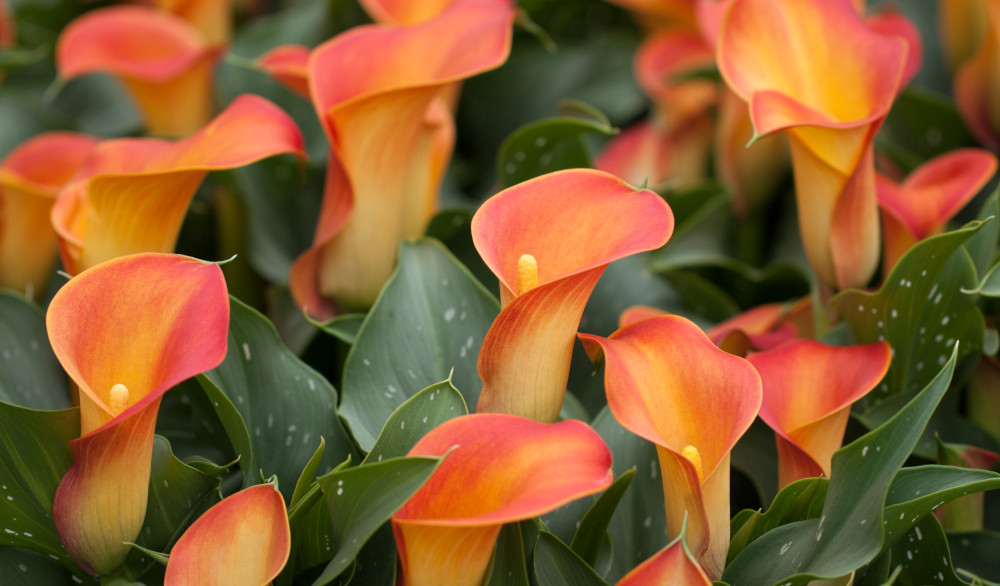
Zantedeschia is a genus of flowering plants from the family Araceae and is native to southern Africa. With a rich history dating back to the Ancient Romans, these deciduous or semi-evergreen perennials have been used as a symbol of celebration. Zantedeschia was Named after Professor Giovanni Zantedeschia, an Italian botanist.
There are two main forms of Zantedeschia: hardy and tender. Hardy forms of the plant can be grown outdoors, enjoy moist soil and full sun or partially shaded conditions - these are known as Arum lilies. Tender forms of Zantedeschia prefer being grown in containers or pots and should be brought inside over the winter - these are known as Calla lilies.
With tuberous flora in all colours from whites, yellows and oranges to deep reds and purples, Zantedeschias are not to be overlooked in any garden, as long as they have sufficient sunlight to grow in.
Ready to learn more about growing Zantedeschia? Read on for all there is to know...
Key Information
Soil pH

Position

Hardiness


Where & when to plant Sisyrinchium
Position - Full sun
Soil - Grows best in a low nutrient, well-draining soil with a slightly alkaline pH. Avoid both extreme drought and excessive winter wet.
Flowering Period - Spring and summer
Hardiness - Hardy. Some are rated H4 (-5 to -10°C), others H5 (-10 to -15°C).
Sisyrinchium is best planted in autumn or spring. An autumn planting can be done by those gardening in mild conditions (and broadly speaking, this is the southern half of the UK). For those liable to cold, wet winters, it is best to wait until spring (generally the northern half of the UK, or those with very heavy soil). Planting can also be carried out in summer, though be prepared to water regularly.
Taller forms are useful for weaving throughout the middle of a border, while shorter types are best appreciated in a more paired back scheme such as a rock garden, gravel area, or well-draining container.
How to plant Sisyrinchium
- For planting in the garden, dig the soil area removing any large stones and weeds and breaking up any lumps. Rake level and firm with your heels. Rake level again.
- Water plants well and allow to drain before planting.
- Dig a hole twice the width of the root-ball.
- Place the plant in the hole, ensuring the top of the root ball sits level with the surface of the soil. Too low and the plant may rot, too high and the roots can dry out.
- Backfill with soil and firm in gently with your foot.
- Soak well with water.
- Mulch around the base with organic matter.
- For planting in containers first choose an appropriately sized pot. Most of the taller species of sisyrinchium are shallow rooted so don’t require a particularly deep pot, though going wide can be a good idea to avoid the top-heavy plant toppling over. Always ensure there are plenty of drainage holes in the container.
- Use a good quality potting compost with plenty of horticultural grit mixed in and, if not already present (check the labelling on the bag) some slow-release fertiliser granules.
- Start by partially filling the pot with compost; enough so that when placed on it the upper surface of the root balls is about 3 centimetres lower than the top of the pot.
- Fill around the plant with compost, firming down with your fingers then adding a little more so it is held tight.
- Pick up the container and lightly tap on the potting bench or ground a few times to help further settle the compost around the plant.
- Soak well with water.
- A mulch with horticultural grit will look attractive and help to prevent a ‘cap’ or crust forming on the top of the compost (something container plants can suffer due to the artificial nature of their watering).

What to plant with Sisyrinchium
Sisyrinchium can play a key role in that delightful, early summer rush of beauty in the garden. Choose companions with a similar flowering period, such as allium, aquilegia, thalictrum, digitalis, lupin, geum, papaver, and peony.
It can also be a good idea to include plants with a later season of interest, to take over as these begin to fade. Think aster, echinacea, helenium, coreopsis, kniphofia, monarda, and veronica, along with a selection of ornamental grasses.
Grown in a rock or gravel garden, shorter forms of sisyrinchium pair beautifully with other low-growing sun and drainage lovers such as erodium, thyme, sedum, armeria, creeping phlox, and helianthemum.


How to care for Sisyrinchium
Pruning and Deadheading
If you’re keen to prevent unwanted spread, cut spent flower stems back before they have a chance to set seed.
Often sisyrinchium is semi-evergreen, so we recommend leaving plants untouched over winter and tidying any withered foliage away in spring just before growth resumes.
Watering
Sisyrinchium should be kept watered throughout its first growing season in the ground, after which it should be largely self sufficient in all but the most prolonged periods of hot, dry weather.
Sisyrinchium grown in a container should be watered enough to keep the compost just moist.
Feeding
Sisyrinchium is not an especially hungry plant, and on healthy soil, an annual mulch of well-rotted organic matter (i.e., a layer of manure or garden compost applied to the soil around the plant) should provide adequate nutrients. This has the added benefit of suppressing weeds and locking in moisture. Do this in autumn or spring, taking care not to cover any surface rhizomes.
Container-grown plants rely more on the gardener for nutrition. Get off to a flying start by making sure you use a good quality compost with some slow-release fertiliser granules mixed in, then to encourage flowering, apply a high potassium liquid feed (tomato food is ideal) a handful of times throughout the growing season. Repotting every few years into fresh compost with slow-release granules is also important and offers the opportunity to divide clumps for renewed vigour.
Cold Protection
Throughout most of the UK, sisyrinchium should overwinter fine in the ground without the need for additional protection. Where winters are especially cold and wet, a dry, insulating mulch around the roots can be a good idea (bark chippings, bracken, or straw work well), applied in mid to late autumn. Remember also to leave top growth intact until spring, as this acts as protection against the elements for the crown of the plant. It also allows plants to self-seed, which can be a good insurance against winter losses (seeds and seedlings are less likely to be killed by winter weather than mature plants).
Like all plants, those grown in a container can be more vulnerable to winter weather. Move to a more protected, sheltered spot if you can, or wrap the pot in a couple of layers of hessian, fleece, or bubblewrap. As well as insulating the roots, this has the advantage of protecting the pot from frost damage.
Pests and Diseases
Sisyrinchium is largely trouble-free, though can suffer from root rot when exposed to excessively wet conditions. Try to choose a well-draining spot and protect with a dry mulch as above if you’re anticipating a particularly soggy winter.
How to propagate Sisyrinchium
Sisyrinchium can be prolific when it comes to self-sowing, and after a growing season or two you will often see new plants dotted throughout the surrounding area. Having said that not all cultivars and hybrids produce seed, so in these cases we recommend division in spring. Often, a well-established clump will produce offsets which can be teased away from the parent plant and either potted up and grown on or replanted in a new location. If not, clumps can be lifted and split:
1. Choose a day when the soil is not frozen or soggy.
2. Dig the plant out of the ground.
3. Shake off any excess soil.
4. Separate the plant into sections using either swift, cutting blows with a sharp spade, or two forks inserted back-to-back with tines touching, handles then pushed together to prise the plant apart.
5. Discard old, damaged, or surplus pieces, keeping healthy, vigorous material.
6. Replant decent-sized pieces where desired, and any smaller bits can be potted up.
7. Water well until fully established.
* Many plants carry Plant Breeders Rights and cannot be propagated for commercial purposes.
Common Sisyrinchium Questions
· Do you cut back sisyrinchium?
You can cut back the whole lot in autumn if you wish, though we prefer to leave it until early spring. As well as encouraging self-seeding, this provides protection to the roots against the winter elements and means you can continue to enjoy what is often semi-evergreen foliage.
- My sisyrinchium died suddenly after a few years despite being given the optimum conditions described above. What went wrong?
This is not uncommon for what is naturally a relatively short-lived perennial. You can stave off this sudden decline by lifting and dividing every few years, and we also suggest allowing it to self-seed its own replacements as an insurance policy.
