


How to grow ornamental Solanum
Solanum is a large and diverse genus of flowering plants which includes the important food crops tomato, potato, and aubergine. This growing guide focusses on the ornamental climbing species, Solanum crispum and the thinner-leaved S. jasminoides, which are valued for their long flowering period and easy, vigorous nature (expect them to look fresh and green throughout the growing season, while requiring minimal maintenance). The only thing they ask of a gardener is support – these are not self-clinging plants, and will need wires, a trellis, or a pergola or suchlike for their tendrils to wrap around.
It's worth noting that ornamental climbing solanum has the potential to grow very large, though can easily be kept in check with annual pruning in spring. Poorer soil and being grown in a container also restrict eventual size considerably.
The two species of ornamental climbing solanum focussed on here are both rated H4 by the RHS, however in our experience we have found S. crispum to be at the hardier end of this scale with S. jasminoides a little more tender. Both will grow outside in the UK in a sunny, sheltered spot, though expect them to lose some or all of their leaves during winter (rather than remaining evergreen, as they do in warmer climates). They can also be grown as indoor plants, in which case the need for regular restrictive pruning becomes even greater.
As members of the nightshade family, solanum produce berries which can be poisonous when ingested. Ensure children and pets steer clear!

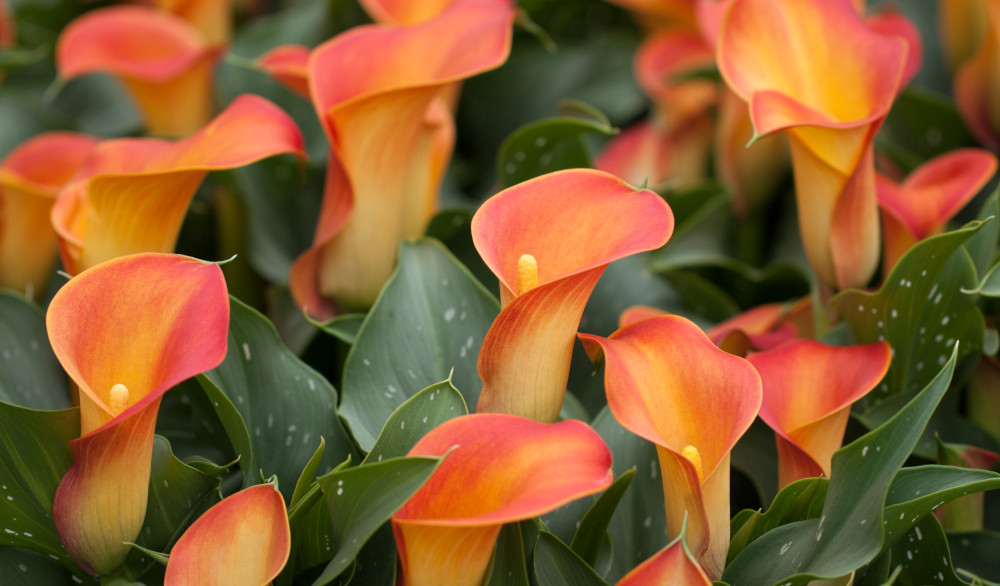
Zantedeschia is a genus of flowering plants from the family Araceae and is native to southern Africa. With a rich history dating back to the Ancient Romans, these deciduous or semi-evergreen perennials have been used as a symbol of celebration. Zantedeschia was Named after Professor Giovanni Zantedeschia, an Italian botanist.
There are two main forms of Zantedeschia: hardy and tender. Hardy forms of the plant can be grown outdoors, enjoy moist soil and full sun or partially shaded conditions - these are known as Arum lilies. Tender forms of Zantedeschia prefer being grown in containers or pots and should be brought inside over the winter - these are known as Calla lilies.
With tuberous flora in all colours from whites, yellows and oranges to deep reds and purples, Zantedeschias are not to be overlooked in any garden, as long as they have sufficient sunlight to grow in.
Ready to learn more about growing Zantedeschia? Read on for all there is to know...
Key Information
Soil pH

Position

Hardiness


Where & when to plant Solanum
Position - Outside: a sunny, sheltered spot
Indoors: full light with shade from hot sun, or bright, indirect light
Soil - In the open ground: moderately fertile, moist, well-drained, neutral to slightly alkaline
In a container: a loam based potting compost such as John Innes No. 2
Flowering Period - Midsummer into autumn (likely to get going earlier indoors)
Hardiness - Hardy. Rated H4 (-5 to -10°C)
For best results, plant ornamental climbing solanum in late spring to early summer as the soil temperature has warmed up but there is still plenty of moisture in the ground. Give it a warm, sheltered spot such as a south-facing wall, fence, or pergola. If you get severe winters, growing ornamental climbing solanum in a cool greenhouse or conservatory for some or all of the year can be a good idea – its root system is relatively shallow, so it is perfectly happy to spend life in a large container. Remember it will still need some form of support to climb up. An obelisk in the container not only looks good but means the plant is portable (rather than being attached to a wall), allowing it to be moved outdoors during the summer months as well as easily repotted.
How to plant Solanum
It is best to install the support (wires, trellis etc.) prior to planting. Then:
- For planting in the garden, dig the soil area removing any large stones and weeds and breaking up any lumps. Now is your chance to mix in some well-rotted organic matter such as manure or garden compost. Rake level and firm with your heels. Rake level again.
- Water plants well and allow to drain before planting.
- Dig a hole twice the width of the root-ball.
- Place the plant in the hole, ensuring the top of the root ball sits level with the surface of the soil. Too low and the plant may rot, too high and the roots can dry out.
- Backfill with soil and firm in gently with your foot.
- Insert an angled cane to encourage the plant to grow towards the support. Tie stems to the cane and/ or support using garden twine.
- Soak well with water.
- Mulch around the base with well-rotted organic matter.
- As growth progresses, tie into the supports as required. Stems close to the support will naturally cling on, but those further away will need a little help.
- For planting in a container, first choose an appropriately sized pot. The best practice is to start just a few centimetres larger than the rootball and increase in size every year or two. Always ensure there are plenty of drainage holes in the bottom.
- If you are using a large or heavy pot, it can be a good idea to fill and plant it in situ to save yourself the trouble of moving once full.
- Use a loam-based potting compost with some horticultural grit mixed in, and, if not already present in the compost (check the description on the bag) some slow-release fertiliser granules.
- Start by partially filling the pot with compost; enough so that when placed on it the upper surface of the root ball is about 3 centimetres lower than the top of the pot.
- Infill all the space surrounding the root ball with compost, firming down with your fingers then adding a little more so the plant is held tight.
- Pick up the container and lightly tap on the potting bench or ground a few times to help further settle the compost around the plant.
- In you’re using an obelisk, insert this into the pot now.
- Soak well with water.
- A mulch with horticultural grit will look attractive and help to prevent a ‘cap’ or crust forming on the top of the compost (something container plants can suffer due to the artificial nature of their watering).

What to plant with Solanum
Possibly our favourite encounter with this plant has been seeing it mingled with a climbing, pale blush rose. ‘Madame Alfred Carriere’ and ‘Blush Noisette’ would both fit the bill perfectly. Embrace this wonderfully unkempt and combination by using rampant self-seeders to fill every nook and cranny at their feet. Think Verbena bonariensis, aquilegia, Erigeron karvinskianus, Stipa tenuissima, Alchemilla mollis, linaria, digitalis, and eryngium. Heavenly!


How to care for Solanum
Pruning and Deadheading
Ornamental climbing solanum falls into the RHS pruning group 12. This means that, unless you are happy to let it run wild over a large area, it is best to prune it annually after flowering. Not only will this keep it in check, but it also promotes bushier and more floriferous growth.
Shorten any sideshoots to 2-4 buds from the main framework, removing any dead, diseased, damaged, or overcrowded shoots whilst you’re at it. If a more drastic approach is necessary (such as on a neglected, overgrown specimen), the whole thing can be cut back to around 30 centimetres above ground level.
Watering
We’ve found Solanum jasminoides to be the more drought tolerant of the two, with S. crispum more on the thirsty side. When planted in the ground, both will require a good initial soaking, then a handful more over the coming weeks and months. Once established. S. jasminoides should be largely self-sufficient, while S. crispum will need watering in prolonged periods of hot, dry weather.
Container-grown ornamental climbing solanum has less access to moisture and, as it is fast growing and likely to fill a pot quickly, can be watered freely throughout the growing season. Try to avoid the compost drying out completely, being aware that this can happen in as little as 24 hours during the height of summer, and sometimes even less for very full containers. Those grown indoors will also benefit from a daily misting. Water sparingly in the cooler months; just enough to prevent the compost drying out completely.
Feeding
On healthy, fertile soil, an annual mulch of well-rotted organic matter (i.e., a layer of manure or garden compost applied to the soil around the plant) should provide adequate nutrients. This has the added benefit of suppressing weeds and locking in moisture. This can be done in either autumn or spring, though we tend to go with autumn as the mulch then also acts as insulation for the roots against the winter cold and wet.
Container-grown plants rely more on the gardener for nutrition. Get off to a flying start by making sure you use a good quality, loam-based compost with some slow-release fertiliser granules mixed in, and then apply a monthly dose of balanced liquid feed throughout the growing season. Repotting every few years into fresh compost with slow-release granules is beneficial, and when this is no longer feasible carry out a topdress each spring. Simply scrape away the top 5 centimetres of compost and replace with fresh, finishing with a good soak of water to settle it in.
Cold Protection
Unless your winters are severe, ornamental climbing solanum should survive outside without the need for additional protection (as long as it is grown in a sunny, sheltered spot out of cold, drying winds). Even so, it can be worth applying an insulating, thick winter mulch around the roots, and being prepared to cover top growth with a layer of horticultural fleece or old bedsheet if an unusually hard frost is forecast (focus most on the bottom metre or so). Don’t be alarmed if your plants drops all its leaves and looks unsightly after a frost; this is perfectly normal in the UK climate and is usually followed by a complete recovery.
For regions where winters are very cold and harsh, we recommend growing ornamental climbing solanum in a container to allow for overwintering in a cool yet frost-free environment. This might be a conservatory, porch, or unheated greenhouse.
Pests and Diseases
Outdoors, ornamental climbing solanum tends to be problem free, though if grown inside all year round the usual issues of red spider mites and aphids can crop up. Keeping plants as healthy as possible is the key to warding off problems, and by this we mean proper ventilation, adequately spaced plants (for good air flow), keeping everything well-watered and fed, and repotting into larger containers when necessary. Thoroughly cleaning the indoor environment every winter can also help to remove overwintering populations of pests.
Where infestations do take hold, try introducing biological controls (often sachets or tubes containing miniscule natural predators), or in the worst cases, remove the affected plant/s altogether.
How to propagate Solanum
We find the best way to propagate ornamental climbing solanum is by taking semi-ripe cuttings from summer to early autumn:
· Look for current year’s growth which is firm and woody at the base while still flexible at the tip. You’re aiming for a cutting of 10 centimetres or less (any longer and they are more likely to dry out and fail). For best results, choose stems where the leaf nodes are close together rather than far apart.
· Using a sharp knife or secateurs, sever the cutting from the plant and put in a plastic bag straight away to keep it from drying out.
· Fill a pot (or several, if you have a lot of cuttings) with a perlite-heavy compost mix (at least 50% perlite).
· Trim the end of the cutting to just below a node (point at which leaves grow).
· Remove lowest leaves, leaving 2-4 on the cutting.
· If the remaining leaves are large, cut them in half with a sharp knife to reduce water lost through transpiration.
· Insert the cuttings into the compost and water lightly. Several cuttings can be put in the same container if there is enough space to do this without them touching.
· Place in a propagating unit with gentle bottom heat if you have one, or covered with a plastic bag on a windowsill if not (out of direct sunlight).
· Keep the cuttings misted and occasionally watered until they root. You will know this has happened when roots emerge out of the bottom of the container.
· Gently remove rooted cuttings and pot them into individual pots. Grow on in a cool yet frost-free environment such as an unheated conservatory, greenhouse, or cold frame, until they are large enough to be planted out as above.
* Many plants carry Plant Breeders Rights and cannot be propagated for commercial purposes.
Common Solanum Questions
· Where are these species from originally?
Solanum crispum is from Peru and Chile, while Solanum jasminoides is a Brazilian species.
Are these species of ornamental climbing solanum evergreen or deciduous?
Both remain evergreen in their native habitats, though it is not unusual for them to become deciduous in the UK.
