


How to grow Solidaster
Solidaster is a hybrid between two members of the daisy family – solidago and aster. It is similar to solidago (AKA goldenrod) in that it produces a profusion of yellow flowers, though has the lower, bushier, and more controlled growth habit of an aster. The most commonly available form is ‘Lemore’, a relatively compact plant which produce pretty, loose sprays of delicate, lemon-yellow flowers. Solidaster is clump-forming, though can spread quite quickly via seed (that solidago heritage kicking in). Deadhead after flowering to avoid this.
Solidaster is valued for its late flowering period (blooming as many other plants are beginning to run out of steam), and is popular as an easy, attractive ‘filler’ plant in beds and borders. It is also widely used in floristry, lasting an impressive two weeks in water and much longer when dried.
It is thought the original cross was made in France in 1910, using Solidago canadensis and Aster ptarmicoides. You may also see it referred to as Solidago x luteus.

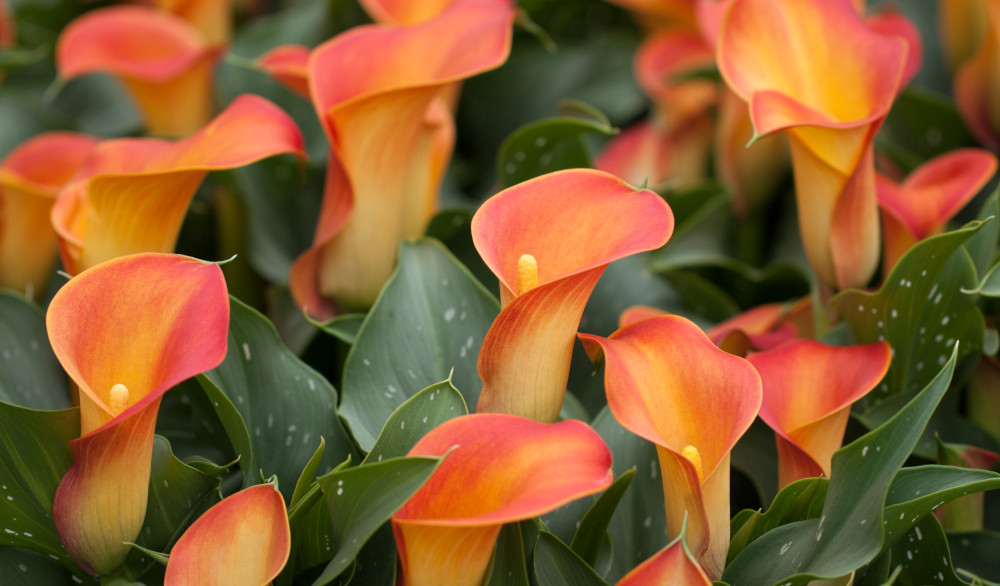
Zantedeschia is a genus of flowering plants from the family Araceae and is native to southern Africa. With a rich history dating back to the Ancient Romans, these deciduous or semi-evergreen perennials have been used as a symbol of celebration. Zantedeschia was Named after Professor Giovanni Zantedeschia, an Italian botanist.
There are two main forms of Zantedeschia: hardy and tender. Hardy forms of the plant can be grown outdoors, enjoy moist soil and full sun or partially shaded conditions - these are known as Arum lilies. Tender forms of Zantedeschia prefer being grown in containers or pots and should be brought inside over the winter - these are known as Calla lilies.
With tuberous flora in all colours from whites, yellows and oranges to deep reds and purples, Zantedeschias are not to be overlooked in any garden, as long as they have sufficient sunlight to grow in.
Ready to learn more about growing Zantedeschia? Read on for all there is to know...
Key Information
Soil pH

Position

Hardiness


Where & when to plant Solidaster
Position - Full sun is best. Partial shade will be tolerated though usually results in fewer flowers.
Soil - Will grow in a range of soils, including sandy, though won’t tolerate soggy, waterlogged conditions.
Flowering Period - Midsummer to early autumn
Hardiness - As hardy as it gets, rated H7 (-20°C and below).
For best results, plant solidaster in autumn or spring. An autumn planting can be done by those gardening in mild conditions (and broadly speaking, this is the southern half of the UK). For those liable to cold, wet winters, it is best to wait until spring (generally the northern half of the UK, or those with very heavy soil). Planting can also be carried out in summer, though be prepared to water regularly.
Solidaster has a naturalistic look ideal for cottage garden borders, prairie-style schemes, well-draining wildflower meadows, and wild gardens. It also makes an excellent cut flower.
How to plant Solidaster
· For planting in the garden, dig the soil area removing any large stones and weeds and breaking up any lumps. Rake level and firm with your heels. Rake level again.
· Water plants well and allow to drain before planting.
· Dig a hole twice the width of the root-ball.
· Place the plant in the hole, ensuring the top of the root ball sits level with the surface of the soil. Too low and the plant may rot, too high and the roots can dry out.
· Backfill with soil and firm in gently with your foot.
· Soak well with water.
· Mulch around the base with well-rotted organic matter such as manure or garden compost.
· For planting in a container first choose an appropriately sized pot just a few centimetres larger than the rootball, ensuring there are plenty of drainage holes.
· Use a good quality potting compost with plenty of horticultural grit mixed in and, if not already present (check the labelling on the bag) some slow-release fertiliser granules.
· Start by partially filling the pot with compost; enough so that when placed on it the upper surface of the root ball is about 3 centimetres lower than the top of the pot.
· Fill around the plant with compost, firming down with your fingers then adding a little more so it is held tight.
· Pick up the container and lightly tap on the potting bench or ground a few times to help further settle the compost around the plant.
· Soak well with water.
· A mulch with horticultural grit will look attractive and help to prevent a ‘cap’ or crust forming on the top of the compost (something container plants can suffer due to the artificial nature of their watering).

What to plant with Solidaster
Solidaster can play a key role in creating a glorious, late summer rush of energy in the garden, along with other perennials such as aster, echinacea, helenium, coreopsis, kniphofia, monarda, and veronica. Complete the picture with a selection of ornamental grasses.
Of course, you’ll need some plants for earlier interest too. Try allium, aquilegia, thalictrum, digitalis, lupin, geum, papaver, and peony.


How to care for Solidaster
Pruning and Deadheading
Solidaster can be an enthusiastic self-seeder. If you’re happy to allow it to naturalise through an area, leave spent flowers intact. Otherwise, remove at the base before they have a chance to set seed. This offers the added benefit of encouraging further blooms.
The whole lot can be cut back any time from autumn to early spring.
Watering
Solidaster should be kept watered throughout its first growing season in the ground, after which it should be largely self-sufficient in all but the most prolonged periods of hot, dry weather.
Solidaster grown in a container will need watering regularly. To avoid overdoing it, a good rule of thumb is to water only once the top few centimetres of compost have dried out. Be aware, however, that in the height of summer this can happen in as little as 24 hours, particularly with small or very full containers.
Feeding
On healthy, fertile soil, an annual mulch of well-rotted organic matter should provide sufficient nourishment for your solidaster (manure, garden compost, or leaf mould are all ideal). As well as boosting the nutrient content of the soil, mulch has the added benefits of suppressing weeds and locking in moisture.
In a container, try to use a good quality compost with slow-release granules mixed in. This generally provides enough nutrients for six weeks, after which a monthly dose of balanced potassium liquid feed (such as tomato food) will help maximise flowering performance. Repot into a slightly larger container every year or two using fresh compost with added feed.
Cold Protection
Solidaster is hardy enough to withstand a UK winter without the need for additional protection. Its weakness is excessive moisture, hence the importance of avoiding soggy, waterlogged soil.
Pests and Diseases
Solidaster can be prone to powdery mildew in a dry summer, appearing as a white, powder-like coating on foliage.
A little TLC usually rectifies things. Simply prune off and dispose of any affected leaves, give the plant a good soak (avoiding water on the foliage if possible), and thin out surrounding plants to improve airflow. Do not be tempted to give an extra feed, as this will generate an excess of soft, new growth which is particularly susceptible.
How to propagate Solidaster
Solidaster can be propagated quite easily from basal cuttings taken in spring:
1. Find several strong, basal shoots (originating from the crown) which are 10-12 centimetres long.
2. With sharp secateurs or a knife, sever cleanly from as close to the base as possible.
3. Put them in a plastic bag straight away to prevent drying out.
4. Fill a container with a free-draining compost mix.
5. Pinch out the soft tip.
6. If there are leaves, remove the lowest third. If the remaining leaves are large, cut in half with a sharp knife to reduce water lost through transpiration.
7. Insert the cuttings into the compost and water lightly. Several cuttings can be put in the same container if there is enough space to do this without them touching.
8. Place in a greenhouse or propagating unit if you have one, or covered with a plastic bag on a windowsill if not (out of direct sunlight).
9. Keep the cuttings misted and occasionally watered until they root. You will know this has happened when roots emerge out of the bottom of the container.
10. Once rooted, take the cuttings out of their pot and gently tease apart. Pot into individual 9 centimetre pots using a well-draining compost mix.
11. Grow on in a sheltered environment, keeping well-watered but never soggy. Plant out as above.
Another option is to divide established clumps in spring. As well as producing new plants this renews the vigour of the parent plant, and is recommended as a routine maintenance practice every two to three years:
1. Choose a day when the soil is not frozen or waterlogged.
2. Dig the plant out of the ground and shake off any excess soil.
3. Separate into sections using either swift, cutting blows with a sharp spade, or two forks inserted back-to-back with tines touching, handles then pushed together to prise the plant apart.
4. Discard old, damaged, or surplus pieces, keeping healthy, vigorous material.
5. Replant decent-sized pieces where desired, and any smaller bits can be potted up.
6. Water well until fully established.
* Many plants carry Plant Breeders Rights and cannot be propagated for commercial purposes.
Common Solidaster Questions
· Does solidaster require support?
In an exposed spot yes, support may be needed. A network of cut branches and twigs inserted into the soil works well (we favour hazel or birch for this), or metal link stakes.
Out of the wind, the support of neighbouring plants should suffice.
· Is solidaster beneficial to wildlife?
Yes, its open flower structure is attractive to pollinators such as bees, making it suitable for the wildlife-conscious gardener.
