


How to grow Stachys
We have always been struck by the diversity of stachys, finding it hard to believe some of the species belong in the same genus. Take, for example, two of the most widely grown species. Stachys byzantina is mat forming with soft, white, woolly leaves and is commonly known as lambs’ ears. Though it does flower, it is mainly grown for its foliage. S. officinalis is commonly known as betony and is grown for its naturalistic flower spikes and rosette of green, wrinkled leaves (‘Hummelo’ is a popular cultivar). Aside from the square stems and salvia-shaped flowers characteristic to most plants in Lamiaceae (the mint family), at first glance there’s not a lot linking these together. As it turns out, the botanists felt the same way and have recently assigned some species (including S. officinalis) to their own new genus, betonica.
As with any name change this will take a long time to ‘bed in’, and along with many growers and retailers we continue to use the name our customers are most familiar with. So for now, all remain ‘stachys’ and are included in this growing guide.

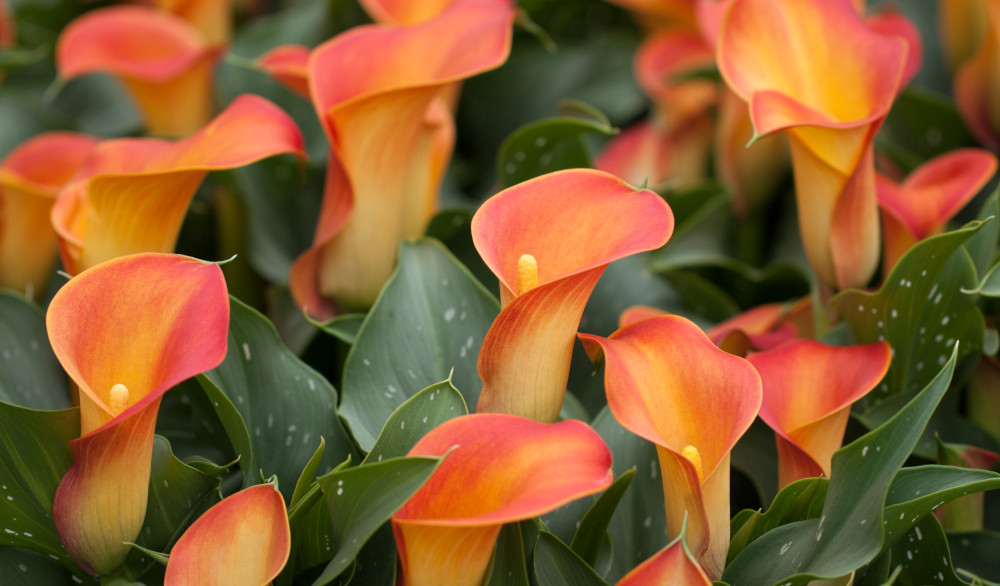
Zantedeschia is a genus of flowering plants from the family Araceae and is native to southern Africa. With a rich history dating back to the Ancient Romans, these deciduous or semi-evergreen perennials have been used as a symbol of celebration. Zantedeschia was Named after Professor Giovanni Zantedeschia, an Italian botanist.
There are two main forms of Zantedeschia: hardy and tender. Hardy forms of the plant can be grown outdoors, enjoy moist soil and full sun or partially shaded conditions - these are known as Arum lilies. Tender forms of Zantedeschia prefer being grown in containers or pots and should be brought inside over the winter - these are known as Calla lilies.
With tuberous flora in all colours from whites, yellows and oranges to deep reds and purples, Zantedeschias are not to be overlooked in any garden, as long as they have sufficient sunlight to grow in.
Ready to learn more about growing Zantedeschia? Read on for all there is to know...
Key Information
Soil pH

Position

Hardiness


Where & when to plant Stachys
Position - Full sun is generally preferable
Soil - Stachys byzantina (lambs’ ears) will tolerate dry conditions, while the rosette-forming species prefer reasonable garden soil. Avoid winter waterlogging.
Flowering Period - Early summer to early autumn
Hardiness - Hardy. Usually rated from H5 (-10 to -15°C) to H7 (-20°C and below).
For best results, plant stachys in autumn or spring. An autumn planting can be done by those gardening in mild conditions (and broadly speaking, this is the southern half of the UK). For those liable to cold, wet winters, it is best to wait until spring (generally the northern half of the UK, or those with very heavy soil). Planting can also be carried out in summer, though be prepared to water regularly.
Stachys byzantina (lambs’ ears) is a useful edging or groundcover plant. Native to the Mediterranean it is highly tolerant of drought, and therefore suitable for dry gardens, gravel gardens, rock gardens, or any reliably well-draining soil. Taller, rosette-forming types such as Stachys officinalis, and the bigger, chunkier Stachys macrantha prefer a better soil (i.e., moist and moderately fertile) and make good border perennials, going particularly well in a naturalistic style such as a prairie scheme or wild garden. Position towards the front to see these at their best.
Although they prefer life in the open ground, stachys can also be grown in a container. Just remember to water and feed them and repot into a slightly larger pot every year or two.
How to plant Stachys
· For planting in the garden, dig the soil area removing any large stones and weeds and breaking up any lumps. Rake level and firm with your heels. Rake level again.
· Water plants well and allow to drain before planting.
· Dig a hole twice the width of the root-ball.
· Place the plant in the hole, ensuring the top of the root ball sits level with the surface of the soil. Too low and the plant may rot, too high and the roots can dry out.
· Backfill with soil and firm in gently with your foot.
· Soak well with water.
· Mulch around the base with well-rotted organic matter such as manure or garden compost.
· For planting in a container first choose an appropriately sized pot. You may wish to grow stachys on its own, in which case use a pot just a few centimetres larger than the rootball, or as part of a larger, mixed container. Either way, ensure there are plenty of drainage holes.
· Use a good quality potting compost with plenty of horticultural grit mixed in and, if not already present (check the labelling on the bag) some slow-release fertiliser granules.
· Start by partially filling the pot with compost; enough so that when placed on it the upper surface of the root ball is about 3 centimetres lower than the top of the pot.
· Fill around the plant with compost, firming down with your fingers then adding a little more so it is held tight.
· Pick up the container and lightly tap on the potting bench or ground a few times to help further settle the compost around the plant.
· Soak well with water.
· A mulch with horticultural grit will look attractive and help to prevent a ‘cap’ or crust forming on the top of the compost (something container plants can suffer due to the artificial nature of their watering).

What to plant with Stachys
To exploit the superior drought resistance of S. byzantina (lambs’ ears), try planting it in gravel or parched earth to create a stunning dry garden along with fellow tough cookies echinops, eryngium, cistus, gaillardia, osteospermum, and delosperma.
If you are growing one of the rosette-forming species such as Stachys officinalis (betony), these fit beautifully into a naturalistic planting scheme with other summer-flowering perennials such as campanula, nepeta, geranium, calamintha, agastache, knautia. Punctuate with ornamental grasses such as stipa, miscanthus, and deschampsia to achieve that dreamy, swaying movement and late season interest.


How to care for Stachys
Pruning and Deadheading
Stachys byzantina (lambs’ ears) has a habit of wearing itself out with the effort of flowering, and when left to its own devices can become scruffy over time. Removing flowers before they have a chance to bloom is a drastic though effective way to extend the ‘good looking’ years, or there are forms bred specifically to be non-flowering, such as ‘Silver Carpet’. That’s not to say it’s wrong to enjoy the flowers. Many gardeners value this element of the plant and feel that the slightly shorter lifespan is a sacrifice worth making. If you are in the ‘let it flower’ camp, we advise intervening before masses of energy is expended on seed production, deadheading the flower stems down to the ground as soon as they fade. Tatty foliage can be removed as required – early spring is a good time to give this evergreen/ semi-evergreen plant a tidying ‘once over’.
The herbaceous, rosette-forming species such as Stachys officinalis and Stachys macrantha can be deadheaded in the flowering period to prolong blooming. Cut the whole lot back anytime from autumn to early spring.
Watering
Stachys should be kept watered throughout its first growing season in the ground, after which it should be largely self-sufficient in all but the most prolonged periods of hot, dry weather. Stachys byzantina (lambs’ ears) is known to be particularly drought tolerant.
Stachys grown in a container will need watering regularly. Stachys hates to sit in soggy conditions, so to avoid overdoing it a good rule of thumb is to water only once the top few centimetres of compost have dried out. Do be aware, however, that in the height of summer this can happen in as little as 24 hours, particularly with small or very full containers.
Feeding
There is no need to feed Stachys byzantina (lambs’ ears). Other species will benefit from an annual mulch of well-rotted organic matter (manure, garden compost, or leaf mould are all ideal). As well as boosting the nutrient content of the soil, mulch has the added benefits of suppressing weeds and locking in moisture.
In a container, try to use a good quality compost with slow-release granules mixed in. This generally provides enough nutrients for six weeks, after which a monthly dose of balanced liquid feed will help your plant in top health. Repot into a slightly larger container every year or two using fresh compost with added feed.
Cold Protection
Stachys is hardy enough to withstand a UK winter without the need for additional protection. The biggest threat to winter survival is excessive moisture around the roots, hence the importance of choosing a well-draining spot.
Pests and Diseases
Stachys (particularly lambs’ ears) can be prone to powdery mildew, especially if congested or experiencing a dry summer. This fungal disease appears as a white, powder-like coating on foliage.
A little TLC usually rectifies the matter. Simply prune off and dispose of any affected leaves, give the plant a good soak (avoiding water on the foliage if possible), and thin out surrounding plants to improve airflow. Do not be tempted to give a feed, as this will generate an excess of soft, new growth which is particularly susceptible.
How to propagate Stachys
The quickest and easiest way to propagate stachys is to divide established clumps in spring. As well as producing new plants this renews the vigour of the parent plant, and is recommended as a routine maintenance practice every two to three years:
1. Choose a day when the soil is not frozen or waterlogged.
2. Dig the plant out of the ground and shake off any excess soil.
3. Separate into sections using either swift, cutting blows with a sharp spade, or two forks inserted back-to-back with tines touching, handles then pushed together to prise the plant apart.
4. Discard old, damaged, or surplus pieces, keeping healthy, vigorous material which has its own roots attached.
5. Replant decent-sized pieces where desired, and any smaller bits can be potted up.
6. Water well until fully established.
* Many plants carry Plant Breeders Rights and cannot be propagated for commercial purposes.
Common Stachys Questions
· How long does it take to grow lambs’ ear?
Stachys byzantina (lambs’ ears) has a fast growth rate and can be expected to reach full size in two to five years.
· Is stachys a perennial?
There are some annual species, though those popularly grown by gardeners (and mentioned in this guide) are perennial and can be expected to live for many years.
· Is stachys poisonous to dogs?
Stachys has no toxic effects reported.
· Do we have a native UK species of stachys?
Yes, in fact there are 14 species recorded growing wild in the UK. The most common are Stachys officinalis (betony) which grows in open grassland and on verges, and S. sylvatica (hedge woundwort) which can be found in woodland and hedgerows. The latter is a persistent, creeping wildflower and is generally considered a weed if it finds its way into a cultivated garden.
· Does stachys have wildlife value?
Absolutely. Like many members of the mint family its flowers are much visited by pollinators – in the case of stachys, mainly honeybees and bumblebees. The wool carder bee has another use for Stachys byzantina (lambs’ ears), biting the tiny hairs from its leaves and rolling them into a ball for easy transportation back to the nest. Once there, the hairs are used to make breeding cells. If you witness bees ‘fighting’ near your plant, this is likely to be a male wool carder bee defending his chosen patch!
