


How to grow Streptosolen
Also known as the marmalade bush, streptosolen is an unusual member of the tomato family from open woodland habitats in South America. It is a loosely scrambling evergreen shrub which can be encouraged to climb, left to trail over an edge, or kept as a compact shrub with pruning. It is notable for its clusters of vibrant orange, trumpet-shaped flowers produced in abundance from May to August, which start off yellow and deepen with maturity. Streptosolen is something of a rarity in the UK, though once seen its intensely radiant flowers are seldom forgotten.
Unable to survive temperatures below 5 to 10°C, in the UK streptosolen is best grown as a greenhouse or conservatory plant or in a container which spends summer outdoors and winter in a protected, frost-free environment.
Streptosolen was formerly included in the Browallia genus (where it was known as Browallia jamesonii), before being assigned its own separate genus. It is monotypic, meaning a genus of just one species (Streptosolen jamesonii). Essentially it’s one of nature’s anomalies, and therefore right up our street!

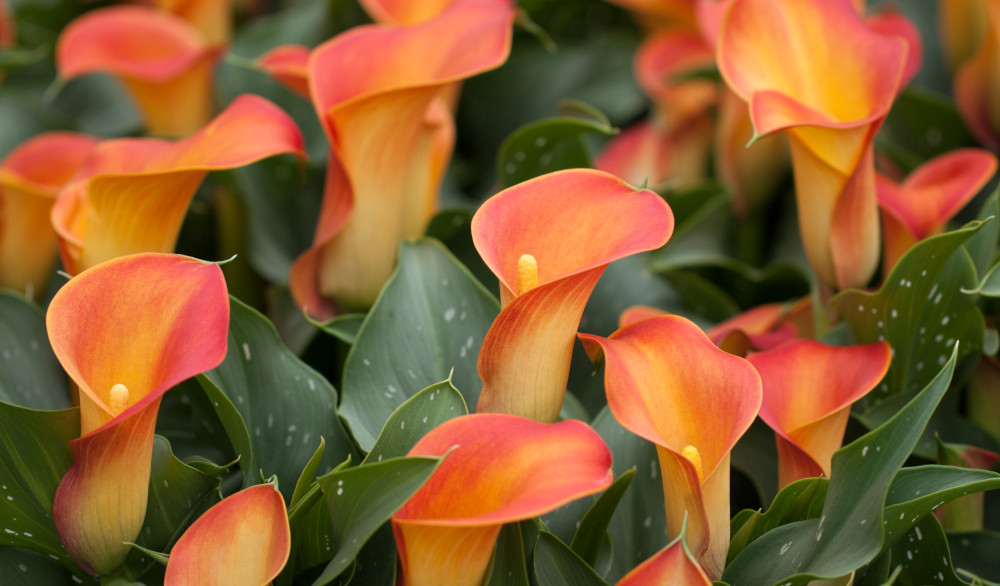
Zantedeschia is a genus of flowering plants from the family Araceae and is native to southern Africa. With a rich history dating back to the Ancient Romans, these deciduous or semi-evergreen perennials have been used as a symbol of celebration. Zantedeschia was Named after Professor Giovanni Zantedeschia, an Italian botanist.
There are two main forms of Zantedeschia: hardy and tender. Hardy forms of the plant can be grown outdoors, enjoy moist soil and full sun or partially shaded conditions - these are known as Arum lilies. Tender forms of Zantedeschia prefer being grown in containers or pots and should be brought inside over the winter - these are known as Calla lilies.
With tuberous flora in all colours from whites, yellows and oranges to deep reds and purples, Zantedeschias are not to be overlooked in any garden, as long as they have sufficient sunlight to grow in.
Ready to learn more about growing Zantedeschia? Read on for all there is to know...
Key Information
Soil pH

Position

Hardiness


Where & when to plant Streptosolen
Position - Indoors: full light with shade from the hottest, midday sun
Outdoors: a sunny, sheltered spot
Soil - A loam-based compost such as John Innes No. 3
Flowering Period - Late spring to late summer
Hardiness - Warm temperate, rated H1C (minimum temperature of 5-10°C)
In the UK streptosolen needs to spend some if not all the year indoors, so unless you have an open soil greenhouse bed it is best grown in a container. You may intend to prune yours as a shrub or have it spilling out of a hanging basket, otherwise it will need a support to scramble up. An obelisk in the container not only looks good but means the plant is portable, meaning it may be moved outdoors during the summer months and easily repotted. Any repotting is best done in spring (see next section).
In terms of choosing a spot, a temperate conservatory or greenhouse are both ideal. If necessary, position some shade netting to intercept the midday sun.
If moving your streptosolen outdoors for the summer months, ensure it is given a warm, sunny spot tucked away out of the wind. You may wish to plunge the whole thing, pot and all, in the ground amongst other plants, or stand it on a patio or decking. Another approach is a hanging basket brought indoors for the cooler months.
If your streptosolen will be switching between indoors and out in this way, remember to gradually acclimatise it to life outside rather than making a sudden move. For the first few days leave it out during the daytime only, returning indoors at night. Although somewhat tedious this ‘hardening off’ process is worth the effect, being highly effective at preventing tender plants going into ‘shock’. In terms of timing the move – it pays to get to know the average temperatures in your area, as well as keep an eye on the thermometer. To give you a general idea, May is when the UK average temperature starts to remain above 5°C, and October when it drops back down. Remember though that these are UK averages and there will be regional variation.
How to plant Streptosolen
· The best practice is to start with a container just a few centimetres larger than the existing rootball and increase in size every year or two. Always ensure there are plenty of drainage holes in the bottom.
· If you are using a large or heavy pot, it can be a good idea to fill and plant it in situ to save yourself the trouble of moving once full.
· Use a good quality loam-based potting compost with some slow-release fertiliser granules mixed in. Sometimes these are already present in the compost, others you will need to add your own (check the description on the bag).
· Start by partially filling the pot with compost; enough so that when placed on it the upper surface of the root ball is about 3 centimetres lower than the top of the pot.
· Infill all the space surrounding the root ball with compost, firming down with your fingers then adding a little more so the plant is held tight.
· Pick up the container and lightly tap on the potting bench or ground a few times to help further settle the compost around the plant.
· In you’re using an obelisk, insert this into the pot now.
· Soak well with water.
· A mulch with horticultural grit will look attractive and help to prevent a ‘cap’ or crust forming on the top of the compost (something container plants can suffer due to the artificial nature of their watering).

What to plant with Streptosolen
Turn your conservatory into a bright, colourful oasis by growing streptosolen with companions such as brugmansia, plumbago, dipladenia, jacobinia, abutilon and cestrum.


How to care for Streptosolen
Pruning and Deadheading
Prune after flowering to whatever size and shape you require. This promotes flowering the following year, while also making the plant more manageable if you’re moving it around. For plants grown permanently indoors, another restrictive prune may be needed in late winter/ early spring.
When pruning, remember to remove any dead, diseased, and dying growth, and tie remaining growth into the support if using one.
Watering
Like many climbing plants, streptosolen is thirsty when grown in a container and can be watered freely throughout the growing season. Try to avoid the compost drying out completely, being aware that this can happen in as little as 24 hours during the height of summer (and sometimes even less for very full containers). Those grown indoors during this time will also benefit from regular misting. Water much more sparingly in the cooler months, i.e., just enough to prevent the compost drying out completely.
Feeding
Get off to a flying start by making sure you use a good quality, loam-based compost with some slow-release fertiliser granules mixed in, then apply a monthly dose of balanced liquid feed throughout the growing season. Repotting every few years into fresh compost is beneficial, and when this is no longer feasible carry out a topdress each spring. Simply scrape away the top 5 centimetres of compost and replace with fresh, settling everything in with a good soak of water. Always remember to include slow-release granules in your fresh compost.
Cold Protection
Streptosolen hails from much warmer climes than ours and will not survive a UK winter outside. Follow our advice above for choosing the best spot to achieve optimum growth.
Pests and Diseases
Outdoors, streptosolen tends to be trouble-free. Indoors, the usual issues of whitefly, spider mite, and mealybug can crop up. Keeping indoor plants as healthy as possible is the key to warding off problems, and by this we mean proper ventilation, adequately spaced plants (for good air flow), keeping everything well-watered and fed, and repotting into larger containers when necessary. A summer spell outdoors can be effective in clearing up any issues, and thoroughly cleaning the indoor environment every winter can help to remove overwintering populations of pests.
Where infestations do take hold, try introducing biological controls (often sachets or tubes containing miniscule natural predators), or in the worst cases, remove the affected plant/s altogether.
How to propagate Streptosolen
We find the best way to propagate ornamental streptosolen is by taking semi-ripe cuttings from mid to late summer:
· Look for current year’s growth which is firm and woody at the base while still flexible at the tip. You’re aiming for a cutting of 10 centimetres or less (any longer and they are more likely to dry out and fail). For best results, choose stems where the leaf nodes are close together rather than far apart.
· Using a sharp knife or secateurs, sever the cutting from the plant and put in a plastic bag straight away to keep it from drying out.
· Fill a pot (or several, if you have a lot of cuttings) with a perlite-heavy compost mix (at least 50% perlite).
· Trim the end of the cutting to just below a node (point at which leaves grow).
· Remove lowest leaves, leaving 2-4 on the cutting.
· If the remaining leaves are large, cut them in half with a sharp knife to reduce water lost through transpiration.
· Insert the cuttings into the compost and water lightly. Several cuttings can be put in the same container if there is enough space to do this without them touching.
· Place in a propagating unit with gentle bottom heat if you have one, or covered with a plastic bag on a windowsill if not (out of direct sunlight). Note that bottom heat will dramatically increase your chances of success.
· Keep the cuttings misted and occasionally watered until they root. You will know this has happened when roots emerge out of the bottom of the container.
· Gently remove rooted cuttings and pot them into individual pots. Grow on in a warm, protected environment such as a heated conservatory or greenhouse, or a windowsill until they are large enough to be used as above.
* Many plants carry Plant Breeders Rights and cannot be propagated for commercial purposes.
Common Streptosolen Questions
· Where might I have seen streptosolen before?
This is a popular plant with gardeners in Australia, and has also become naturalised in Hawaii.
· Are the flowers of streptosolen scented?
No, streptosolen is not a plant known for its fragrance. In its natural habitat it is pollinated by hummingbirds and therefore has had no need to develop a perfume (usually a way of attracting bees and other insects).
· Is streptosolen poisonous?
Streptosolen is considered toxic when ingested by people or animals, though this is thought to be a speculative assumption based on other members of the tomato family (e.g. nightshade), rather than any documented cases of poisoning.
