


How to grow Tetrapanax
There is just one species of this large suckering shrub or small tree, originally found growing in woodland in S China and Taiwan. Here in the UK, the striking relative of ivy and fatsia is a staple of exotic or sub-tropical borders, valued for its huge, lobed leaves which add a lush, jungle-like feel to planting schemes.
Here in the UK, the cultivated form ‘Rex’ is the more widely grown than the straight species. While visually there is little to distinguish the two, ‘Rex’ is both hardier and less suckering.
In its natural habitat, tetrapanax remains evergreen and bears umbels of woolly flowers followed by clusters of black fruit. The UK climate, however, is at the very edge of its ‘comfort zone’, and it typically responds to this by dropping some or all its leaves in winter and seldom producing flowers.
Tetrapanax is also known by the common name of rice paper plant, a nod to the history of its pith being used to produce paper in China.

Zantedeschia is a genus of flowering plants from the family Araceae and is native to southern Africa. With a rich history dating back to the Ancient Romans, these deciduous or semi-evergreen perennials have been used as a symbol of celebration. Zantedeschia was Named after Professor Giovanni Zantedeschia, an Italian botanist.
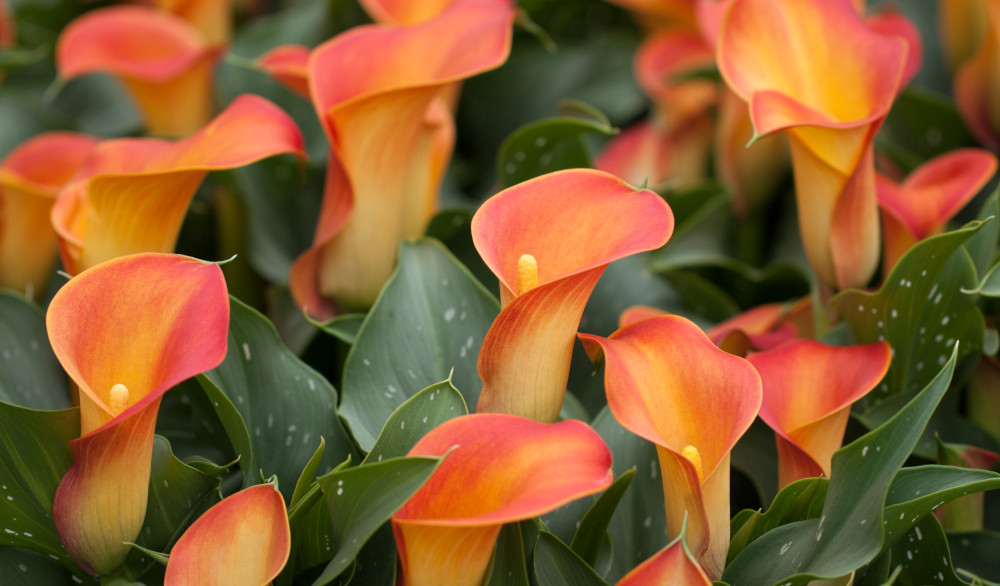
There are two main forms of Zantedeschia: hardy and tender. Hardy forms of the plant can be grown outdoors, enjoy moist soil and full sun or partially shaded conditions - these are known as Arum lilies. Tender forms of Zantedeschia prefer being grown in containers or pots and should be brought inside over the winter - these are known as Calla lilies.
With tuberous flora in all colours from whites, yellows and oranges to deep reds and purples, Zantedeschias are not to be overlooked in any garden, as long as they have sufficient sunlight to grow in.
Ready to learn more about growing Zantedeschia? Read on for all there is to know...
Key Information
Soil pH

Position

Hardiness


Where & when to plant Tetrapanax
Position - Full sun with shelter from strong winds
Soil - Any well-draining soil
Flowering Period - Summer, though flowering is rare in a UK climate
Hardiness - The straight species (Tetrapanax papyrifer) is half-hardy (H3, 1 to -5°C), while the widely grown cultivar ‘Rex’ is hardier (H4, -5 to -10°C).
Tetrapanax is best planted in spring or early summer to give it a full growing season to establish before being faced with a UK winter. Only plant the straight species in the open ground if you can offer a mild, frost-free environment – perhaps in an urban or coastal garden, or in front of a sunny wall tucked away out of the wind. Otherwise, go for ‘Rex’, which can cope with slightly lower temperatures though still appreciates shelter from cold winds.
As a vigorous, spreading, suckering plant, tetrapanax is far happier in the open ground than in a container. However, if you do wish to try container growing, be prepared to replace it every few years with a smaller, younger plant (either bought new or propagated from suckers – see below).
How to plant Tetrapanax
· For planting in the garden, dig the soil area removing any large stones and weeds and breaking up any lumps. Now is your chance to improve the soil by digging in some well-rotted organic matter such as manure or garden compost.
· Rake level and firm with your heels. Rake level again.
· Water the plant well and allow to drain before planting.
· Dig a hole twice the width of the root-ball.
· Place the plant in the hole, ensuring the top of the root ball sits level with the surface of the soil. Too low and the plant may rot, too high and the roots can dry out.
· Backfill with soil and firm in gently.
· Soak well with water.
· Mulch around the base with well-rotted organic matter.
- For planting in a container, first choose an appropriately sized pot. Tetrapanax can take a few years to get going then spread quite rapidly, which means that if you’re starting off with a very small plant, it’s best to go for a pot just a few centimetres larger than the current rootball, while bigger plants can go in the largest pot you can find. Always ensure the pot is deep enough to provide sufficient anchorage, and that there are plenty of drainage holes in the bottom.
- If you are using a large or heavy pot, it can be a good idea to fill and plant it in situ to save yourself the trouble of moving once full.
- Use a good quality, loam-based compost (such as John Innes no. 2) with some horticultural grit mixed in for drainage and, if not already present (check the labelling on the bag) slow-release fertiliser granules.
- Start by partially filling the pot with compost; enough so that when placed on it the upper surface of the root ball is about 3 centimetres lower than the top of the pot.
- Fill around the plant with compost, firming down with your fingers then adding a little more so it is held tight.
- Pick up the container (if you can!) and lightly tap on the potting bench or ground a few times to help further settle the compost around the plant.
- Soak well with water.
- A mulch with horticultural grit will look attractive and help to prevent a ‘cap’ or crust forming on the top of the compost (something container plants can suffer due to the artificial nature of their watering).

What to plant with Tetrapanax
This jungle-like plant pairs well with similarly exotic companions. With oversized flowers brugmansia is a good match for scale, as are trachycarpus and dicksonia. For floral value, try the tropical-looking blooms of cestrum, campsis, hibiscus, cuphea, and passiflora. Most of these will need some form of winter protection, but the striking, jungle-like results are well worth the effort!


How to care for Tetrapanax
Pruning and Deadheading
Tetrapanax is in RHS pruning groups 1 and 7.
This means it needs little pruning and is best left to its own devices apart from removing the occasional dead or damaged leaf when necessary. If the top growth is killed by frost, the whole lot can be cut back in early spring and will often regrow from below ground, in much the same way as an herbaceous perennial.
Suckers can be removed to prevent unwanted spread. This can be done any time, though to use the suckers for propagation do it in spring or summer.
Watering
Like all woody plants, tetrapanax establishes best when regularly watered during its first two growing seasons in the ground. After this it should be largely self-sufficient and may be left to its own devices in all but the hottest and driest weather.
When grown in a pot it’s hard to overwater tetrapanax. Water freely throughout the growing season, then from mid-autumn scale back to just enough to keep the compost moist.
Feeding
On healthy, fertile soil, an annual mulch of well-rotted organic matter (i.e., a layer of manure or garden compost applied to the soil around the plant) should provide adequate nutrients for your tetrapanax. This has the added benefit of suppressing weeds and locking in moisture, and is best done in autumn or spring.
For container-grown specimens, try to use a good quality, loam-based compost with slow-release granules mixed in. This generally provides enough nutrients for six weeks, after which a monthly dose of balanced liquid feed will help maintain a healthy, thriving plant. It is also a good idea to get into the routine of repotting into fresh compost every year, going up slightly in pot size each time. Expect perhaps two to five years from your container-grown tetrapanax, after which it is likely to need replacing with a younger plant.
Cold Protection
The straight species of T. papyrifer is best kept frost free, and in the UK can only really be grown with confidence by those with an unusually mild microclimate. ‘Rex’ is the more common choice which, when grown in the right conditions, can withstand the average UK winter without the need for additional protection. By ‘right conditions’, we mean in well-draining soil (no winter waterlogging) and with shelter from cold winds. Having said this, young plants can be less hardy, so it can be worth using a protective fleece jacket whenever a hard frost is forecast during those first couple of winters in the ground.
Like all plants, tetrapanax grown in a pot is more vulnerable to the effects of winter. Where possible, move to a bright, protected environment for winter such as a greenhouse, porch, or conservatory. Otherwise, tuck against a sunny, south-facing wall and wrap the pot with hessian, bubblewrap, or horticultural fleece. As well as insulating the roots, this protects the container against frost damage.
Pests and Diseases
Tetrapanax tends to be problem free.
How to propagate Tetrapanax
The quickest and easiest way to propagate tetrapanax is by using suckers which arise from the base of the plant:
1. In spring or summer, use a spade to lift suckers out of the ground. Select those with established leaves and a good root system attached.
2. Either replant directly into a new location, or pot into individual containers using a well-draining compost.
3. Water well and grow on as above.
It is rare for tetrapanax to flower and set seed in our climate, however if you do get hold of seed it’s worth noting that these have a very short viability period (around two months), and should be surface sown as fresh as possible.
* Many plants carry Plant Breeders Rights and cannot be propagated for commercial purposes.
Common Tetrapanax Questions
Is tetrapanax invasive?
In a warm climate, the straight species can spread extensively if left unchecked. Regularly removing unwanted suckers is an easy and effective method of restriction.
How fast does tetrapanax grow?
These plants can take a few years to get going, then will often grow and spread quite rapidly.
Is tetrapanax poisonous?
Not so much poisonous, though the tiny hairs that cover its stems and leaves can cause irritation to skin, eyes, and lungs.
